Seeking solace
How books helped me process my 51st state fears
Lisa Timpf
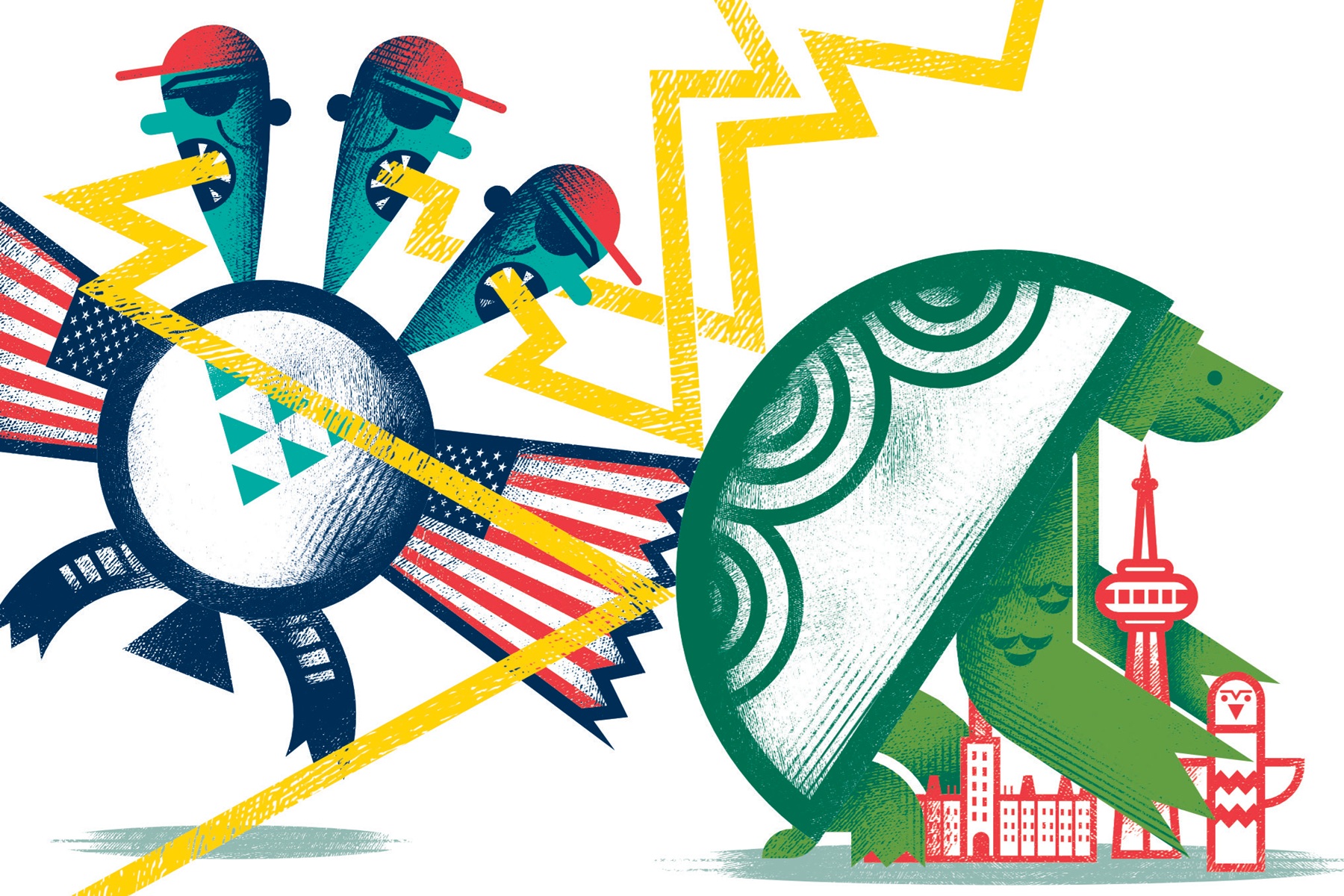
Illustration by Matthew Daley
When taunts and threats about Canada becoming the 51st state flew last year, my mind spun like a hamster wheel. What would it look like? What would it mean for me? As I often do when processing difficult issues, I turned to books. I started by rereading Richard Rohmer’s 1973 novel Ultimatum (Clarke, Irwin & Company), which I’d first encountered as a teenager.
Ultimatum is about threats, too. In this case, it’s the threat of a physical invasion of Canada by the United States so they can secure access to the oil reserves on these lands. In Rohmer’s book, arrogance proves to be the Americans’ Achilles heel. Meanwhile, in both Ultimatum and another of Rohmer’s books, Exxoneration (McClelland & Stewart, 1974), Canadians get by thanks to resourcefulness, resilience, and a little help from our friends. With respect to the latter, in Ultimatum, British troops support Canada’s defence against American incursion, while in Exxoneration, Swiss bankers and the government of Saudi Arabia assist Canada’s efforts to gain ownership of Imperial Oil, a move deemed necessary for our sovereignty. Rohmer’s novels offer hope: though Americans may outnumber and outgun us, that doesn’t mean we are doomed.
But what’s the big deal, other authors wonder. Would it be so bad to be assimilated by the U.S.? In Louise Penny’s The Black Wolf (Minotaur, 2025), Chief Inspector Armand Gamache of the Sûreté du Québec discovers a plot to take over Canada. The plot includes social media and online efforts to paint Canada as the bad guy. Conspirators plan to stage an incident that will provide the U.S. with an excuse to invade. Once again, it’s all about resources: this time, water.
General Bert Whitehead, an American, asks Gamache, “‘Why not just give up? Would it be so bad to be the fifty-first state?’” In reply, Gamache references George Orwell’s 1945 novel Animal Farm (Secker and Warburg), stating, “‘We’d fight back because in your new country, some would be more equal than others.’” Gamache goes on to say, “‘How long before we were taken from our homes, because you’d need them too . . . You know perfectly well, Bert, how easily the inconceivable becomes a reality. Becomes acceptable. Becomes the norm.’”
In Carolyn Martin’s self-published Rise, Tomorrow Girl (written as Cara Martin, 2024), she suggests that for some, resistance will not be a choice, but a matter of survival. The novel revolves around protagonist Leanne Khoury, whose parents place her in cryogenic sleep during a global pandemic. She is awakened when a cure is available, becoming one of the “reborn.”
Khoury comes home to a changed world. Expansionists in the U.S., who have recently staged a coup to take over the U.S. government, invade Southern Ontario and parts of B.C. Many Expansionists are from the southern states, which “have lost a lot of habitable land to climate change” and now “they want more.” In addition, they covet Canada’s water. The reborn are targets for the Expansionists, who revile them as unnatural. Khoury must flee from the occupied areas, or risk death.
Concern about what we stand to lose when it comes to culture and acceptance is echoed in the nonfiction book Elbows Up! Canadian Voices of Resilience and Resistance (McClelland & Stewart, 2025), edited by Elamin Abdelmahmoud. Several essays, including Ivan Coyote’s “We Have Already Lived Through This,” discuss how those who benefit from more progressive viewpoints in Canada may have much to lose in the event of a takeover. In their essay, Coyote, who is transmasculine, expresses their dismay and anxiety about U.S. President Donald Trump’s declaration shortly after being inaugurated into his second term that “there are only two genders.” As Coyote tells a colleague, during his first term Trump “‘vowed to erase ‘gender ideology’ by disappearing us on paper. He said he would take away our right to change our names and gender markers. He said he would erase us.’” Coyote, and many others, have reason to be concerned that an American takeover that resulted in the imposition of American laws and attitudes would make life more difficult.
Nina Munteanu’s novel A Diary in the Age of Water (Inanna, 2020) presents a scenario in which Canada’s water resources are no longer under its control. Massive amounts of water are diverted to the U.S., or sucked from aquifers by corporations to sell elsewhere. Meanwhile, water use among Canadians is rationed, with daily quotas gradually ratcheted down. It’s a dystopian, but chillingly plausible, scenario.
When discussing the novel with me, Munteanu noted that A Diary in the Age of Water “explores the NAWAPA project, proposed by Ralph Parsons Company and the Army Corps of Engineers in the 1960s to transform the entire Rocky Mountain Trench into a giant 800 kilometre-long reservoir to hydrate the U.S. This would be achieved by inundating a fifth of B.C.’s prime habitat and literally destroying the fishery and impacting several towns and Indigenous communities. In fact, Congress was seriously looking at it and the plan keeps resurfacing to this day among corporate entrepreneurs, engineers and politicians.”
Though most of these works I’ve been turning to for support are relatively recent, American takeover of Canada has been literary fodder for far longer. In 1997, Allan Weiss, who is now a professor in the Department of English at York University, published a conference paper titled “Beyond the Borders: Invasion Narratives in Canadian Science Fiction.” In it, he notes, “During the late nineteenth century, Canada feared American invasion, and had every reason to do so.”
This fear was reflected in literary works like The Dominion in 1983 (Toker & Co.). Published as a booklet in 1883 and written by Ralph Centennius (a pseudonym), Weiss writes in his paper that the book “is a future history of Canada that includes a threatened American invasion.” The Dominion in 1983 reflects fears about the fallout from American “Manifest Destiny.”
Current talk about a 51st state, Weiss told me recently, “is in line with long-standing thinking in the United States. The notion of ‘manifest destiny’ goes back to the nineteenth century, if not earlier, and is based on the imperialist idea that the U.S. is sanctioned by God to possess all of North America. What we’re seeing is the revival of this idea whose territorial and economic ambitions deny the rights of anyone—Canadians, Indigenous people, and so on—who stand in the way of American expansionism.”
In his paper, Weiss cites other examples of American invasion narratives, including W. H. C. Lawrence’s The Storm of ’92 (Sheppard), published in 1889, Bruce Powe’s Killing Ground (Peter Martin, 1968), and Gordon Pape and Tony Aspler’s Chain Reaction (Viking, 1978). All of these books, Weiss notes in his paper, “reflect the specific Canadian concerns—or rather fears—of their day.” Weiss’s comment about fears made me wonder: What draws us to read about things that scare us? An Interstellar Flight Magazine article by Catherine Tavares titled “A Great and Terrible Comfort: How Horror Became My Cozy Genre” offers one possible answer.
“Horror stories see it,” Tavares writes. “They see it, and they say it. They paint a vivid picture of the terrible things, show all the dark and twisted possibilities, bind it all up, and shove it back at you with no sugarcoating. And I welcome it. It is a relief to have something, even something fictional, receive and reflect my sadness, my rage, my terror.”
Reading works about the prospect of an American takeover of Canada has, if anything, strengthened my opposition to the whole idea. Some aspects are out of my control. Still, I’ve become even more determined to do what I can, including supporting Canadian businesses wherever possible.
In The Black Wolf, Penny portrays a poignant scene in which Gamache and his wife Reine-Marie discuss whether an American takeover is inevitable in the long term. Some science fiction novels, like Carolyn Martin’s Tomorrow: Yesterday Book 2 (CreateSpace, 2013, written as C. K. Kelly Martin), foresee a time when Canada is part of a United North America. But books like The Black Wolf, Elbows Up!, Ultimatum, and others affirm that resistance, for as long as possible, is preferable to the alternative. Yes, that day might come. But it’s okay to not want to go gently.