Reframing failure
Vancouverites turn their personal misery into collective catharsis
Robert Kuang
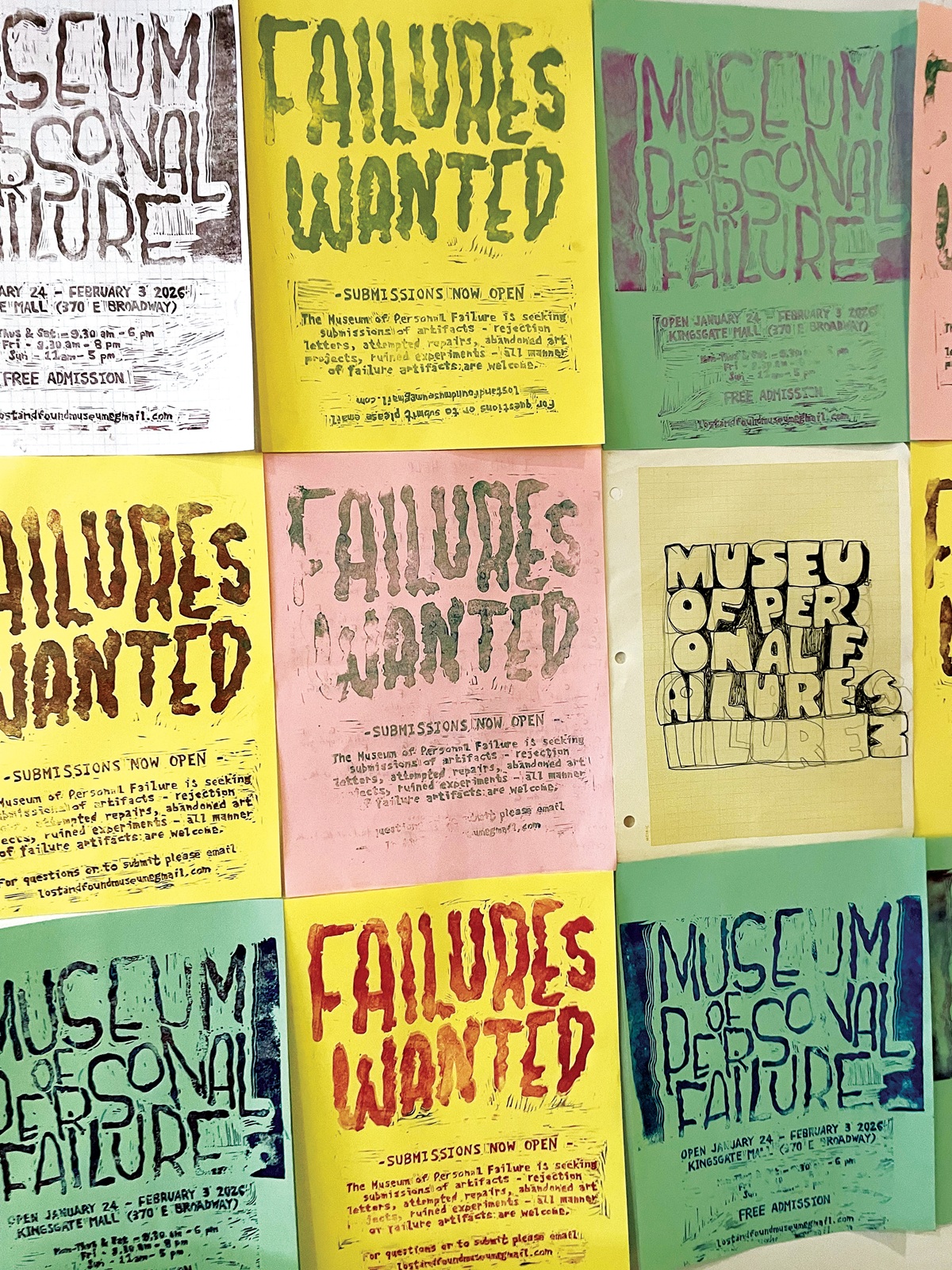
Photo courtesy of Robert Kuang
Jenniah Minchin stumbled upon the “Failures Wanted” posters on a typical day of Vancouver downpour, at a bus stop near her home. Whether it was the art style or the words themselves, something intrigued her. She set down her groceries long enough to make out the email address at the bottom.
Minchin is one of many curious people in and around Vancouver who responded to the posters late last year, which sought out submissions of artifacts representing people’s most personal, gut-wrenching letdowns. Minchin immediately knew what she’d submit: an abstract painting she’d started in 2024. It shows a pair of eyes watching over different symbols and textures encircling a spiral. In one corner, the word “normal” is barely discernible underneath black and brown paint. Its canvas is decorated with cuts and slashes from a kitchen knife. In January, it was shown as part of the community-sourced exhibition The Museum of Personal Failure at Mount Pleasant’s Kingsgate Mall.
“It kind of made me laugh a little bit, because I’m always there,” says Minchin, who calls herself a hobby artist. She’d lived close by until very recently. “This was probably going to be the most approachable environment for me to show my art and the emotional meaning behind it.”
For months, Eyvan Collins, the person behind the posters, traversed the city with their callouts for failures and tub of wheat paste, distributing posters wherever they went. Though Collins started the project out of their own heartbreak last year, they’ve activated a sense of community engagement that has taken on a life of its own. The exhibition received far more media coverage than they had anticipated, from the CBC to The Washington Post. This level of scrutiny felt at times overwhelming for Collins, and somewhat beside the point. Failure, after all, doesn’t require success and prestige. “My preference would be to focus on the clear yearning for third spaces and community art that has been evidenced by the interest in the project, and less on me,” they say.
On opening day, the shopping centre’s regulars, the project’s contributors and visitors, and an assortment of journalists gathered in and around the exhibition space. There was a DIY aesthetic that matched the show’s honest, confessional tone, with decorations assembled from inexpensive, upcycled materials like wood, glass, and cardboard. Underneath Kingsgate’s fluorescent lighting and neglected interiors, the exhibition’s mix of abandoned, rejected, and at times devastating artifacts felt right at home. Below her work, aptly titled just Stabbed Painting, a piece of cardboard framed Minchin’s accompanying typewritten wall text, revealing that it was made as an expression of having been diagnosed with epilepsy.
“It wasn’t just a failure of technique on the canvas or a failure of the inability to capture the emotion,” she explains. “To me, it was bigger. It was a failure of my brain put down on a canvas. This inability to function the way it’s supposed to.”
Some of the other submissions were centred around grief, too, but there was also humour and morbid curiosity in seeing so many of the ways people have been disappointed documented and displayed in one place. Near the Museum’s entrance, a wedding ring glistened underneath a glass display case, described by its former wearer as an artifact of fraud from marrying a con man. Further into the space, a “wall of rejection” gradually filled with sticky notes left by visitors, describing setbacks that ranged from failing to learn French to not reconnecting with a parent before they died. In the middle of the crowded exhibition floor, what looked like a heap of broken chair parts turned out to be a back brace someone wore after a cliff-jumping accident. “I probably should have taken a ceramics class. Or given myself bangs,” read the wall text.
Amidst everyone’s shoulds and regrets, though, hummed an energy, a togetherness, that’s rare in a world of ever-shrinking third spaces. Collins may have unveiled an antidote to that.
*
For researchers like Dr. Michael Ungar, our ability to bounce back has a lot to do with those around us. He’s the founder and director of the Resilience Research Centre at Dalhousie University and has spent decades examining the ways people adapt when things go awry. From a scientific and research perspective, he notes that conversations around resilience are often too diluted or too narrowly defined, straying from its core principles.
“Failure is useful if you integrate it into future adaptations or transformation,” he explains. “A resilient system doesn’t propagate success constantly.”
In his writing, Ungar argues, among other principles, that resilience does not originate solely within the individual, and is culturally relative. This lens defines resilience as more than simply overcoming individual adversity—it’s a byproduct of how we individually and collectively negotiate the provision of psychological, social, cultural, and physical resources in culturally meaningful ways.
This social-ecological model emphasizes that true resilience is not a static trait, but a more dynamic process of engaging with the world. Through a series of creative impulses, The Museum of Personal Failure found its way toward this idea and gave it form. Inside, when confronted with failure in all its conceivable forms, its remnants became something that connected us all. Once-isolating, often crushing experiences were transformed into a community experiment. Community art reaffirms the principle that resilience is environmental and systemic. Failure, on the other hand, like in its many forms shown at the Museum, feels deeply personal and individualized.
Collins’ community-based approach provided an ecological survey of sorts, one that focused on those who felt overlooked. The Museum of Personal Failure reflected a community simmering with struggling artists with limited opportunities, hobbyists who feel alienated from the arts world, and those who mostly contributed because it was a chance to share something meaningful. Leading up to the exhibition’s opening, participants came when they could to help set up stations, opening the space for social gathering and introductions, making something where once there was nothing. The project gave people a level of connection that had clearly been missing.
“There has always been and will always be DIY stuff going on, in Vancouver and beyond, with the fault of sometimes being socially insular,” says interdisciplinary visual artist Bug Cru, an old friend of Collins. After living in Vancouver for 12 years, they describe their relationship to the city as one might a complicated former flame—incompatible but ultimately grateful. Cru contacted Collins after recognizing their art style from the “failures wanted” posters and submitted two unfinished pencil sketches for the exhibition, both based on the lingering memories of a specific dream. The sketches were originally meant for their annual illustrated year-end calendar, but Cru eventually moved on to other projects. The experience ultimately turned failed illustrations of a fleeting moment into a tribute of resurrected art. For them, the project was a reminder that the professional arts industry is not art itself, but merely a system that facilitates it. “The barriers to these worlds were intentionally broken down for the Museum of Personal Failures with the wish of reaching everyday weirdos and celebrating our faults,” Cru says.
It seemed fitting that the project found its home at Kingsgate Mall, known to some longtime Vancouver residents as Hell’s Gate Mall, an informal nickname which took hold in the ’80s when Mount Pleasant was still a predominantly working-class neighbourhood. It’s a gritty, ramshackle mall, part relic, part living thing. But people go there, and they love it: they buy shoes, they buy lotto tickets, they gossip with neighbours. Today, BC Assessment values the site at $112 million, marking it as prime territory for high-rise redevelopment, and yet the mall survives, still serving an important function as a community gathering space.
Dying third spaces are an issue for everyone. In a 2024 survey commissioned by YMCA Canada, 36 percent of respondents said they didn’t have a third space at all. Academic researchers like Dr. Zhixi C. Zhuang and Ryan Lok have noted the intersectional value of third spaces, which are especially needed for marginalized populations like migrants, older people, and rural communities. Outside of urban areas, underfunding and closing of community buildings bear greater consequences for community well-being. Third spaces are more accessible in cities, yet they have become harder and more expensive to access.
Despite all this, Kingsgate has obstinately persevered as one of Mount Pleasant’s last remnants of its working-class roots, and remains one of the few places where DIY, community-led projects like The Museum of Personal Failure remain sustainable and accessible. Through this experience, Collins spent weeks observing the comings and goings at Kingsgate, describing it as “at moments haunting, at moments heartening.” In sidestepping traditional pipelines like fine art galleries and consumers, the exploration of space was just as central to the exhibition as failure.
*
Vancouver is a case study in urban gentrification, where redevelopment and rising housing costs have reshaped historically working-class neighbourhoods and placed pressure on long-standing communities. In 2022, the City of Vancouver unveiled its 30-year Broadway Plan, which aims to dramatically increase housing density along the Broadway corridor, including Mount Pleasant. In 2024, city councillors approved 13 high-rises for the neighbourhood (though that decision was later put on pause). While Kingsgate remains, its proximity to a future SkyTrain station, tentatively scheduled to open in 2027, means the site will likely continue to attract development interest.
Projects like The Museum of Personal Failure point to the uncomfortable truth that fine art galleries and studios are often early indicators and accelerators of gentrification. As community members and workers, artists face a catch-22. Artist Jenie Gao succinctly captured this at their recent exhibition opening at grunt gallery in Mount Pleasant, where they said, “The marginalized artist must contend with a twofold problem. There is a dire need for our work to exist, and the systems around us readily prey upon what we create. So I enter my work with the question ‘Whom will this work benefit?’”
In its aftermath, some Museum contributors, like musician Jamie Greenberg, known by the artist name JAM!E, are left with a desire to find other community DIY projects. “I, for better or worse, aspire to make a living off my art somehow,” he says.
For the exhibition, Greenberg chose old tracks that otherwise would’ve vanished with time. Using an old CD stereo system and a pair of headphones, Greenberg’s first attempts at music production became A 33 Dollar Bill: (Failed Album) at The Museum, a six-track artifact that visitors could sample, flaws and all.
As someone born and raised in Vancouver, he’s noticed the city’s underground art spaces being pushed out by gentrification. Greenberg hosts a series of open mics with dctrl., Vancouver’s longest-running decentralized tech space. But things are changing. According to a recent statement, dctrl. is losing its Downtown location on Pender Street due to “city re-zoning and rising real-estate pressure.” With the building set for demolition, the group is expected to vacate the premises. An interim location is still being determined.
For Minchin, exhibiting at the museum hasn’t changed the way she feels about her painting. She still considers it a failure. “I thought that was the most exciting part of showcasing this painting, that I could hate it as much as I want, but other people will like it and find it interesting and intriguing,” she says. Stabbed Painting has returned to Minchin’s place for the time being.
Minchin has something new taped to her wall—a note someone left behind after seeing her work. It tells the story of Dutch painter Gerard Jan van Bladeren, who famously slashed abstract artist Barnett Newman’s painting, Who’s Afraid of Red, Yellow and Blue III, at the Stedelijk Museum in 1986, because he despised the form. After serving jail time, he would return to the same museum in 1997, Stanley knife in hand, and destroy another of Newman’s paintings. The connection, made by a stranger over a painting Minchin hated, has stayed with her. “I just moved and it was one of the first things I put on my wall,” she says.
*
Without financial profit driving independent community art, it’s people behind projects like The Museum of Personal Failure that matter most. If there was a divide between career artists, hobby artists, and non-artists, the ones who cared showed up anyway. Some said it was like going to therapy. People also repeatedly said: there should be more of this.
Yet the question of space and access remains. DIY events function through taking profit and formality out of the process, which makes them particularly vulnerable when commercial interests intensify and threaten low-barrier, informal spaces for gathering. Who will get pushed out in the process?
People will keep showing up, and they’ll keep making art. Resilience is not something we have; it’s something people access through their environments. We can learn and cultivate resilience through failure, but as this project shows, we need the space that makes this process possible.
ROBERT KUANG is a writer, musician, and aspiring plant dad. Having spent time in Beijing, New York, and Vancouver, his mission is to bridge the distance between online and local arts and culture communities.