Pedalling the provinces
How strong is Canada’s cycling infrastructure?
Matthew Hanick
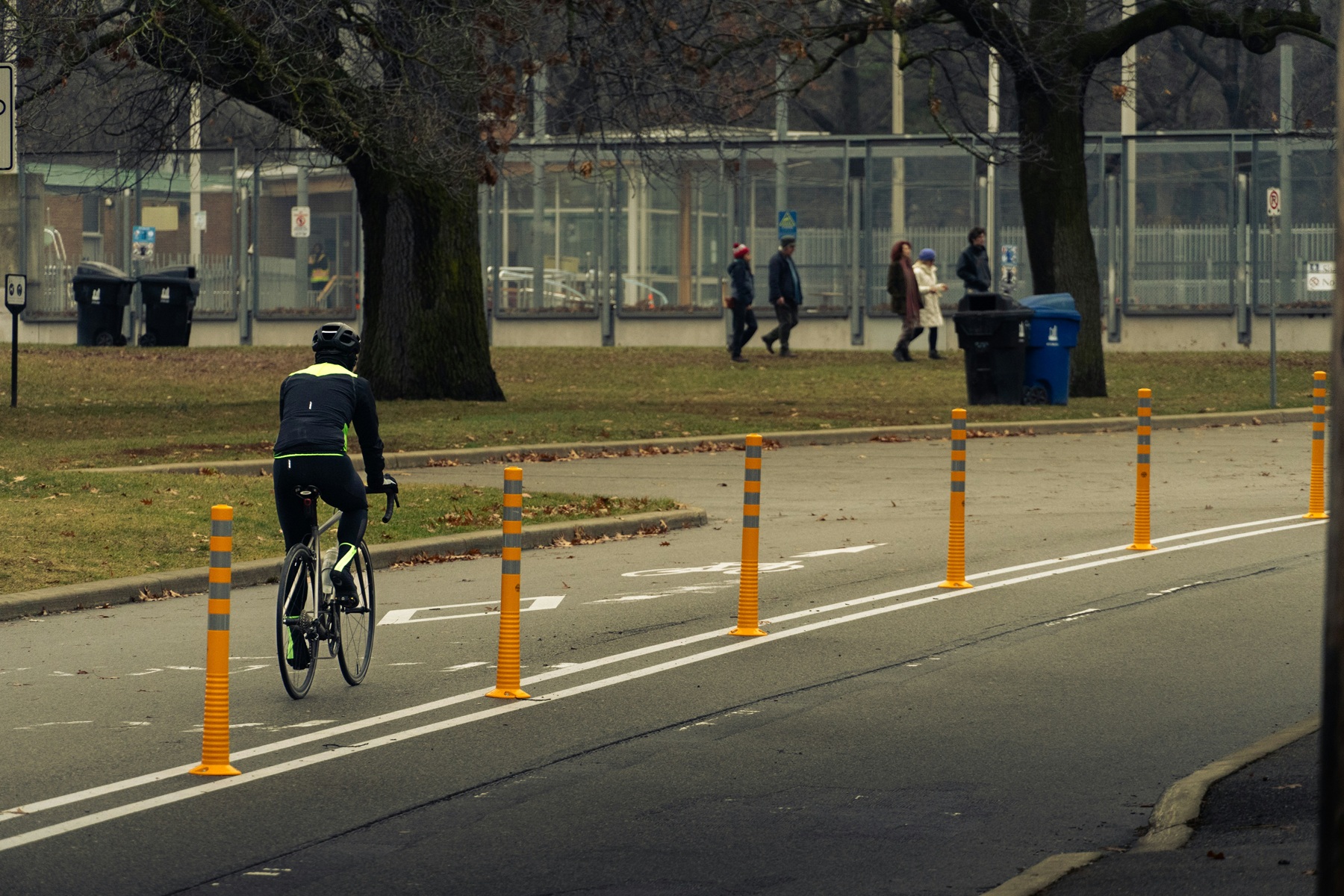
Maksym Dashko via Unsplash
A cyclist quickly glances over their shoulder before edging between a row of parked cars and a stream of traffic, scanning for signs they’re about to get doored, thumb alert on their bell. Across Canada, scenes like this play out daily, a symptom of uneven cycling infrastructure that forces riders to navigate gaps rather than safe, connected routes. Canadians deserve to move easily and comfortably within their communities, which requires infrastructure that supports active transportation. Cycling reduces car congestion, improves air quality, makes efficient use of urban space, and boosts local business. Yet, the Canadian Bikeway Comfort and Safety classification system found that one-third of Canadian neighbourhoods have no cycling infrastructure. To encourage more cycling, many municipalities are investing in bike-friendly streets with the goal of promoting health and equity. Well-designed complete streets can boost cycling rates by as much as 105 percent compared to areas without bike lanes. Still, long-standing tensions between current and future-oriented notions about street-use priorities have slowed progress, especially in Ontario and Quebec. As a result, only six percent of Canadians live in areas with strongly supportive environments for cycling.
British Columbia
In 2016, Victoria started building an All Ages and Abilities (AAA) cycling network. The first phase connects 33 kilometres of downtown bikeway, allowing 95 percent of residents to live within 500 metres of a route. Vancouver is expanding its greenways, improving connections to nearby municipalities. By 2040, the city expects that two-thirds of all trips will be made by foot, bike, or transit. The broader Vancouver region is advancing a Major Bikeway Network, a proposed 850 kilometre regional system connecting urban centres to major destinations with safer cycling infrastructure. Nearly 70 percent of Metro Vancouver residents live within 400 metres of traffic-separated bike lanes.
The Prairies
Though known for endless wheat fields, the Prairies are not a flat pedallers’ paradise. Despite ample road surface, bikeways are limited. Calgary boasts the largest urban bikeway network in North America, with around 1,000 kilometres of regional pathways and 96 kilometres of trails. Much of this network runs along the river valley or through parks, providing scenic, off-street routes that are largely separated from traffic. Edmonton is also expanding its bike infrastructure, but gaps in the network remain, and winter maintenance challenges year-round usability. Saskatchewan has more road surface—about 160,000 kilometres—than any other province. Saskatoon and Regina have added some bike lanes and multi-use paths, but overall cycle routes are fragmented over long stretches of open roads. In Winnipeg, where long winters and icy conditions shape daily life, a growing network of more than 400 kilometres of protected bike lanes and multi-use pathways is taking shape, though connectivity remains uneven and often fragmented.
Ontario and Quebec
Residents in Ontario and Quebec are locked in a continuous debate over the rights of drivers and cyclists. In 2010, Toronto—Canada’s largest city and the one with the longest average commute—recorded the highest per capita rate of bike-car collisions among Canadian cities. The Ontario government passed legislation in 2024 requiring municipalities to seek provincial permission before removing vehicle lanes for protected bike lanes and threatening to tear out bike lanes on three major streets, a move that was struck down by an Ontario court last July. Last year, Toronto police issued over 17,000 tickets to drivers parked in bike lanes. Montreal—Canada’s most bicycle-friendly city—is expected to complete its 191-kilometre Réseau Express Vélo, a network of year-round separated or protected bike lanes, by next year. However, some boroughs have introduced temporary rollbacks, removing select bike lanes in winter to restore parking, while political leaders propose changes to longstanding routes in high-traffic areas. In both provinces, bike share programs complement efforts to expand cycling infrastructure and support everyday mobility as well as tourism and recreation. Bike Share Toronto, which had a 40 percent spike in individual riders in 2025, operates a network of about 10,200 bikes and over 1,000 docking stations. BIXI Montréal is one of North America’s earliest and largest bike share systems, with over 11,000 bikes in more than 900 stations.
The North
Most of Canada’s North completely lacks bicycle infrastructure, but offers some of the most remote, challenging, and scenic wilderness and adventure cycling experiences in the world. Whitehorse has an extensive trail network, featuring about 33.9 kilometres of trails per 1,000 residents compared to the Canadian average—0.9 kilometre per 1,000 residents. The network includes paved, double track and natural surface single-track trails, as well as old roads and hinterland routes, which help cyclists access the city and its surroundings.
Atlantic Canada
Nova Scotia’s Blue Route, a projected 3,000 kilometre provincial network, aims to link communities across the province through a combination of paved shoulders, low-traffic roads, and multi-use trails. Halifax is advancing an AAA network, with roughly 60 percent of the city’s core grid complete as of early 2026. Expansions to existing infrastructure include protected cycle tracks in downtown corridors, multi-use paths, and local neighbourhood greenways. Unfortunately, it’s in jeopardy. Mayor Andy Fillmore brought forward a motion last summer seeking to pause construction across the city. In February, he asked staff to explore cheaper alternatives to upcoming network construction. In New Brunswick, the Véloroute de la Péninsule Acadienne is a popular, well-signposted cycling route tied into the Trans Canada Trail system, with segments connecting small communities along the Acadian Peninsula.