Lingua franca
Edmonton-based multilingual magazine makes space for all voices
Saman Dara
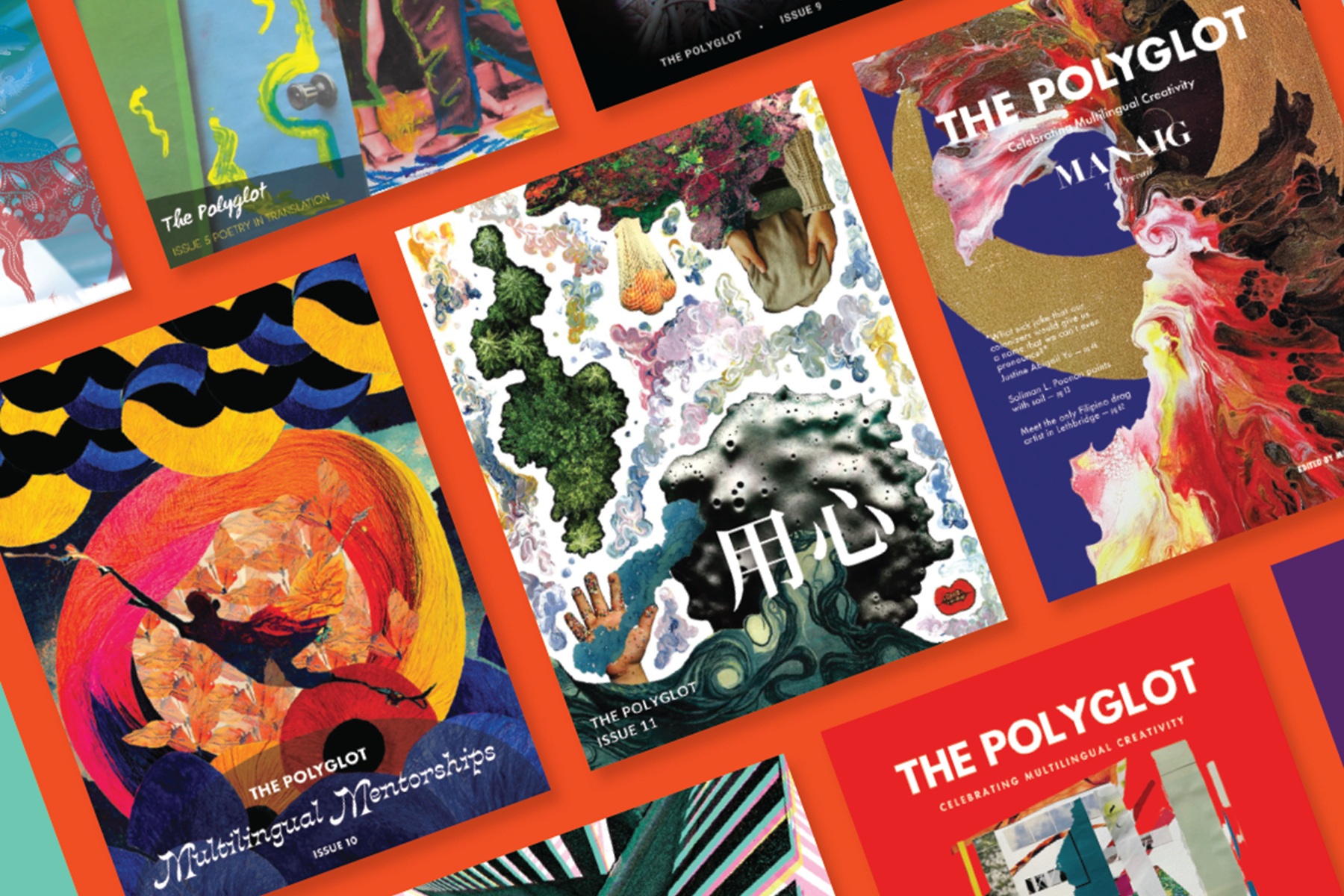
Images courtesy of Polyglot Magazine
Adriana Oniță, founder of The Polyglot magazine, says the publication is rooted in the idea that language can be a tool for healing.
“We cannot create a world where languages unite rather than divide without first tending to those linguistic wounds so many of us carry from childhood—the moments our mother tongues or true voices were silenced,” she says. “Healing is central to our vision as a magazine.”
The publication views linguistic diversity as an “inspiring catalyst for experimenting together and creating a better world within our spheres of influence and beyond.” Oniță says that transformation requires The Polyglot to be more than a magazine. It also provides a gathering space in Edmonton, where it was created—a community hub rooted in the well-being of those who spend time there.
Each issue of the magazine, published in print and online, features different languages, with guest editors curating content to fit a specific theme.
The most recent issue, “Purge,” explores censorship through the work of 10 young artists confronting the erasure of knowledge and language, whether it is through books, bodies, memory, or history. Contributors write in Arabic, Cree, Igbo, and more. “Each speaks to a different site of silencing while confronting the same threat,” Oniță says. She describes that threat as “a widescale assault on our liberties to think, read, remember, write, experiment, love, and live freely.”
Oniță says most issues of the magazine emerge through partnerships with other artists or community organizations. “We believe collaborating with others is one of the best ways to accomplish our mission of celebrating and supporting multilingual creativity.”
Another recent issue, named “Daaira,” explored creative well-being, an idea brought up by teammate Catalina Morales Vélez. Oniță was invited to a poetry evening at Daaira House, an Edmonton-based initiative rooted in a cyclical and spiritual exploration of art, poetry, and wellness. They invited Daaira House’s two co-founders, Aaima Azhar and Zainab Azhar, to collaborate.
Daaira is the Urdu and Arabic word for “circle.” The name was chosen by Zainab, who found comfort in the shape. “Whenever we gather, it’s in a circle,” says Zainab. “Circles and cycles exist all around us in nature.”
The “Daaira” issue, which includes works in Urdu, Arabic, Filipino, Yoruba, and Hungarian, grew organically from there, Zainab says. “Artists put their energy into their work in a way that reaches your heart—even if it’s in a language you don’t fully understand,” says Aaima.
Oniță believes a significant milestone for people to reach is garnering a “sense of wonder and comfort with the unknown” that a new language may ask of the reader.
The magazine is always working toward inspiring that, and with a focus on Indigenous languages. In 2020, The Polyglot published two issues of poetry and art curated by Naomi McIlwraith and Dorothy Thunder, supported by the Edmonton Arts Council. McIlwraith is a Métis educator, poet, and essayist and Thunder is a Cree instructor in the Faculty of Native Studies at the University of Alberta.
In 2024, the magazine started a relationship with Supporting Indigenous Language Revitalization (SILR). SILR is a collective of Indigenous leaders, scholars, and community members who advocate for Indigenous languages at the University of Alberta.
Hosting Indigenous artist-led workshops alongside SILR led to the award-winning issue “âniskôverberation” co-curated by author Anna Marie Sewell and artist Lana Whiskeyjack, which received the 2024-2025 Alberta Magazine Publishers Association Silver Award for Innovation. Print copies were distributed for free to the community and the issue is permanently accessible in Alberta’s public libraries. Oniță says The Polyglot’s collaboration with SILR is ongoing.
Since the multilingual community hub’s inception in 2016, Oniță says linguistic diversity has come a long way in literary and artistic spaces. “I see more poets, writers, publishers, prizes, litmags, and festivals that are embracing translingual and multilingual works,” she says. “But I think there’s still a lot more work to be done.”