7Estez I am Tattooing
Jacqueline Merritt
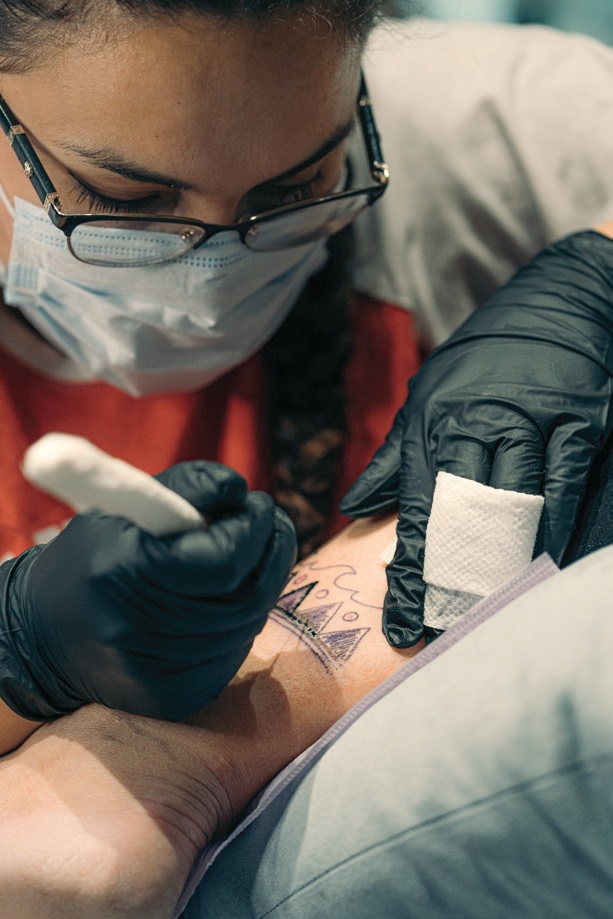
Incorporating mountains, water, and moon cycles, this tattoo tells a visual story of home, ancestral lineage, and seasonal rhythm through a contemporary cultural lens. Photo: Robert Burns (2022).
I come from a place where the mountains kiss the sky and the rivers run crisp and clear, known as Xeni Gwet’in or, in English terms, Nemiah Valley, British Columbia. Xeni Gwet’in is one of six communities in the Tsilhqot’in Nation and among the first Indigenous nations in Canada to secure title and rights to our land. As Tsilhqot’in people, we hold great pride in our land and our identity. The experience of being raised in Tsilhqot’in country is a powerful symbol of strength, love, and collaboration—qualities that are essential for surviving and thriving through the seasonal changes and challenges our land presents. Our connection to the land, like the roots of a tree, binds us to our ancestors and their spirit, grounding us in both our cultural heritage and our future.
Nenes Jidats’edelhtsi means marking of the skin in Tsilhqot’in and it serves as a profound symbol of our interconnectedness across time linking the past, present, and future for the Tsilhqot’in People. It embodies a unity that transcends superficial changes and transformations, acting as a constant reminder of our origins and our identity for all Indigenous people.
The challenges of colonization, war, disease, and famine forced communities to prioritize physical survival, silencing teachings that once guided and connected generations. Despite these disruptions, the power of memory, tradition, and storytelling endures, often preserved in the physical and emotional landscapes of those who carry them forward. Through revitalization, we have a powerful opportunity to reconnect with these narratives, underscoring the importance of embracing our shared heritage. This journey back to our roots not only honours where we come from but also reaffirms who we are, inspiring a future built on resilience, wisdom, and cultural pride. Once a formidable and vibrant force, the Nenes Jidats’edelhtsi “marking of the skin” represented boldness and cultural strength, which was diminished within the Tsilhqot’in.
*
A Direct Link to My Heritage
Among the Tsilhqot’in Nation, many of these cultural teachings were preserved in the stories of our ancestors, although they were often veiled from broader understanding. I discovered, through my own lineage, that the tradition of body markings is a direct link to my heritage. This practice stopped by my great-grandmother ?etsu Annie Elkins (Bulyan), Xinlhi and great-grandfather ?etsi Sambulyan xinlhi of Xeni Gwet’in. In my understanding it was discontinued to protect the next generation from the harsh realities of colonization and the punitive environments of residential schools and western society as a whole.
The last traditional marking in my family was performed by my ?etsu Annie Xinlhi on her daughter (my great-aunt) ?abes Helena Myers Xinlhi, who received three red skinstitch markings on her forearm as a symbol of her coming of age and womanhood over one hundred years ago. Helena, the eldest daughter of thirteen siblings, was the only child to receive these markings. As time shifted, her younger siblings were taken to residential schools at a young age where they were subjected to cultural suppression and the discrediting of their language and traditions.
In these institutions, traditional ways of life were vilified and branded as “savage” or “devilish,” leaving many to suppress their cultural heritage and disconnect from their roots. My ?inkwel Francy (mom) shared moments of being hit with a ruler when speaking her language or doing anything that showcased her Tsilhqot’in cultural background. She explained that her cousin whispered to her, “We can’t do that here, Francy, don’t speak Tsilhqot’in and do your best to speak English.” This experience was ingrained into her at the young age of five when she was taken from her parents and displaced eight hours away from her community to attend residential school in Williams Lake, B.C., then on to Kamloops, B.C..
In reflecting on the importance of cultural teachings and emotional well-being, I asked my ?inkwel if her grandparents had ever passed down wisdom about caring for her mental and emotional spirit. Her answer was both touching and revealing. She shared that her grandparents passed away when she was only eight or nine years old, so many of the teachings she received were indirect, woven into the fabric of daily life. The memories she holds most dear are of the love and care her grandparents gave her, and the way the entire family lived together as one. During those times, different siblings and families supported each other, and ranch life, centred around cattle, was the way of survival.
It is painful to acknowledge that my family, like many others, had to set aside traditional ways of healing and cultural practices in order to survive in a world that was foreign to them and often hostile. Survival became the primary focus, and as a result, cultural traditions surrounding emotional and mental well-being were frequently sacrificed. My ?inkwel Francy shared that her ?inkwel Lucy, one of twelve siblings and the second-youngest daughter, focused on teaching her practical skills for survival, particularly the ways to harvest traditional foods and medicines, alongside the ranching lifestyle that sustained them.
As a child, I was eager to learn from my grandparents and family, always asking countless questions in my attempt to weave together an understanding of our culture and history. I vividly remember asking my ?etsu, in our Tsilhqot’in language, “Did we sing songs in Tsilhqot’in? What were they like?” Her response was simple yet telling: “I don’t know, ask your ?etsi (grandfather).” At the time, I wondered if my curiosity annoyed her, but now, as I reflect on these moments, I realize her response was shaped by the pain of the past. My ?etsu was a strong woman, but her upbringing marked by the trauma and abuse she endured seemed to have taken a toll, especially on her connection to the cultural knowledge she might have otherwise passed down. She often relied on my ?etsi to share that knowledge instead. Looking back I realize that my ?etsu’s struggle to answer my questions wasn’t a sign of annoyance, it was a reflection of the deep cultural loss she had experienced.
The legacy of residential schools and the forced assimilation policies inflicted on Indigenous peoples created generational gaps in knowledge. Many, like my ?etsu, grew up in a world where cultural practices were repressed or forgotten as survival took precedence. The effects of this layered trauma rippled through the generations, influencing the way cultural teachings and emotional support were passed down. ?etsu Lucy, like many Indigenous women of her time, was taught to focus on survival, to endure hardships, and to provide for her family. Her ability to teach the next generation was shaped by the survival strategies she had learned, yet these teachings often came at the cost of emotional and spiritual care, which had been central to Indigenous ways of being before colonization disrupted those practices. The trauma my ?etsu Lucy carried was not just her own; it was the weight of a collective history of displacement, loss, and abuse.
The pain of these past injustices is undeniable, and it highlights the resilience of our people. Despite the systemic efforts to sever our connection to our culture, some knowledge survived, and those who were fortunate enough to escape the worst of these policies or able to bridge the gaps like my ?etsi Douglas Xinlhi (late) and ?etsu Lucy Xinlhi (late) became critical keepers of our traditions. Both of their stories, songs, and teachings are living links to a cultural heritage that was almost lost, and they offer us a path forward.
By honouring both the practical survival skills of our ancestors and the cultural traditions that sustain our emotional well-being, we can create a future where our children not only survive but also thrive. We can reclaim the space for healing, where emotional and spiritual care are valued alongside strength and resilience. In doing so, we honour the full complexity of our identity as Indigenous people who are more than their survival and more than their trauma—who are whole and connected in body, mind, and spirit.
*
Healing from the Traumas of Colonization
In today’s world, the process of healing from the traumas of colonization requires not only acknowledging the pain of the past but also actively seeking to revive the knowledge and practices that were once central to our identity. We must strive to reconnect with the traditions that sustained our ancestors, ensuring that future generations have access to the cultural wisdom that was denied to so many of our ancestors.
By honouring the experiences of my lineage and recognizing the complexities of their lives, I am inspired to continue asking questions; seeking answers, and reclaiming the cultural knowledge that remains. It is through this process that we can begin to heal not only as individuals but as a community and ensure that our traditions are preserved and celebrated for generations to come. Yet, in reflecting on these stories, I see a powerful opportunity for reclaiming what was lost. The resilience of my ancestors is something to be honoured, but it is equally important to acknowledge that resilience alone is not enough. Our people need space to heal, to reconnect with the emotional and spiritual practices that were once integral to our identity.
The teachings that I received about my language, traditional foods, and medicines are vital, but they are only one piece of a larger whole. Reclaiming the practices that nurture our emotional and mental well-being is equally important. As we move forward, I hope to integrate these teachings with the emotional and spiritual care that was sidelined during generations of survival.
The oppression they faced forced them to hide or adapt many teachings, ensuring the survival of spirituality and self-expression amidst trauma. Unlike surviving the cold winter months or fighting off a bear, colonization meant our continuous pursuit to find strength, safety, and love to endure and not lose ourselves. There was so much to hold that certain cultural teachings slipped through our fingers.
In my pursuit of knowledge, I turned to the Tsilhqot’in Nation, reaching out to community members who carried pieces of history and cultural knowledge, especially regarding Nenes Jidats’edelhtsi. Through these connections, I began to unearth the stories of our ancestors and their traditions, stories often passed down through oral teachings rather than written records. When I dived into stories from my cousins, the practice of marking the skin through painting and tattooing with charcoal, ochre, and bear grease was a profound visual tradition that celebrated cultural heritage, encapsulated ancestral stories, and conveyed important social roles and responsibilities. These markings served not only as expressions of personal identity and beauty but also as symbols of protection and unity within the community. As I reflect on these teachings, I realize the importance of reclaiming and reviving our cultural practices. My childhood curiosity, my eagerness to learn, and my many questions were a way of bridging the gap between the past and the future. Though my family may not have had all the answers, their strength and resilience, coupled with the teachings, have gifted me with the foundation I need to continue this journey of cultural reclamation.
From the stories shared over two hundred years ago, when 7Estez was prominent in my nation, my cousins ?etsu had markings on their faces or arms. Today, these markings are either forgotten or distant memories, erased by the fear of drawing attention from Indian Agents enforcing catholic religious practices and punishments. For example, raised in the remote depths of Tsilhqot’in country, in the Tatla Lake area, Joyce’s ?etsu lived far from the main roads and out of reach of western society. She had tattoos on her face and arms, symbols that had marked her deeply, not just physically, but culturally and spiritually. Through this intimate sharing, I learned that in Tsilhqot’in culture, tattoos were far more than mere adornments. They were symbols of family, matriarchal power, and social hierarchy. The markings on the skin served as a form of self-expression, a way to embody identity and status through art that was often applied with handpoking techniques. Materials such as deer bone, charcoal, bear grease, and sinew were used to create these permanent designs, each one imbued with meaning that connected the individual to their lineage and community.
As I continued my research, more stories emerged from other relations within my community. Many spoke of grandmothers or great-grandmothers who had facial tattoos; though faded with time, these markings still carried deep significance. The stories behind them, however, remained dormant for generations, almost as if they had been lulled into a deep sleep by the pressures of colonization and cultural erasure. Yet, through these small fragments of knowledge, I began to see a path forward.
The stories of our ancestors’ tattoos are not lost, they are simply waiting to be awakened. Through continued sharing, teachings, and community connections, I believe we can bring these stories back to life. As we uncover more about the meaning behind the marks our ancestors wore with pride, we will not only revive the tradition of tattooing but also honour the resilience of our culture. This process is a reclamation, a way of symbolizing ourselves once more through the markings of our skin, of our heritage, and of our shared history. My hope is that by rediscovering these stories, we can pass them on to future generations, ensuring that they are never forgotten again.
*
Yedan Nilhghid — “Taking Care of Yourself”
As Tsilhqot’in people, we have long been proud of our strength and resilience, which have carried us through generations of hardship. Yet, I have noticed that our emphasis on strength often leaves little room for other forms of expression. Strength has become the dominant language of survival, but in doing so, we have limited the space for feelings of hurt, sadness, and anger—emotions that deserve acknowledgment and release. Our collective trauma, much of it unhealed and untold, calls for more than endurance; it calls for transformation through expression.
One way I believe we can begin to shift this narrative is by reclaiming holistic cultural practices that invite us to connect with our bodies and spirits. Handpoke tattooing, for example, is a practice that holds deep meaning for me. This ancient art form is more than just physical markings on the skin—it is a release of the energy we often withhold inside. Through handpoke tattooing, we externalize emotions, memories, and pain that have been trapped within us, creating a tangible path toward healing. Each poke allows us to release that withheld energy, and in the end, the tattoo reveals something beautiful—whether it represents hope, love, or a personal connection.
This journey of healing goes beyond marking the skin; it marks a new way of being. Handpoke tattooing represents a reclamation of cultural practices that were once integral to our ancestors. By integrating these traditions with modern understandings of emotional and spiritual well-being, we create a safer space for future generations to be their whole selves—unburdened by the weight of untold trauma. I want our future generations to know that it is possible to move through trauma, not just carry it. By embracing practices like handpoke tattooing, which are both physical and spiritual, we can begin to transform how we understand and express our inner worlds. My hope is that, as a community, we can balance our pride in strength with vulnerability and emotional honesty. By doing so, we allow ourselves to heal more deeply—not just as individuals, but as a collective. By creating space for emotional expression, we honour all parts of ourselves—not just the parts that have carried the weight of survival, but the parts that long for joy, love, and connection. We are not defined by our hurt. While we are resilient, we are also whole, multifaceted human beings who deserve to live fully and authentically.
Excerpted with permission from Truly Tribal: Contemporary Indigenous Tattooing, edited by Dion Kaszas, ©2026, Fernwood.