Gen zine
DIY publishing sees a youthful resurgence
Liz Worth
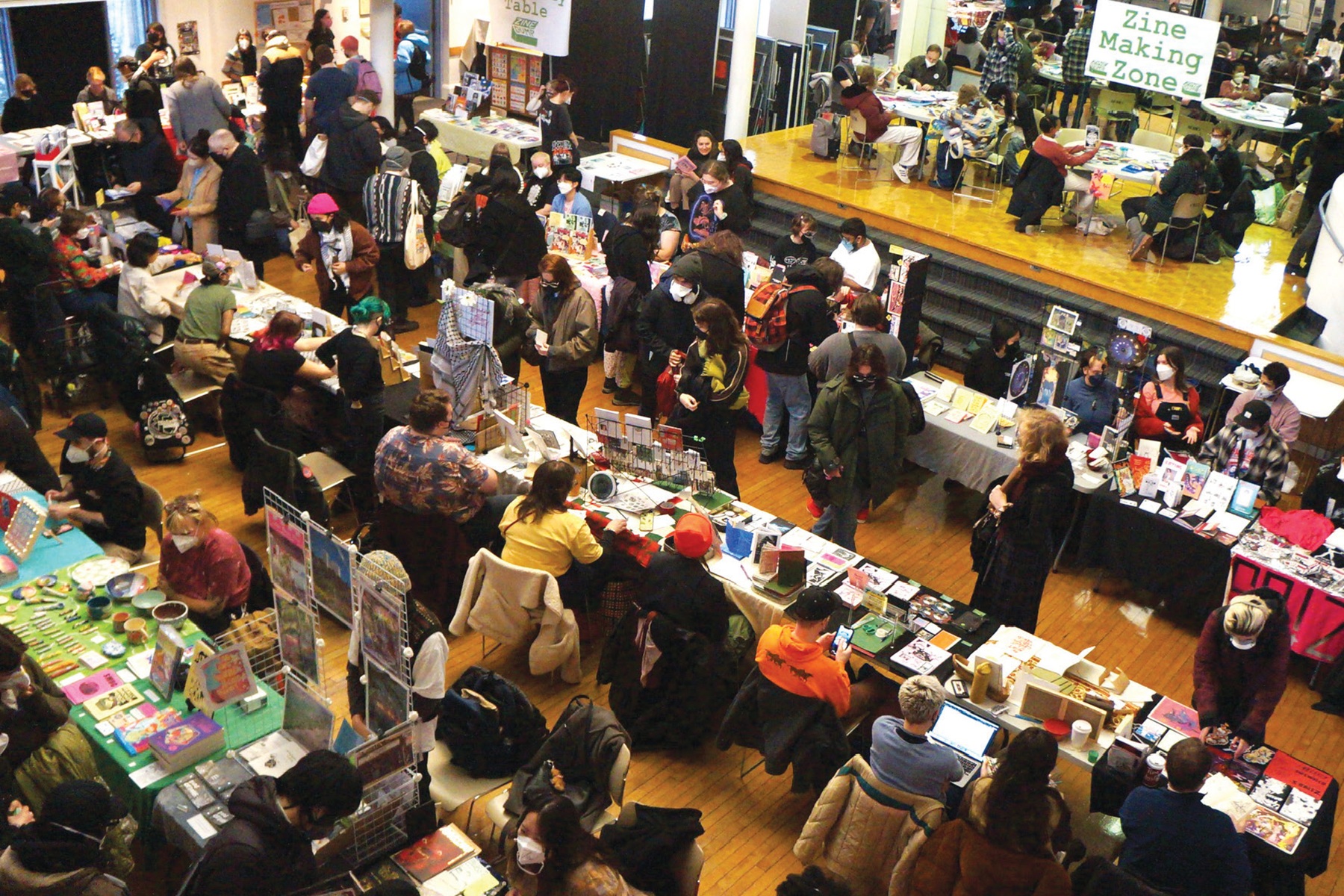
Photo by Alexander Arvelo McQuaig
When Broken Pencil magazine abruptly shut down in 2024, it left a gap in the Canadian zine community.
Broken Pencil launched in 1995 with a distinct focus on zines and independent culture. It also hosted Canzine, one of the country’s biggest zine fairs. Running for nearly 30 years, Canzine gave countless independent and marginalized creators a venue to sell, share, and celebrate alternative culture in Canada. Beginning in Toronto and eventually expanding with events in Vancouver and Ottawa, as well as an online version dubbed Virtual Canzine, the end of this long-running zine fair felt like the end of an era.
Canzine and Broken Pencil created space for progressive voices, but their founder, Hal Niedzviecki, shuttered both after the community he had built spoke out against his support for Israel and the war on Gaza. Despite Niedzviecki’s politics, Broken Pencil and its Canzine events held a special place for many in Canada’s indie arts scene, and their collapse was deeply felt in the DIY community.
Zines, however, prove resilient as a new wave of young creators take up the helm. Not that Canzine was the only game in town to begin with: Montreal’s Expozine endures as one of North America’s biggest zine fairs. Hamilton, Ontario’s Zineposium and Toronto’s Zine Dream are just a few of the many zine events that happen throughout the year. But like any medium, zines have gone through ebbs and flows of popularity.
“There was kind of a—I would call it a zine nuclear winter from, like, 2008 to 2018 or so where I felt zines were just surviving,” says François Villeneuve, who sells a diverse selection of zines through the long-running zine distribution project Great Worm Express Distro. “Lots of the old hands had stopped making them.”
That lull has ended, Villeneuve observes. “I really feel there’s a great zine resurgence right now,” he says.
Once considered a hallmark of the Gen X culture from which communities like Canzine emerged, zines are now being embraced by Gen Z and young millennials. Publishing can feel out of reach for many. Narrow editorial mandates mean that not all stories will find a home in larger publications, and the diminishing landscape of print journalism doesn’t help. For generations, zines have been the antidote: They put publishing power directly into the hands of whoever wants it. New generations are discovering that magic.
“I work with students, and I see a lot of younger people making zines,” says illustrator and cartoonist Jenn Woodall. “I think it’s because it’s a very accessible way to get your story and your information out. I also feel like there is a bit of a rejection of the online realm with younger people.”
Woodall and Villeneuve are two of seven organizers behind Zine Dump, a new Toronto-based zine fair that debuted in November with 65 vendors. “All of us who organize Zine Dump are of the older generation,” Woodall says, adding that it was important for the event’s organizers to open the doors to younger zine makers. Some applicants were as young as 18.
Laszlo Shaak of Zine Harvest, a Vancouver-based zine fair, says he’s seeing younger people participating in zine culture, too. “I think it’s totally a misunderstanding of Gen Z that they’re digital only,” he says, adding that many Zine Harvest attendees are under 25.
While the internet was expected to democratize free speech, its corporatization is doing the opposite, according to Tyler Ellis of Toronto’s Scizr zine. Self-described as “Toronto’s filthiest sapphic party and zine,” censorship around politics and sexuality can be a concern for Scizr. “Having this physical, tangible [zine] doesn’t have that risk of being removed for not following certain guidelines,” Ellis says. “There aren’t any rules that we have to follow, and we can say whatever we want.”
There’s also a call back to physical media that’s important for the new generation of zine makers. The opening editorial statement in Cotton Mouth, a Toronto-based punk zine, states, “having a digital record of a subculture taking place is useless and uninformative. We make these zines to prove that this culture existed and continues to do so.”
“It’s just always seemed like something I missed out on,” says Georges Emille-Roy, co-creator of Cotton Mouth. “Because we’re a younger generation, I feel like that whole dream about getting a zine, looking up local shows . . . I never got to do that growing up. I think that’s a big part of the draw toward physical media.”
Declan Fowler, Cotton Mouth’s designer, agrees. “From a design perspective . . . it’s really fun to actually get to work on something that you can hold in your hands. Just seeing your work at the end and being able to flip through it is a surreal experience.”
The collective behind Brantford, Ontario’s Dead Ringer echo this motivation. Run by Aleura Chatzis, Dani MacDonald, Cadence Nixon, and Ethan Silver, Dead Ringer launched in 2023 in response to “the lack of historical documentation within our local music scene,” says MacDonald. Like Scizr and Cotton Mouth, Dead Ringer’s efforts are multi-layered: These zines run parallel to events they organize. “We’re starting to focus on community action as well,” MacDonald says, “doing more things like zine nights, encouraging community to get involved in the making of their own zines.”
Activism has always been part of zine culture, and that tradition continues today, too. Many emerging zine makers raise funds and awareness about a range of issues, including houselessness and harm reduction.
For all of social media’s intentions to connect people, it’s not always enough to do it from behind a screen, says Zoya Naghdianei of Toronto punk zine Licentia. “Everything has become TikTok-ified,” she says. “[People are] talking about politics, but what are they doing to directly involve themselves and help their community?”
Naghdianei also stresses the importance of longevity in these efforts to make lasting change. “This isn’t just a youth project,” she says. “I want to keep doing this forever. And I hope other people feel the same way.”
The spirit of zine culture is hard to break, and a new wave has arrived. If today’s creators have their way, it’s only going to get bigger from here.