Sounding off
How a marching band turns counter-protest into a joyful act of solidarity
Leslie Sinclair
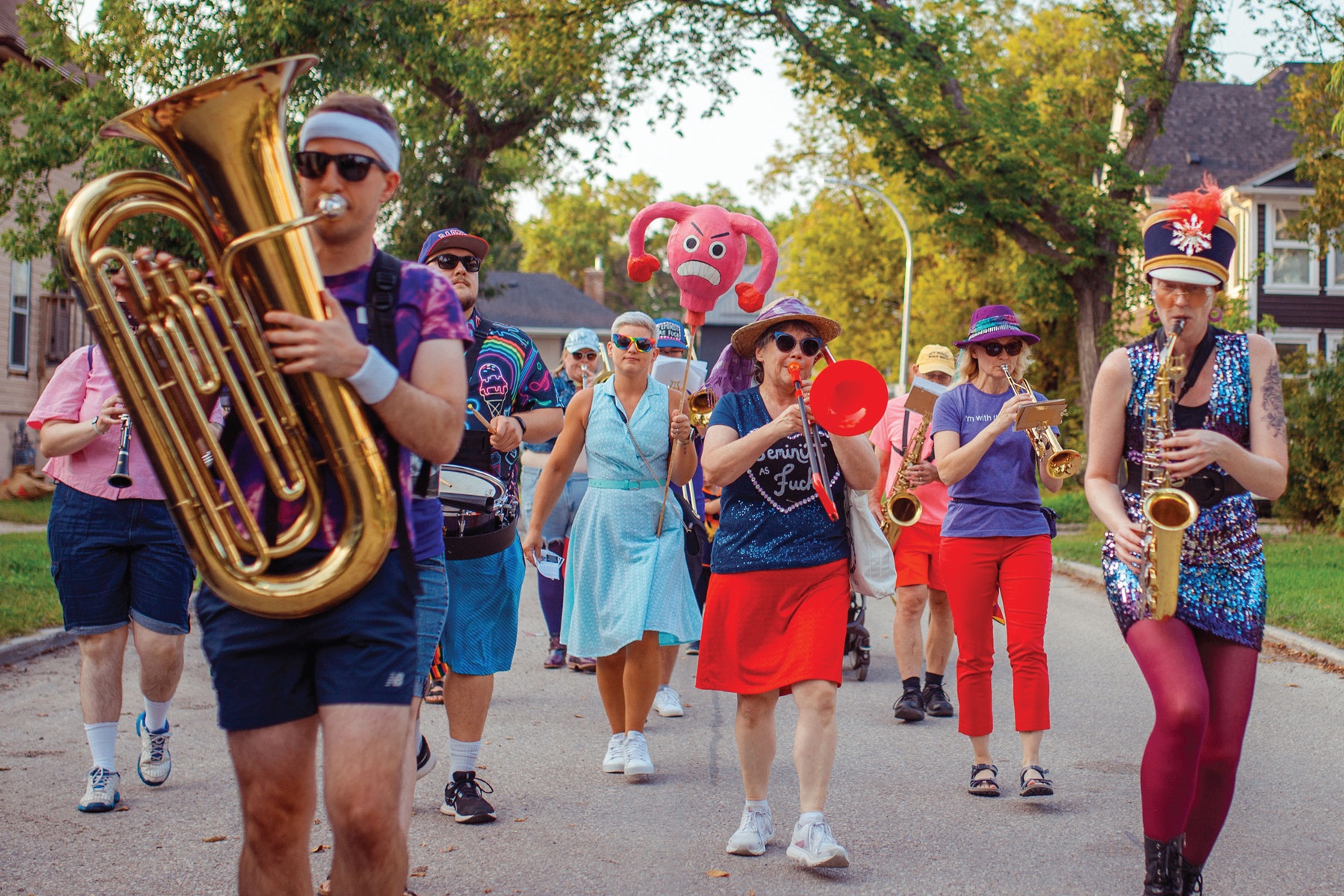
Photo courtesy of Leslie Sinclair
A chant swells as a ragtag marching band pounds out a familiar riff. These musicians didn’t just come to perform. They came to disrupt.
It’s October 2018, and Jacquie Nicholson knows that anti-choice activists are staging an annual picket outside the Women’s Hospital near Winnipeg’s Health Sciences Centre and that local feminists are organizing counter-demonstrations. Active in community organizing related to solidarity with incarcerated people, feminist and other “lefty” causes for many years, Nicholson discussed counter-protest strategies with her partner and sister, aiming to make it “a little bit less of a bummer” to rally outside for hours in the chilly damp of mid-autumn.
“We were thinking, what’s a way that we could not just go argue with these people and debate abortion with them? What if we could annoy them and make them feel uncomfortable like they’re in public making people accessing health services feel uncomfortable?”
The Feminist AF Marching Band was born. The trio—Nicholson on alto sax, her partner on tuba, and her sister, a talented musician and high school band teacher—and a small group of other musicians brought their instruments to the counter-protest to disrupt the anti-abortion crew and raise the spirits of their fellow feminists.
Part protest, part performance, the group uses brass and percussion, chants and humour to counter anti-choice demonstrations, support Pride events and boost morale during labour pickets. What started as a creative form of counter-protest has become a regular presence at Winnipeg and area events, using music as a tool of political activism. Since it was originally conceived, the group has both expanded its role to include fundraising and evolved its tactics.
“For the most part, [anti-choice demonstrators] just love attention. They want any kind of attention that they can get because otherwise they’re just walking around in the cold by themselves,” Nicholson says. “When people drive by them and give them the finger, they love it. When people blare the horn, they love that.”
So, about five years ago, the band took a new approach. Rather than “meeting them for a battle in the streets,” the band takes a head count while the anti-choicers are on their picket. They then reach out to their supporters asking for a “sponsor” for each demonstrator.
Often people in remote Manitoba communities must travel long distances to access abortion and other reproductive health care. The funds raised through sponsorships help pay for travel and other expenses.
In 2024, Manitoba introduced buffer zone legislation relating to hospitals, clinics, and other abortion providers, another reason that the band has drifted away from the “let’s go honk at the anti-choicers outside the hospital model” they started out with, explains Nicholson: It is now illegal for antichoice protestors to congregate within 50 metres of the front door of an abortion provider.
While that doesn’t keep the Campaign Life Coalition—the group Feminist AF formed in response to—from their vigils every fall, it means they are forced to set up a couple of blocks away where they are less likely to come into direct contact with people seeking health care. Now that they are “less relevant than ever before,” Nicholson says, it made sense to switch gears.
Last year, the band tried its first virtual busk stop, setting up near a popular walking and running spot along the Assiniboine River. They played for about an hour in hopes that people walking by would donate, which didn’t really happen since people don’t carry much cash these days. But they’d hired a photographer to shoot video, which they posted to their social channels. The effort generated about $2,600 in online “tips.”
In February, the band put out a call for new members. Nicholson says this latest recruitment feels different than usual, perhaps due to atrocities south of the border.
“The Winnipeg-Minneapolis connection is strong,” Nicholson explains. “There’s not really anything we can do tangibly about what we’ve been watching in horror in the U.S.—but we can take that horror and translate it into local actions.”