Partners in time
B.C. couple have been building Canada's dance industry together for nearly 50 years
Leslie Stark
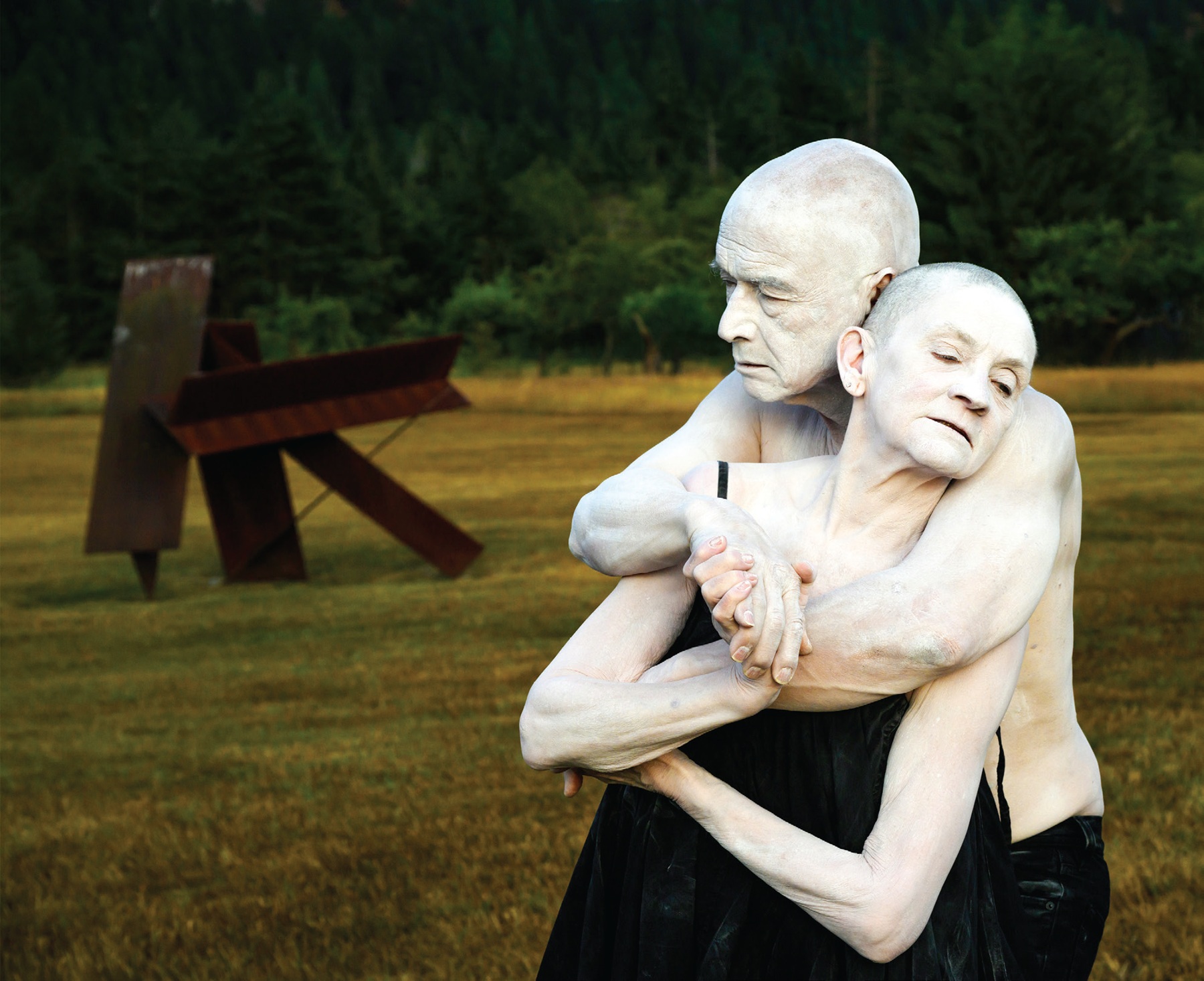
Photo by Chris Randle
Two ghostly figures appear, moving across a vast field strewn with steel sculptures. The dancers—a man and woman, shaved bald and painted white—move with a languid fluidity, bending space and time.
This is A Simple Way, performed this summer at The Jeffrey Rubinoff Sculpture Park on Hornby Island off the east coast of Vancouver Island, just north of Nanaimo, B.C. Barbara Bourget and Jay Hirabayashi, the dancers, are 74 and 78 years old respectively and have been dancing together for over 46 years.
Hirabayashi describes their process of creating work now as more improvisational, but informed by their years of shared Butoh-based choreography. Butoh is a form of dance rooted in subversion, and focused on the individual’s ways of moving and being. Butoh’s founders, Tatsumi Hijikata and Kazuo Ohno, developed it as a radical rejection of both Western dance forms and traditional Japanese performance arts.
“My view of art is that as an artist you are a saboteur. You are trying to change the way people look at reality and not be complacent about what they see,” Hirabayashi says.
When Hirabayashi first saw Bourget dance in 1979, it was her jumps that caught his attention. “I saw her flying across the studio like a gazelle. It was a low ceiling, but it looked like her head was going to hit the ceiling.” As professional dancers at the Paula Ross Dance Company (one of Vancouver’s first contemporary dance companies), they soon choreographed their first piece together, Restless, which Ross didn’t like. “Well, I wanted it just to be on the ground,” Hirabayashi says, “so the whole thing was just rolling around on the floor.”
“And then, of course, I fell in love with Jay,” Bourget remembers, “and then that changed my whole life.”
Bourget had been dancing from the time she was four years old. Hirabayashi had only been dancing for nine months, as rehab for a ski-related knee injury. Bourget admired Hirabayashi’s fearlessness, and Hirabayashi describes how for Bourget, movement “just flowed out of her all the time.” In 1980, Hirabayashi remembers attending their first Butoh performance, Ankoku Butoh—which translates to The Dance of Darkness—performed by Koichi Tamano.
“He took 15 or 20 minutes to go from a crouching position to standing up… the whole thing just was mesmerizing,” Hirabayashi says.
“It had a profundity that I had not experienced in my performing life,” adds Bourget.
Bourget and Hirabayashi then co-founded the company EDAM (Experimental Dance and Music) with Peter Bingham, Jennifer Mascall, Lola MacLaughlin, Lola Ryan, and Ahmed Hassan. The company was known for groundbreaking work, including a performance at Expo 86 entitled “Bach to the Future.” The dancers wore superhero costumes, and as the Bach fugue decayed in various ways (volume, speed, pitch), the dancers had to get the music back on track through movements. The result, Hirabayashi says, was pure chaos.
Working with EDAM, however, became more challenging over time. “It was a cooperative collective,” Hirabayashi says, “which just meant everybody argued all the time.” In 1986, Bourget and Hirabayashi left EDAM and founded Kokoro Dance, a dance company based in Vancouver, where they continued to explore contemporary Butoh. Kokoro, a Japanese word, is difficult to translate, connecting to the idea of heart, mind and spirit as one.
Bourget and Hirabayashi continue to train in Butoh and in other forms of dance. Over their nearly 40 years running Kokoro they have created and produced works such as Rage, Embryotrophic Cavatina, Wabi-Sabi, LSD (Love, Sex and Death), and the annual Wreck Beach Butoh. They also founded the Vancouver International Dance Festival in 2000, and opened KW Studios, a rehearsal, recording, and performance space for performing artists.
What has united the two through their 46-year marriage and partnership is a shared sense of curiosity, strong discipline, and an interest in pushing the boundaries of what dance can be.
“If you don’t push yourself to do something that you may not be comfortable doing,” Bourget says, “then you can’t discover anything more about yourself.”