Halfway
Ruth Taylor
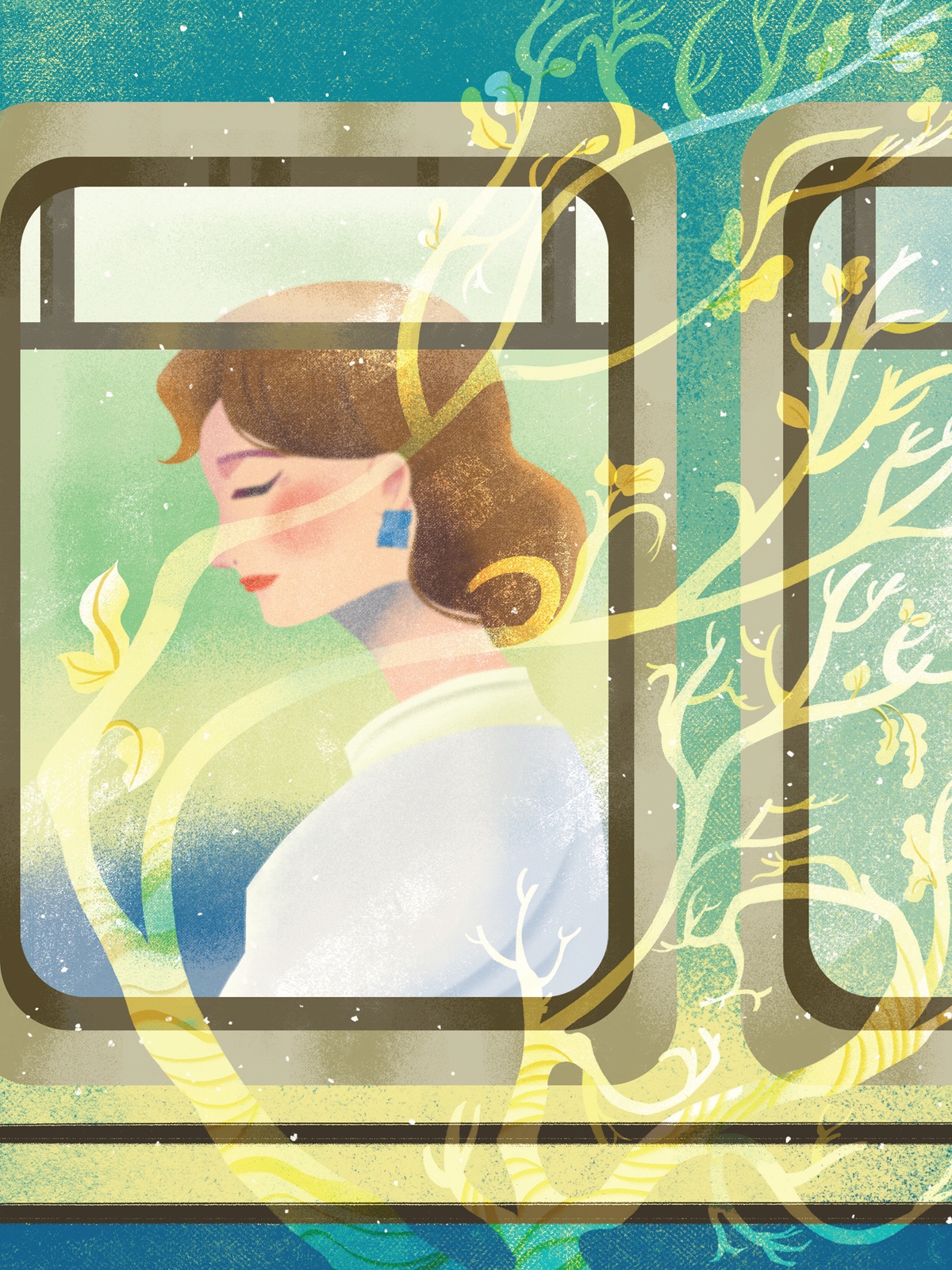
Illustration by Kristen Huang
The first time he phoned the house, Katie was at work, helping old folks in and out of bed at the rest home. She found the scribbled message on her return. When the phone rang again, she asked her husband to pick up. And then her oldest son. It used to be her father who got these calls, once a month, dependable as a full moon. And he would go, drop everything and drive the two hours down to Windsor, somewhere around the docks, to give Anthony the money he said he needed—to pay rent, to relieve a debt, to jumpstart his cigarette business, to buy food. But a year ago, their father had died, and Katie feared she’d inherited the constant tending to the prodigal son.
Katie was not their father. She could barely keep her own family housed and fed. Dan had been out of work for years, his days spent sprawled in front of the TV or in bed, burrowed under a jumble of blankets, while Katie prepared the kids’ lunches, bustled them off to school, got herself to her miserably paying job, did the shopping and put dinner on the table. She, the feminist, the believer in equality, in justice. But life wasn’t that simple.
Anthony, she was sure, never considered any of that when he dropped his quarters into a public telephone and punched its buttons. He thought everybody was better off than he was. Which they were, actually. Because for all her predicaments, Katie’s life and accomplishments shone beside her brother’s endless failures. Their older siblings had cut all ties. Even their mother had given up. They blamed Anthony for the pain he’d caused. But Anthony had endured his own share of pain, a far larger share, in Katie’s opinion, even if much of it was self-inflicted. He was little more than a child when the trouble started. She was a child herself and had seen it all through a child’s eyes. And since nobody ever talked about Anthony, her memories were all she had to go on.
Those memories told her that once they’d been close, that when she’d climbed one of the fat beeches in the wood behind their house and gotten stuck, he’d come to her aid. She couldn’t reach the foothold of the branch below her, so Anthony had climbed up and guided her feet, holding her heel in the palm of his hand, supporting her weight, as he lowered her toe to the branch he sat on. He’d done the same for the next branch and the next, until she was able to shinny to the ground on her own. It wasn’t the only time he’d rescued her.
So when she heard the phone again, and she could find neither her son nor her husband before the third ring, she picked up.
Now here she sat in a padded red-leather booth in a roadhouse outside Thamesville. She’d come down on a Greyhound, an hour’s ride through the autumn colours and pancake-flat fields of southwestern Ontario. Meet you halfway, Anthony had said when he’d phoned, and then he laughed at his own joke. She didn’t tell her husband where she was going—secret rendezvous every few years with Anthony were part of her and her brother’s spotty history. Nor did she know herself exactly why she’d come, except that Anthony had asked her. Everybody needed a little help now and then, and she was good at that. Helping. A memory came to her as she scanned the wildlife photographs hung at intervals along the roadhouse’s walnut-stained walls. She was sixteen, maybe seventeen. Anthony had called. For money. And because their father wasn’t home, he’d asked her to come, to meet him halfway, at another roadhouse, thirty minutes east of London. Of the visit itself she recalled very little except the dim lighting, the padded red booths and the restaurant’s dark walls. He must have asked how she was. He always did. But of their conversation nothing remained. She couldn’t even, as she thought about it now, remember how much money she’d given him. It made her wonder how many other memories she’d misplaced along the way.
The glass door leading into the restaurant opened, and she saw him: heavier, greyer, his short-cropped hair just long enough to cover the scar she knew was there. As he entered, he said something to the waitress, who brought her order pad to her lips to hide a smile. Always the charmer. Katie waved and stood as he approached and gave her a bear hug. Then they sat, Anthony laying his thick hands on the table’s wooden surface, the homemade—jailmade—tattoos that spanned his knuckles just legible:
LOVE
HATE
“Tell all,” he said. “How the hell are ya?”
She recited her children’s latest: Chris was in his last year of high school and looking at colleges; Tanis had just started the recorder; Billy loved baseball—thank God—hockey broke bones and the bank. As she spoke Anthony gazed past her, toward the waitress, she imagined. She didn’t tell him the pride she took in having blazed these very ordinary paths for her children.
“And you?” she said. “Seeing anybody?”
“I’m in between. Between girls. Between jobs.”
“Not between houses, I hope.”
“I got a place. Disability pays the bills. Some of them.” He examined his knuckles. “How’s Dan?”
“Same, same. Nothing ever changes with us.”
The waitress appeared and they both ordered coffee. Katie watched Anthony empty two creams and four packets of sugar into his. She took her coffee black.
“You still bootlegging?” she asked. “What was it? Cigarettes? Booze?”
“Ha. Too old for that shit. Last time I went over, you should’ve seen it—no headlights, black as sin on the river, jackass skipper gunning it. I thought we’d both end up on the bottom. Fish food. No more, I says. The reflexes are shot.”
He’d had an aneurysm rupture a few years back, delayed payment from a prison beating a decade earlier. She’d gone with their dad to see him after they opened his skull to drain the blood pooling around his brain. The surgeon told them he might die. But Anthony was tough and made a full recovery—except he was slower now. Slower to take offense, slower to raise his fists, slower to throw the first punch. Slow enough to realize he should just walk away.
“But if you need any pharmaceuticals,” he said. “Dan’s on meds, isn’t he? I can get you a good price. Just ask.”
Katie was trying to remember how much Anthony knew about Dan. She started to laugh.
“What?” Anthony said.
“Remember when you two first met? Dan walks over, hand out, all eager to finally meet his brother-in-law. ‘How do you do? I’m Dan,’ he says, and you say—”
“How do you do, I’m a son of a bitch.” He shook his head. “It never gets old.”
“It’s so dumb.” But she kept laughing.
“When was the last time we had a good sit down? Just you and me. Maybe that time you came to Milhaven? I didn’t think they’d let you visit, but the guard must’ve had a thing for you.”
“Or for you. You always were a sweet talker.”
She’d never asked him what it was like. Prison. Solitary. But she listened and held on to what she heard. He was fifteen the first time they locked him up—not juvey, the real thing—never to return home. Twenty-five years later, he was still the guy the police kept tabs on, his the first door they came to when anything disturbed the peace. If they found him stumbling blindly down the street, tripping into pedestrians, they’d arrest him on a D&D instead of calling an ambulance. That’s what had happened with the aneurysm. He lay unconscious on a cell floor for four hours before anyone realized it was a medical emergency. There seemed to be no expiry date on punishment in his life.
“Tell me more about you,” he said. “How’s work?”
“Well, it’s work. You know. I’m still at the nursing home.” She took a serviette from the dispenser and placed it under her cup to absorb any spilled coffee.
“No more dreams of joining the circus? You wanted to be a lion tamer.”
“I think the closest I ever got to a dangerous animal was that time we snuck into Phillips Farm and the bull charged us.”
“It was a cow.”
Katie laughed. “A very scary cow. God, those things are big.”
Next he’d be talking about her thumbsucking. Or the time a swan attacked her and he scared it off with a stick. They’d distilled the messiness of their lives into this: a handful of stories they repeated to each other every time they met. Or were the words placeholders for something else? She liked being here, listening to him, watching the way he turned his coffee cup round and round. It was probably cold by now, the coffee, his cup still half full. He moved it to one side and again placed his hands flat on the tabletop.
“Does he ever hit you? Dan?”
She recoiled into the padded seat. “Where did that come from?”
“Dad said you left once, with the kids. And that Dan has mood swings.”
Katie didn’t want to talk about Dan. How mean he got when mania took hold. The times she’d slept on the floor of the kids’ room, her back against the door, to stop him bursting in and berating her or wanting sex or weeping and pleading and pouring his sorrow all over her at three in the morning. The following day, she’d pack the kids off to a neighbour’s and face him alone, absorbing the cutting words, keeping it together, until she could get him, somehow, into hospital.
“He has a disorder,” she said. “But no, he doesn’t hit me.” She sipped her coffee and returned the mug with care to its saucer. “Dad used to hit you.”
It was Anthony’s turn to lean back against the padded red leather. He folded his hands in front of him, the words on his knuckles pointed right at her.
“I was a handful. That’s how it was back then.”
“You were a kid.”
Anthony was quiet. The distance across the table had grown. Here they were, two people who’d eaten every meal together, walked to school together, made blanket forts, argued over stupid things only to forget them the next day, defended each other, lied for each other. How could two people who’d gone through so much, who shared so many memories, good and bad, reach the point where conversation stops?
When they parted, they promised to meet up again soon. It was exactly what they’d said after their father’s funeral. She climbed onto the bus and settled in, her eyes turned to the horizon, heavy with rain. It wasn’t until the bus was halfway down the highway that she realized Anthony hadn’t asked her for money. Perhaps he hadn’t asked that night when she was seventeen either. She watched the rain spot the window and the sky turn dark—it was going to be a bruiser of a storm and she wished she was headed anywhere but home.
RUTH TAYLOR is a writer and copy editor living in London, Ontario. Her short stories have appeared in The Dalhousie Review, The Massachusetts Review and Potomac Review, among other journals. In 2024, she won the Penguin Random House Student Award for Fiction. Her first novel will be published by Guernica Editions in fall 2026.