Mean Girls meets horror
Ava Maria Safai’s Foreigner confronts the immigrant nightmare
Sarah Regan
What does it mean to be Canadian?
That’s the question Iranian Canadian filmmaker Ava Maria Safai was presented with while completing her application for Telefilm Canada’s Talent to Watch program—a funding initiative that supports emerging filmmakers in producing their first feature. As part of the process, she dug into the archives of previously funded projects and noticed a pattern.
“I looked at past films as a reference point and saw a strong emphasis on immigrant and first-generation trauma,” Safai says, “and a lot of movies about Iranian culture are about that.”
Determined to move beyond these limiting representations and create something more fun and accessible, Safai took a different approach. “Especially at a time like this, I felt it was really important to flip that concept on its head and explore a campier angle,” she adds.
Blending bubblegum horror with satirical coming-of-age, Foreigner—Safai’s engagingly self-aware feature debut—explores the painful, sometimes absurd pressures of cultural assimilation and teen conformity, all while staying true to that vision.
The film was screened at Vancouver’s Gender Equity in Media Festival [GEMFest], a film festival dedicated to amplifying the voices of women and gender-diverse creatives, in March, and continues to be showcased at various events. Safai says watching the film at GEMFest with an audience it was made for—women, especially women of colour and Persian women—was a special moment.
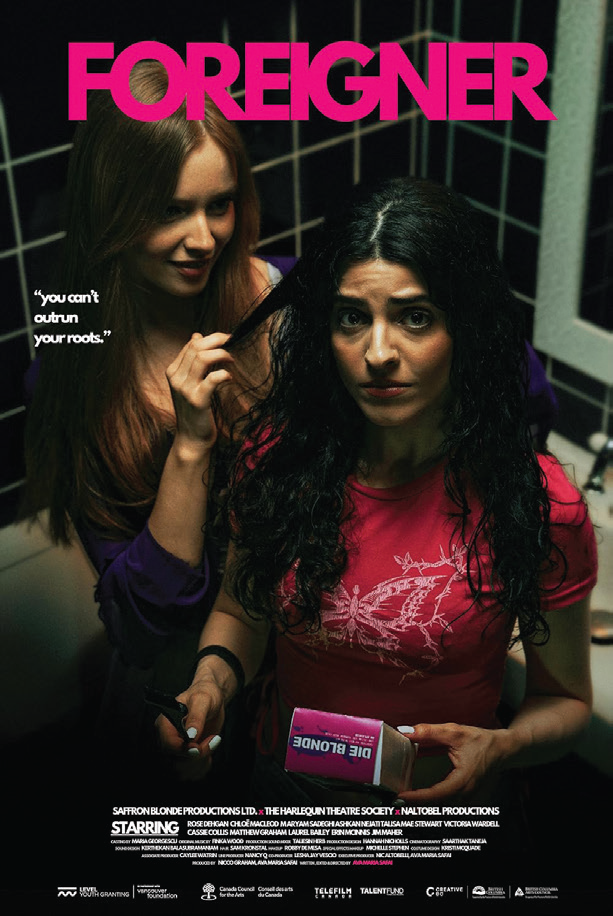
Set in a nostalgia-drenched early 2000s, and described by reviewers and film festivals alike as Mean Girls with an edge, Foreigner follows Yasamin (Rose Dehgan), a 15-year-old Iranian immigrant who desperately seeks belonging at her new Canadian high school, drawing from Safai’s own experiences growing up.
“I think every first-gen kid has a story similar to Yasamin’s,” Safai says. “Growing up in a Farsi-speaking home, where you eat kebab, drink tea, and talk to your relatives on WhatsApp (if you’re able to reach them), and then you go to school and speak a completely different language, and there’s a lot of different social norms.”
“That’s the basis of it,” Safai continues, “but then really stylizing it, hyperexaggerating some moments in my life where I was met with microaggressions or assumptions about what it means to be an Iranian person.”
This creative approach comes into sharp focus through Yasamin, who—despite clearly recognizing the ignorance and ridiculous suggestions of the doppleganger-esque queen bees at school, ruled by the comically vicious Rachel (Chloë MacLeod)—takes extreme measures to fit in by dyeing her hair blonde.
“You can read English, right?” Rachel asks, offering Yasamin a box of drugstore hair dye and questioning whether she can follow the instructions.
It’s a transformation that comes at a cost, with Yasamin unwillingly awakening a sinister force bound to the parts of her identity she longs to erase, bringing in a supernatural element that operates on both literal and metaphorical levels. Safai draws inspiration for this from the Zār—a cultural phenomenon and form of spirit possession common across the Middle East and North Africa—grounding the film in rich significance.
“I read a lot of papers about people immigrating to other countries or areas, and bizarre occurrences would start to happen, like speaking in tongues, banging your head against the wall, feeling out of body or not in your own skin, so those were themes that I wanted to talk about,” Safai explains, adding that the erasure of Persian women is deeply tied to the Zār.
What began as a stylized presentation of identity has since gained new resonance, deepened by the heightened repression and resistance in Iran—a reality that made Safai emotional at her GEMFest screening.
“When I watched Foreigner at GEMFest, with everything happening in Iran, it was the first time I cried watching the film,” she says. “It means more now than it did when I wrote it because so many Persian lives are being erased on every front—you come here, you try to change yourself—erasure. You live there under a brutal dictatorship—erasure.”
Foreigner is not only the movie Safai set out to make as a filmmaker, but, in her words, “the movie that I didn’t know I needed,” and one she hopes will be just as meaningful for audiences.