David and the train
The train went by, with Ben seated there on his bike, staring after it
Jackson Weaver
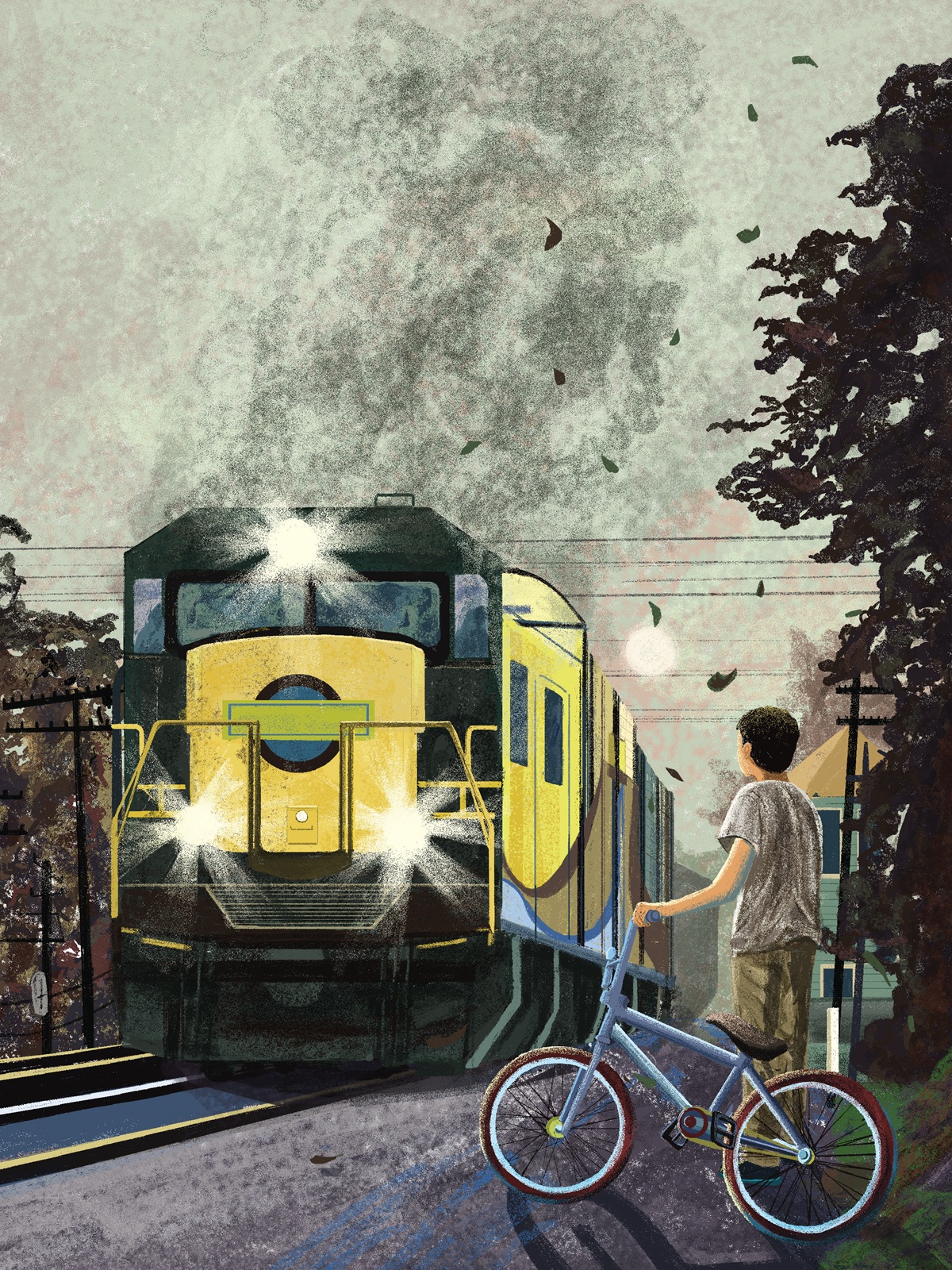
Illustration by Teddy Kang
Ben wandered past the bedroom. Inside, he could hear, his mother was helping the boy get dressed. Snaking his ankle down through the cuff of the jeans she’d pooled on the floor, cajoling him to raise his arms and draping the sweater from his own closet over that other boy’s chest. Disgusting, really—needing help with something so simple. They were cousins, though gladly by marriage, not blood. He’d been dressing himself for years now; at 10, he was more grown-up than not, he reckoned. Sure, there were things he would still learn: fractions being one, or what makes up a barnyard pellet and how exactly to reconstruct the bones of the vole inside. But these were subtle things, details, background information. Like his father, gone now, told him two summers ago, gold-tan arms wrapped round the bags of concrete even still stacked in forlorn piles in their somehow still unfinished basement: There’s no need to think so much. His future was a steady path, laid right out before him, that he merely had to walk down.
It was a comforting, instant flash of his future: a heavy, hard and simple thing that rested like cool iron in the palm of his hand. He knew the path he would walk. The idea of a fundamentally different traveller walking that path, grown in any way but height, had not even occurred to him. Frankly, he knew, the idea couldn’t even exist.
What could exist were the noises behind the bedroom door, which he now stepped lightly back to. Pressing his ear to it to listen. Balancing expertly on socked toes to hear without giving away his position:
…she really doesn’t like many people, you know. You hadn’t found her in the street before, had you?
The ‘she’ was Ben’s tabby, Ploc, he could tell. And it was true; unlike her twin, Plic, she acted allergic to anyone not a member of their household, and often even to them. After the boy arrived though, tripping over himself in the doorway and making such a racket it sent Ploc running from her spot on the windowsill into the basement, she had eventually ventured between his stomping feet. She brushed herself like a loving eel between his ankles, humming and rumbling away as if she were his best friend in the world. As if Ben hadn’t only just emptied the litterbox of her hard black nuggets the night before.
But worse was what the boy had said after, he and Ben’s mother giggling through a shared joke Ben didn’t see the evidence of and didn’t really care to look for.
Looks like you tamed her right-up, his mother said, laughing dead-eyed with fingers pressed to her mouth.
Suddenly solemn, the boy had started his parlour trick right there and then, not even halfway through the foyer.
Cats actually are a tame species, he said, pushing his chest out at Ben’s mother, presenting the buttons of the jacket she then started unbuttoning. They can care for themselves without humans, so they’re not domesticated. Cats can hunt if abandoned. Domesticated animals like dogs have to go feral first.
Well, isn’t that just the most—
She didn’t need to finish the thought, or maybe couldn’t. Instead, she lightly clapped her hands, held them under her cheek as she looked at the boy looking up at her. He didn’t seem proud of impressing her, instead just seemed stuck between the acts of being dressed and undressed. This, Ben thought, despite him being what his mother had already described as a genius. He had suspected it already, but it was in that moment Ben knew: he hated the boy.
It wasn’t the end of his tricks. No, unfortunately it was only an hour later that he was playing his cello; a great screechy thing that looked older than even their house. It was worth nearly as much, if not more, according to his mother. She sat on the couch with her hands pressed together, listening to the song that sounded to Ben like nothing more than indiscriminate wails, random thumps and noises not unlike Ploc’s loudest protests when he accidentally stepped on her tail.
He grunted. His mother elbowed his side.
It sounds like ass, he said.
It was actually a phrase he had just picked up—an insult recently hurled at him that fascinated like the reflecting light inside a diamond. That he’d turned over and around inside his mind so long he half expected similar appreciation, a giggle or at least grunt of approval.
But all that happened was the high note of his mother: a piercing Benjamin! followed by another silence and then more words he understood the feeling behind more than heard the syllables of.
After that it was his foot swiping out at a glass on the table, which flew balletically across the room to shatter just in front of the boy, now posed statically, pathetically there. He barely even reacted, beyond a partial move toward the instrument, as if to protect it in the minor seconds before the glass landed feet away.
Ben, despite himself, was impressed. He himself was very conscious of how hard it was, how unnatural, to continue slouching with his arms crossed and heel digging into the table as his mother continued to shout louder and sadder.
Eventually, he lurched up from where he’d begun to sink into the couch, and half-stumbled across the carpet as he remembered at the last moment about the broken glass. He momentarily thought about stepping forward, pictured the red blood spilling from his foot, his mother’s worried shriek and the other boy raising wondering eyebrows. The blood spilling from a gash half an inch—no, two inches across. The pulsing of blood like from David’s arm last year. When Ben and that boy, a neighbour Ben paid little attention to except as an occasional audience, rode their bikes around the overgrown fence in Ben’s backyard.
They weren’t allowed to go back there, something David had quietly tried reminding, but Ben liked the wide-open space cut between the sides of forest. His father had showed him that path, where you could look up to the sky that went on forever, or down the way to where the train tracks curved off in the distance in both directions. A place where the distant rumbling of the coming train felt like the hum of an ancient giant, the dull grumblings of some great and terrible god come to wipe them all away.
With David standing there, unsure and anxious by the gorse Ben would otherwise be peeking out of, he’d felt a surge of something warm, bright and golden hit him. Impulsively, he’d walked out past the dusty slope of the hill, skittered over the gravel and shale and stood in the middle of the track, hearing and feeling the rumbling from down the way as he stared down the infinite.
For half a second, for a brilliant moment, he’d felt something he’d never felt before. He couldn’t put words to it, as its brilliance mostly rested in the temporary absence of thought, a glorious quiet he’d since come to compare to his imagined memories of the womb. But instantly after, like an eye-blink of heaven, the train rounded the bend. The angry metal and sudden all-consuming scream of the engine filling the space between his ears. Of the beating, pumping, thrumming motion of the engine. Of the fear and enormity and permanence he thought, unbidden, of something he could not understand.
David sprung up silently then, grabbed the collar of Ben’s shirt and pulled him tumbling down the hill, held a paternal arm over his head, protecting him despite the fact that Ben was seven months older and a whole grade above at school, only with the younger boy because he had deigned to allow him to discover this ancient and secret and dangerous thrill that until this moment had belonged only to Ben.
But as they cowered in the bushes, Ben hiccoughing up sobs that only became obvious to him once the train’s heavy roar began to fade out to the far side of the cut, he felt smaller and more afraid than he ever remembered, than he’d ever felt possible. It wasn’t until he stood—until he saw David’s torn arm, the porcelain muscle below porcelain skin that filled with purple-red blood to the slow beating of his heart, the jagged wound that David looked at with the calmest, strangest curiosity; until David himself was the one to tear a strip from his shirt and tighten it with a stick around his bicep, guide him hobbling into Ben’s kitchen for his mother to call an ambulance as Ben heard David lie so simply, so beautifully and directly that he had cut himself while just running past an unfortunately positioned tine of the chain link; until Ben had that moment drifting above himself, to first experience the collar-hot sensation of seeing himself and his shortcomings and his fears from outside and look fearfully and dreadfully and uncertainly at the train bearing down until it consumed every inch of his vision and filled him with a buzzing and pointed blackness—that he could question how David was different than him.
But David was gone now, moved to Europe or Mexico maybe as Ben listened to the rumble low in his feet now. Now, as the worry about the pain of broken glass made him stumble. As his mother warned Careful! and her arms shot out toward the cello the boy was already defending, that was too far away for her to do anything to protect anyways.
But he was already down the stairs, down the hall, down the back path to the backyard. He was opening the garage door, pulling his bike from the cobwebs without even squirming. He was around the dirt path, winding up and around the fence gate; up, up and over the first hill, around the second. The rumbling, growling, sputtering spitting was coming up through the pedals, through the dirt, into his feet. He was over the steep dirt rise beside the track. He was seated on his bike, foot kicked out with the frame leaning over, one leg propping him up as he heard the train bearing down. As he readied himself. As the roar built up into a kind of penetrating, shoring mass.
The train went by, with Ben seated there on his bike, staring after it.
It was 10 minutes later when he came back, walking the bike like a tired horse through the curved trail back into his backyard. He entered the yard, looked up. The boy was in the window, his window, looking down at him as if he’d been expected.
Ben dropped the bike in the yard, left it where it lay and walked into the living room. The boy’s instrument was in its case, lying on the ground near a dark, damp circle on the carpet.
Ben went upstairs, didn’t even look at the boy sitting on his bed as he entered. He simply lay down on the floor, staring up at his ceiling, and waited for the boy to tell him something he didn’t want to know. Maybe that trains all weighed precisely 340,000 pounds. Or that cats can fly on certain Wednesdays.
The boy didn’t say anything. Instead, after Ben lay down, he stood up from the bed, walked over, and sat down. Cross-legged beside him, looking at the shelf on the wall as Ben continued to look up.
They sat, silent, for a while. Eventually, the boy walked to the shelf, examined in his hands the rusty, cold wrought-iron railroad pin resting there that Ben himself hadn’t moved in a year.
It was my dad’s Ben said, and the boy nodded as if that was somehow enough, put it gently, reverently back and sat once again beside him in their delicate and shared and intimate silence.
Ben turned. The boy was still looking ahead, untroubled, Ben’s too-big sweater swallowing his chest. The light from the window behind lit up his hair, going through and lighting up the blonde curls going so wide and crazy around his head. Bright enough to highlight the gemlike flecks around the black part of his eyes. He’d never known someone with green eyes, never seen how the brown and emerald shards could bleed and break over one another. He felt himself falling into them, lost inside the reflecting light so bright he worried he’d stopped existing. And his, he couldn’t stop from thinking, were simply brown.
This, he suddenly realized, was a new thought too. Though it didn’t feel so black, so rough as before. He instead examined it as he’d examine anything else; carefully he held it in his hands, in his mind, as he considered what it meant.
You could come to my concert, the boy said. I have extra tickets.
Something shattered then. Ben didn’t know why. In fact, despite the turning, whirling, spinning his mind would do over the rest of his life, he would never know. Standing from the floor, moving out of the bedroom, walking, then running down the stairs; smashing into the wall as he turned into the living room and then standing in front of the case, ripping it open so it thumped in its great cavernous voice, stepping on and through it so the splinters screamed into his thigh and into the air around him, he was soon staring down at the hopelessly broken thing.
He wasn’t sure. He was backing away from it and hearing the garage open as his mother backed the car in, and he was gone, gone down the stairs and round the hallway, gone into the recesses of the grim black basement, smelling of wet, smelling of dirt and mold and all the evil of the dark. And he was moving forward with his hands out, guiding, leading him through the blackness as his eyes adjusted to the cryptlike dimness, he was finding the alcove space where the concrete half-wall his father never bothered to finish building led to a space where Ploc could hide with eyes wide black and sightless. He was crawling back there, back into the inky black space and feeling the dirt and the soil and the black with his hands and not even aware enough to be afraid: afraid of the dark, of the cold, of being alone where the light and the sound would not and could not find him.
He was pushing himself further back into the cold, cold den and hearing nothing but the flurry of his breath, the screeching of his fingers, then the quiet of the bottom of the house, the dim, dim footsteps and the echo of shouts and perhaps a cry. He was hiding there and waiting, wondering, turning the moment around in the wide open and empty space of his head for the first step of those that would become the rest of his life. He was wondering which wrong ways he’d gone, wondering why he shrank down there in the dark, wondering which wrong steps he’d taken and, shivering in the cold, counting all the ones gone on him now.
JACKSON WEAVER is a writer and journalist living and working in Toronto.