Speaking Tanglish
Embracing my struggles with my family’s language helped me find a new way to define identity
Nuthanan Tharmarajah
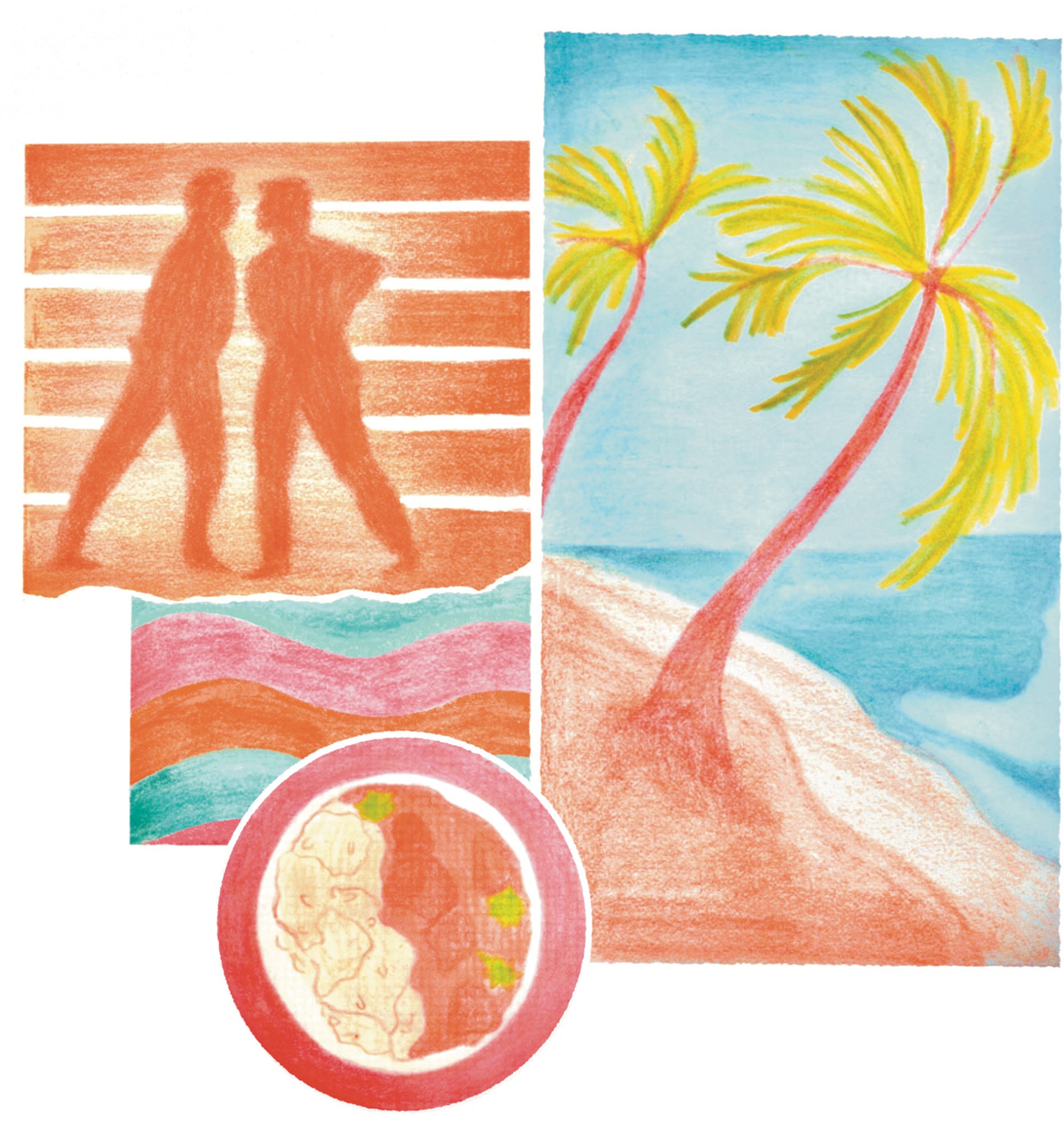
Illustration by Moe Pramanick
I hate speaking Tamil. It’s one of the oldest languages still spoken today, dating back to at least 450 BCE, and I’m proud it’s part of my life. It’s the language of my parents, who fled Sri Lanka’s civil war (1983–2009), a conflict that left hundreds of thousands of Tamils killed or displaced. The language is important to me, but I’ve never felt fully at home in it.
Growing up, being Canadian felt normal—from eating
pancakes with maple syrup to enjoying the rights we have
to trips to the movie theatre. It wasn’t until Grade 5, when
I was working on a heritage project on Sri Lanka in school,
that I realized how fortunate I was.
I was excited for the project. I loved geography and considered myself an expert in world flags. However, my interest slowly began to fade when I came across an entry in an old encyclopedia about Sri Lanka and noticed that Tamil was not listed as one of the official languages. I was confused and lost.
I quickly turned on the computer at my elementary school, typing in “Tamils in Sri Lanka,” desperate to understand. That search exposed a brutal history marked by tragic struggles and the loss of countless Tamil lives during the Sri Lankan civil war. I felt a pit in my stomach as I stared at the screen, knowing that halfway across the world, Tamil Sri Lankan children did not have the same educational opportunities that I had at that moment. I realized that behind the pretty trifold board I had created about Sri Lanka lay a deep and complex history shaped by thousands of years of struggle and resilience amongst the Tamil population.
Since that search, I’ve understood my privilege as a Tamil Canadian. It made me more motivated to advocate for Tamil struggles and accomplishments. But one problem remained: knowing the language.
Balancing between two languages was a challenge. I went from hearing the Tamil language at home under an aroma of chai, to the bustling use of English everywhere else I went. Something about Tamil never felt right. Maybe it was the constant exposure to English at school and in daily life, or maybe it was just easier to fit in that way—but somewhere along the line, Tamil started to feel unfamiliar, even though it was my first language. I didn’t like talking to my parents at home in my native tongue, because I could never group words to make a succinct sentence.
Nonetheless, I’ve always felt an inclination to at least try to learn the language to stay connected to my identity. When I visited Sri Lanka for the first time in 2021, at 15, I remember sitting under a palm tree and being forced to talk to one of my grandfather’s brothers, who explained in Tamil that, as a result of the civil war, mass immigration waves to economically developed countries caused people to lose their ability to communicate with their elders. In an instant, I felt a sinking guilt in my stomach, thinking, “I’m losing my culture and my roots.”
Since then, I’ve tried to learn how to express myself more in Tamil, but I still struggle to piece together sentences. I always insert English words for words I just can’t translate. My cousins call it “Tanglish.” My accent is still off, and I’m forced to go back to English in frustration, knowing I just can’t get it right. In these situations, I feel like I have to learn the language or risk losing the culture I’m trying to hold onto.
Despite the fact that 238,000 people speak Tamil in Canada, sometimes people say things like, “Well, you’re bound to be okay, I mean no one uses Tamil in Canada nowadays.” Every time someone says that I feel like I’m descending a long flight of stairs, losing every single part of who I am as I go down.
During the same trip to Sri Lanka, I remember eating a staple Tamil meal of rice and goat curry at one of my athai’s (older aunt’s) houses. After we finished eating, she asked me if I wanted some coconut water. I said, “illai illai, I’m okay,” meaning “no no, I’m okay,” but because of the language barrier, she misunderstood “okay,” thinking I meant yes, I wanted some. She brought it, and guilt hit again: if I knew how to communicate in Tamil, I would’ve been able to respond accordingly.
How am I supposed to develop a strong understanding of and communication in a language if I can’t even say anything right and am forced to resort to English? Am I the generation that will break the chain of this ancient language? I’ve felt confused and worried about this my entire life.
It wasn’t until last year, in my first year of university, that I realized that there are other ways to stay connected to my Tamil identity. I joined the Tamil Networking Association at the University of Waterloo, thinking it was the golden key that would get me back in touch with that part of myself. However, to my surprise, hardly anyone spoke Tamil.
Instead, we just played a couple of games as a start-of-term bonding activity. We played Guess the Tamil Song: if you knew the tune, you ran to the middle and named it.
The first song was called “Nee Indri Naana.” I’d heard it many times on family road trips, when my parents played their favourite CD of Tamil songs while we headed to our destination. I rushed to the centre, guessed the song, and got a point. The process kept repeating: I knew most of the songs.
At this moment, I realized something. Language isn’t the only thing that holds my identity. My experiences also shape who I am. And through these experiences, I aim to educate people about the struggles and resilience of the Tamil community. Language doesn’t define me; my character, my culture, and the people around me shape who I am.
Tanglish, I’ve come to realize, isn’t a failure of language; it’s a testament to survival. I haven’t lost my identity. I’ve just been shaping it, word by word, experience by experience.
NUTHANAN THARMARAJAH is a second-year software engineering student at the University of Waterloo with a passion for coding, public speaking, and staying connected to his Tamil heritage. He has family across five countries and always has a guitar nearby. He spends a lot of time building apps, and “Speaking Tanglish” is his first published piece.
MOE PRAMANICK is a visual artist living and working in Toronto. She is guided by a commitment to the city as a living thing, and an aspiration to capture her people within it as beautiful, funky, in rhythm and in resistance. Moe's practice includes drawing, painting, public art and workshop.