Interrogating the Indian Act
Why the Act is still around, and what needs to change
Evelyn Ullyott Hayes
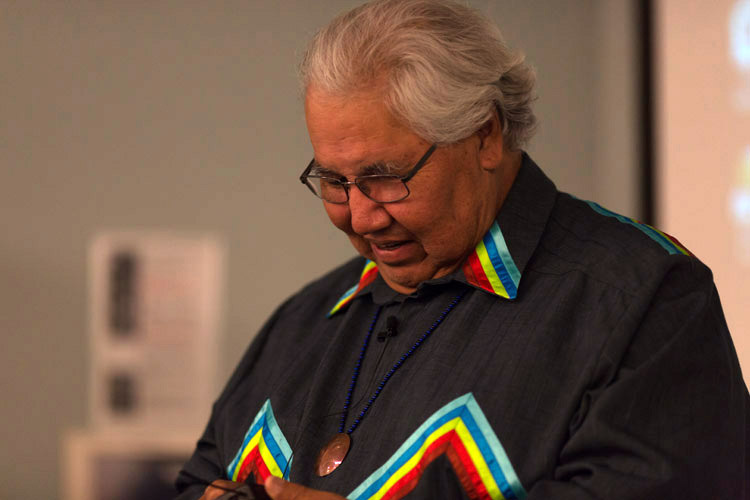
Murray Sinclair during the opening keynote of the Shingwauk 2015 Gathering. (Archkris via Wikimedia Commons, CC BY-SA 4.0)
Governing everything from band leadership to land management, the Indian Act continues to shape daily life for many Indigenous people 150 years after it was enacted. For many Indigenous leaders and scholars, its enduring framework remains a barrier to self-determination.
On April 12, 1876, the Act to amend and consolidate the laws respecting Indians, soon known simply as the Indian Act, became law in nine-year-old Canada. The law grew from more than a century of British and colonial policy, with roots in the creation of the Indian Department in 1755 to manage alliances between Great Britain and the Iroquois Confederacy and maintain neutrality with France’s First Nations allies during the Seven Years’ War. These relationships were codified in King George III’s Royal Proclamation of 1763, which asserted the King’s dominion over North America and established the protocol for treaty-making between the Crown and Indigenous representatives. The 1876 act consolidated the succession of laws and patchwork of treaties governing Indigenous peoples. Senator Paul Prosper, a Mi’kmaw lawyer with over 25 years of experience in Indigenous legal issues, says it still affects how governments and settler institutions approach Indigenous people, imposing paternalistic oversight and external management over Indigenous self-governance.
“The Indian Act was created as a way to control, diminish and assimilate First Nations into the Euro-Canadian populace,” Prosper says. Assimilation under the act meant eradicating Indigenous cultures. This process started with replacing people’s names with European ones, then widened to suppressing cultural practices such as the potlatch ceremony. Women were added to their husbands’ bands, while those who married non-status men lost status—a restriction that has since been removed, but the harms of which still affect Indigenous women and their children today.
Among the act’s most destructive legacies is the residential school system, established in the 1880s and now acknowledged as an act of genocide. Before the act, children were educated at schools on reserves, but in 1920, the act was amended, making attendance mandatory for all status children and allowing government agents to seize children and arrest parents who resisted. Thousands of children died or disappeared. Violence, abuse and neglect left lasting scars on pupils and their families; Indigenous health experts believe intergenerational trauma will affect six generations. The schools, the last of which closed in 1997, were established far from children’s families and communities in order to impose Christian beliefs under the guise of education.
“The schools were not about education,” said then-Justice and Truth and Reconciliation Commission chair Murray Sinclair, speaking at the Commission in 2015. “The schools were about indoctrination.”
While it is well known to be both sexist and racist, the act remains largely intact, in part because it defines the legal relationship between Indigenous peoples and the government. “It’s not an easy task for First Nations to fully extricate ourselves from the Indian Act,” says Prosper, explaining that many present-day institutions are linked to it, including chiefs and councils. The act broke apart traditional territories and drew new boundaries when it created new reserves. As a result, he says, much repair is required around supporting capacity development, resolving land claims, and ensuring the full transfer of programs to First Nations with appropriate funding.
Many Indigenous people have called for a closed door on the act, abolishing it or replacing it with government-to-government relations based on treaties.
In 1969, then-Prime Minister Pierre Trudeau and Minister of Indian Affairs Jean Chrétien proposed ending the legal relationship between the Canadian government and Indigenous peoples, eliminating the act and status alongside it. Indigenous leaders soundly rejected this idea, which provided for neither Indigenous contributions to policymaking nor treaty rights, viewing it as a means for Canada to both renege on past promises and enact further cultural erasure. Cree leader Harold Cardinal called the proposal, which was withdrawn in 1970, a “thinly veiled programme of extermination through assimilation.”
The act continues to cause harm. Prosper believes that “there is no greater existential threat to First Nations than the second-generation cut-off,” a rule in the act that limits who can pass status on to their children. Amnesty International condemns the cut-off, which it says will spell the legal erasure of First Nations unless the act is amended.
Douglas Sanderson, the Prichard Wilson Chair in Law and Public Policy at the University of Toronto and member of the Opaskwayak Cree Nation, says reform or repeal isn’t easy. “The Indian Act is necessary,” he writes, “because some piece of legislation must govern the settler-Indigenous relationship.” Replacing or abolishing the act, Prosper says, would require a framework to address the gaps that would be left behind. “We are still at the early stages of our true reconciliation era,” he says.