A thinly veiled attack
With Quebec’s Bill 94 and Law 21, Muslim women face an impossible choice
Daniyah Yaqoob
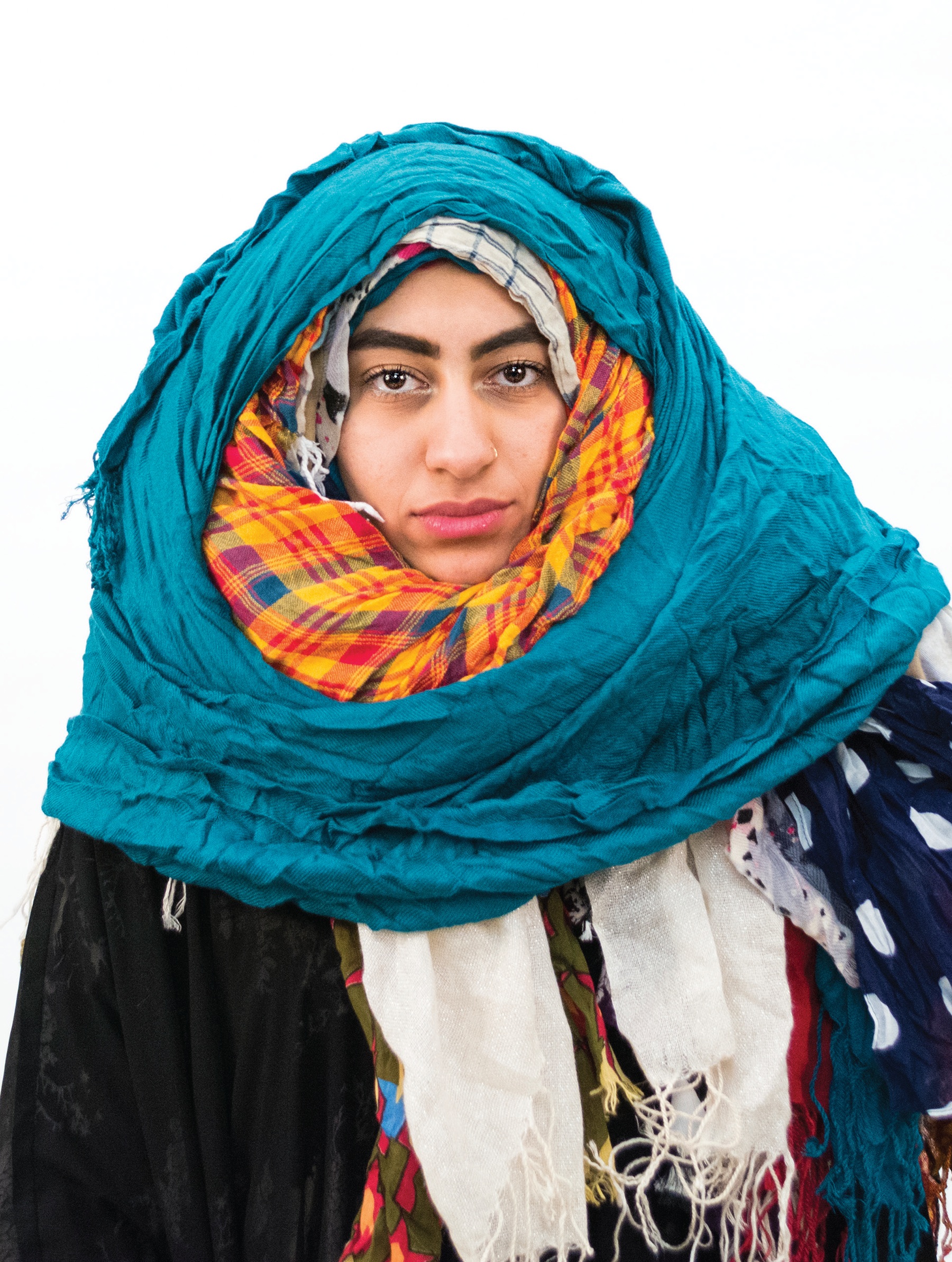
Photo by Durrah Alsaif, QIMASH, 2017
Several times per day, the Adhan sounded from the depths of the Mohammad home. When sisters Salmana Janjua and Sharae Mohammad were growing up in Brossard, Quebec in the ’90s, the Islamic call to prayer signalled that it was time for Ahmadi Muslims in the area to gather in their basement for one of their five daily prayers. On bed sheets laid out on the floor, they formed rows of people. For segregation between women and men, a necessary practice for the Muslim prayer, a sofa made for a makeshift barrier. But their actions, regardless of gender, were the same.
Janjua and Mohammad would watch their aunties and the older girls gather after the prayer, dressed in long coats and confidently wearing their hijabs. Years later, they followed suit, proud of their female Muslim identity.
The cloth that Muslim women wear is a result of the Islamic commandment which instructs them to draw a cover over their heads, hair and chest. To some, the instruction seems oppressive. But for many Muslim women, the hijab is empowering. It’s also a public identifier of their faith. In Quebec right now, however, they’re once again facing a profound problem that’s getting in the way of their right to wear it.
*
Most of Canada seems to have moved on from the long battle for secularism in Quebec. People’s lives, meanwhile, hang in the balance.
In June 2019, the National Assembly of Quebec passed Law 21. The legislation aimed to solidify Quebec’s secularism by banning religious symbols for civil servants in some fields, echoing 2013’s Quebec Values Charter. Muslim women face the brunt. Because the hijab clearly distinguishes them, it’s next to impossible to exist freely alongside the legislation without removing their head covering, quitting their job or leaving the province. All of those options present a painful, and for many, impossible, decision. With a law like this, hijabi women in Quebec will be forced out of the public eye—and making the powerful decision to adorn the hijab will no longer be personal and spiritual, but political as well.
More than 400,000 Muslims live in Quebec, many of them immigrants from French-speaking countries. Nearly 50 percent identify as Muslim women and of that, about half wear the hijab. For six years, those women have felt pushed into a corner by their provincial government, where they can’t stay and also, in many cases, can’t go. Already, one study found that 71 percent of Quebec Muslim women surveyed were considering leaving the province and 73 had percent already applied to jobs outside of the province.
Now, the law is being pulled in two directions. In March 2026, the Supreme Court of Canada will hear a challenge against Law 21 raised by rights groups. Meanwhile, the Quebec government passed another piece of legislation, Bill 94, to expand the religious symbols ban to everyone who works with children in Quebec schools and to ban face coverings for students, a thinly veiled attack on the Muslim niqab (a cloth worn to cover part of the face). It also places a ban on prayer accommodations at schools. More legislation is on its way to ban prayer in public spaces and to restrict offerings of meals that accommodate people based on their religion, drawing outrage.
Though the current legislation doesn’t explicitly single out Muslim women—they are among Sikh people, Jewish people and other visibly religious people affected—social debates surrounding secularism often mention Islam.
“Our identity is criminalized, our practices are criminalized. For what? For a political project, a nationalistic project,” says Zeinab Diab, a refugee to Quebec and PhD candidate researching Law 21. Diab had lived in the province since 1989 before she ultimately decided to leave. She says in the last 30 years, politicians and the media have politicized the hijab to the point that the public became used to attacks against it.
With Quebec’s Law 21, and now Law 94—in addition to the proposed expansions—Muslim women are more under attack than ever for their veils, and are unsure if the pain of being forced to choose will ever subside.
*
The hijab is a critical part of many Muslim women’s identities. It’s a way to adopt modesty, as outlined in Islam’s holy book, the Quran. Whether worn as a hijab, khimar, jilbab or otherwise, Diab says the veil is like an appendage and that the loss of it is violence toward Muslim women’s bodies.
“If I don’t have my hijab on, or my hair showing, I will feel like I’m naked walking down the street,” says Nadia Mahmood, president of the Ahmadiyya Muslim Women’s Association (AMWA). “The hijab is not just an accessory for us.”
Law 21 claims to promote equality between men and women. But in Islam, there already is equity between the two. While women are commanded to veil, men are commanded first in the Quran to lower their gaze and observe modesty as well.
Mohammad and Janjua say they always felt empowered by their religion. Their father, a professor, never made a distinction between them and their brother. He empowered all of his children to seek higher education, pursue careers and be outspoken when they thought their rights were infringed. If someone glared at their hijabs on the metro, they’d stare right back.
When Law 21 was proposed, Mohammad’s father kept assuring their family it couldn’t pass.
Then on June 16, 2019, the gavel struck and Bill 21 became law. The legislation banned religious symbols for teachers, administrators at schools, lawyers, judges and police officers. Rights groups like the Canadian Civil Liberties Association (CCLA) got involved to appeal it.
In Quebec, women make up 76 percent of educators. Given Islam’s nurturing teachings, many Muslim women, including Mohammad and also Areej Siddiqui, a hijab-wearing woman raised in Quebec, are drawn to the field.
After Law 21, Siddiqui decided she couldn’t pursue teaching because it would mean removing her hijab. Now, she doesn’t want to leave the house to work. “My goal is I have to be hidden at home so no one gets offended by me,” she says.
Mohammad, on the other hand, kept pursuing teaching. As a child, she loved filling out the scantrons her father brought home from work. Her siblings only saw her as an educator. Despite the fact that Law 21 fell like an anvil in her last semester of teachers’ college, she pushed through to graduate in 2020.
Mohammad received her first contract right after graduating. But the school gave her an ultimatum: the job or the hijab. Her father told her it would be okay if she removed it—after all, most of her day would be spent with young children. Someone else recommended she could wear her hijab differently, so it didn’t look like one. When she finally decided to remove her hijab to teach, she saw the irony: she taught her students to be themselves while removing a critical part of herself. The contract was the longest two months of Mohammad’s life. And the worst.
When her contract ended, Mohammad was offered another, and found a way to keep her hijab. Some school administrations hadn’t been as strict in enforcing the rules at first. But before winter break, she was called in by the administration. A parent had seen her hijab and complained. Mohammad’s supervisors found a way to keep her on for a little while longer, but choosing between her faith and her career was an exhausting battle.
In 2022, Mohammad applied to jobs in school districts outside of Quebec. Offers rolled in. Her parents didn’t want their youngest daughter to have to leave their home to pursue her dream. But by the start of the March break, she packed up her life and moved to Toronto to teach as a hijab-wearing woman—she felt it was her only choice. “I’m a good teacher,” she says. “I know I was doing a good job.”
Roshan Jahangeer, a research fellow studying Islamophobia at York University, says a wave of Muslim families left Quebec after the fatal 2017 Quebec mosque shooting, when a gunman stormed a mosque killing six Muslim men and injuring others. With Law 21, it’s individual Muslim women leaving.
“It’s the idea that the Quebec government is not going to protect your rights. They’re not willing to uphold even the Quebec Charter of Human Rights, because Bill 21 not only uses the notwithstanding clause, but it also suspended the Quebec Charter of Human Rights and Freedoms,” Jahangeer says. She also says that Muslim women’s visible identification through their hijabs makes them the target of hateful Islamophobic actions first.
When Law 21 passed, Diab immediately decided to leave Quebec. As a hijab-wearing woman, she felt afraid and anxious thinking of her daughter wearing the veil in the province. Every day as a Muslim woman in Quebec felt like a fight. She decided to study the legislation for her PhD through the University of Montreal, but she based herself in Seattle, where she felt it was easier to practice her individual right to religious freedom.
Throughout the course of her PhD research, Diab concluded that Law 21 was the “social death” of Muslim women in Quebec. They are forced to lose their identity, lose their sense of belonging and forced to tear a “body extension” out.
Now the law is beginning to shape the attitudes of average Quebecers. A survey by Angus Reid found that 52 percent of people in Quebec hold an unfavourable view of Islam, compared to the rest of the country where a still-alarming but less-whopping number of people (39 percent) have an unfavourable opinion. The survey also found that 45 percent of Quebecers don’t support wearing the hijab in public places—even though “public spaces” are not a part of Law 21.
Siddiqui has worn a head covering since the early 2000s, when girlish jersey instant-hijabs were in fashion. She loves to express herself now through patterned fabrics, recently getting into khimars which cover her from head to waist. But often, she gets stopped on the street and interrogated. Strangers tell her that, legally, she cannot profess her faith on the streets of Quebec. She’s been followed and badgered to take her hijab off. She has accepted that glances and remarks are part of the experience as a hijab-practicing Muslim in Quebec. As long as no one spits at her, she says, she’ll be okay.
Mahmood, the AMWA president, says there is dire need for education in Quebec on the relationship between women and Islam. She warns that if Quebec’s government continues this way, more injury is yet to come.
*
Quebec’s government is already trying to expand Law 21’s scope. Law 94 is the province’s most recent attempt to “reinforce” secularism—since it’s passed, more staff in schools beyond teachers will be required to remove religious symbols. Students are also no longer allowed to wear face coverings and can’t have prayer accommodations at school. And Bill 9 is gearing up to ban prayer in public spaces altogether, apply the religious-symbol ban to daycare workers and others, and restrict institutions like hospitals from serving food based on a religious tradition.
Meanwhile, rights groups like the CCLA, National Council of Canadian Muslims and others are working hard to prepare a case for the Supreme Court that will not only address Law 21’s violation of the Charter of Rights and Freedoms but allegedly the Constitution too. The decision will be contentious no matter which way it rules—it will be precedent-setting for provincial affairs, the use of the notwithstanding clause to override freedoms and the right to religious expression.
In the meantime, Muslim women are forced to reckon with decision-making processes of their own. Many are packing up and leaving. Those who haven’t left still might.
In the last few years, Janjua and her family have moved homes twice. Both times, they got closer to the Quebec–Ontario border. As an early childhood educator rather than an elementary or high school teacher, Janjua hadn’t been impacted by Law 21, but she’s long seen her job as a target. With Bill 9, it might be. Despite the fond memories she’s created in the province, she worries for her kids’ upbringing. She mourns what Quebec used to be and what it has become for Muslims today.
Now, Janjua lives in a brown brick home. Surrounded by farmland, she has to drive to the next city over for anything beyond groceries, medicine and gas. But she’s just three minutes away from the exit ramp out of Quebec, toward a vibrant blue sign that reads “Welcome to / Bienvenue en Ontario.” Laws 21 and 94 have made sure that it’s not a matter of if Janjua will permanently cross that border. It’s a matter of when.
DANIYAH YAQOOB is a journalism student in Toronto and long-form writer. She has covered issues related to global politics, social justice and religion for various publications. Daniyah is especially passionate about reviving trust in journalism. Her identity as a Muslim, hijab-wearing woman shapes how she navigates the world.