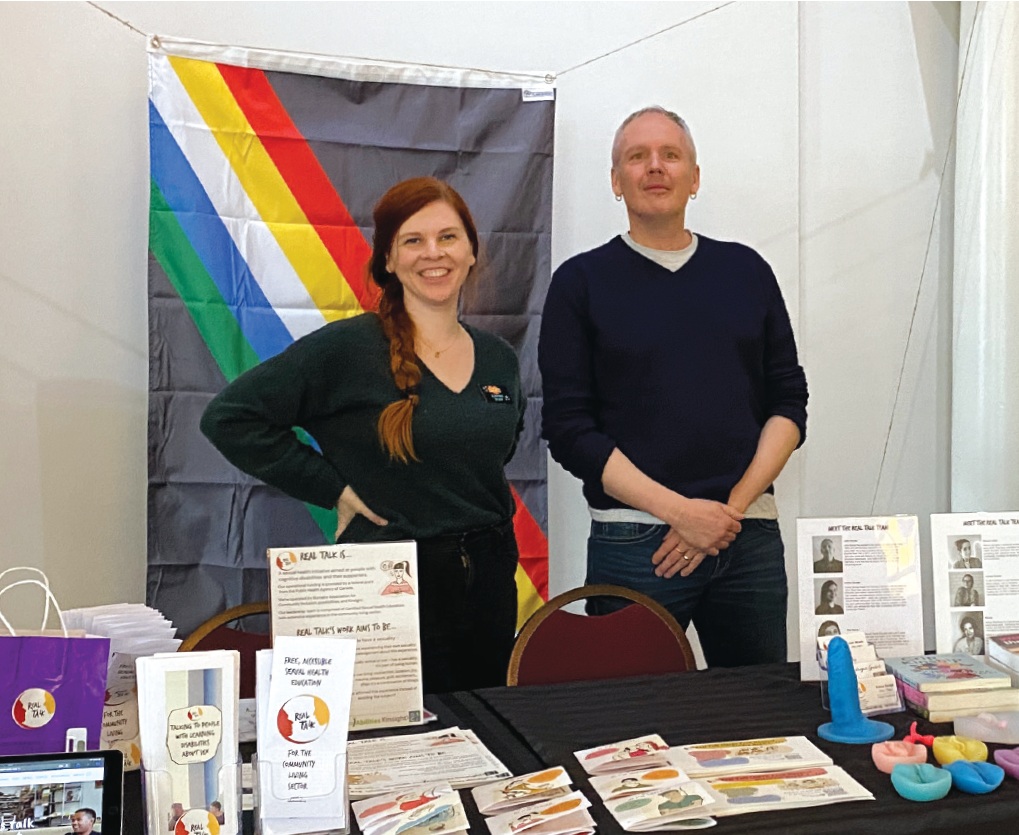
Photo Courtesy of Kelsey Savage & John Woods, Real Talk
On paper, Alison Klein is a serious academic with a master’s in interdisciplinary studies focused on adult education and disability. Meet her at one of the Real Talk’s free public events (affectionately known as “pizza parties”), and she’ll be the first to greet you as a peer facilitator and make a joke—sometimes with anatomically correct models at the ready.
“I go, ‘Look, a present’, and then just walk away,” says Klein with a smile. “I have kind of a funny side.”
Founded and managed by sexual health educator John Woods, Real Talk is an initiative based in Metro Vancouver that supports people with intellectual and developmental disabilities (IDD). Woods has worked in community living spaces, schools, and sexual health organizations since the early ’90s, both in Canada and in London, UK. He saw the urgent need for sex education tailored to the IDD community, and a slew of intersectional barriers rooted in eugenics. Now, in between pizza parties and Q&As, Real Talk works with the community living sector to support providers and those with cognitive disabilities.
“Step five is getting the public to acknowledge and affirm that folks with intellectual disabilities could be LGBTQ,” explains Kelsey Savage, Real Talk’s project developer. “Step zero is the general population believing that folks with intellectual disabilities have a sexuality at all.”
Since its founding in 2017, Real Talk has grown to include both certified sexual health educators and peer facilitators with lived experience, ensuring its initiatives are driven by community needs. While the disability rights rallying cry “nothing about us without us” has existed for decades, Real Talk remains one of the few accessible sex-positive resources that centre self-advocacy. It provides an extensive library of YouTube videos addressing common questions around sexuality and disability. Savage also oversees Connecting Queer Communities (CQC), a social group for 2SLGBTQIA+ folks with cognitive disabilities to connect across the Lower Mainland both in person and online. People often attend both Real Talk and CQC events, and several have joined Klein as peer facilitators themselves. As facilitators, honouring education and community could mean helping someone explain orgasms to their partner one day, and being with someone’s deepest traumas the next.
“It’s happened a number of times at our events, where people have discovered they’ve been taking birth control and it’s been called a vitamin, or they’ve had an IUD and they didn’t consent to it,” says Savage. “There’s already a lot in the room before you step into it.”
As Real Talk works across communities to expand its outreach, what’s needed to ensure the future of good sexual health education is clear: government-sponsored education and publicly funded accommodations and support so people with cognitive disabilities have an equitable pathway to become sexual health educators. “I want to ideally work myself out of a job,” teases Savage.
“Earlier, I was mostly around staff and disconnected from my community,” Klein says. “I hope Real Talk is a starting point, and that sex education can be taught in schools to kids from all different backgrounds, so they all have a frame of reference [for] each other.”
]]>
Collage by Valerie Thai
Isabella Calahoo-Zeller was attending eighth grade in Alberta when she received sex education for the first time. It consisted of a YouTube video about consent, and not much else. “We didn’t really get much on what a penis looks like, or what a vulva looks like,” Calahoo-Zeller says. “We never got the birth video that you hear so much about. So for me, I was like, what is this?”
Calahoo-Zeller is one of many young people in Alberta, and across Canada, who have been left wanting more from the sex ed experience offered in schools. Research by the Sex Information & Education Council of Canada (SIECCAN) has shown that 82.5 percent of young people across Canada see sex ed as a basic right for all.
These results come at a time when political and popular support for sex education seems to be shifting. Across the country, some parents, who claim to be advocating for parental rights, have been extremely vocal in their distaste for comprehensive sex ed, especially content focused on 2SLGBTQIA+ identities. According to Statistics Canada, about four percent of the population identifies as 2SLGBTQIA+. This means that if queer and trans-related content is left out of sex ed, many young Canadians won’t be receiving essential information about their health.
In Alberta, Saskatchewan, and New Brunswick, trans and nonbinary young people’s rights in the education space are on a backslide. New policies by the United Conservative Party, the Saskatchewan Party, and the Progressive Conservative Party respectively around the use of changed names and pronouns, as well as sex-ed access, are increasing the number of hoops through which young people have to jump to be recognized as their authentic selves and access resources made to support them.
“You’re already struggling in surviving to be yourself. How can you ask for help when the help doesn’t want to help you, right? I think it’s really a struggle right now being a trans person,” says Calahoo-Zeller, who is Two Spirit.
The benefits of receiving comprehensive sexuality education have been proven by science, and they’re not just about healthy and safe sex. From a violence prevention perspective, sex ed is key because it builds knowledge and understanding of bodily autonomy. It can be the first place children who are being abused learn that what’s happening to them is not okay. The health and safety aspect of sexuality education is essential, but that’s no less true of learning about gender identity, self-expression, and the full spectrum of human relationships.
“Historically, sexual health education focused on issues related to problem prevention. It has been focused on the needs of heterosexual, cisgender, white youth primarily, and focused on preventing unwanted pregnancies and preventing sexually transmitted infections,” says Jessica Wood, research and project development lead at SIECCAN. “It’s really important to understand that sexual education is not just learning about safer sex and reproduction, but should be a comprehensive approach to learning about sexuality and bodies and relationships, personal and interpersonal well-being, gender and sexual diversity, and values and rights.”
Because education falls under provincial jurisdiction, sex ed experiences are known to vary widely across Canada. Approaches can differ even between classrooms in the same school, as educators have different levels of comfort and training in delivering this knowledge. This means some students get all of the details, while others are left in an unfortunate state of ignorance. And it’s not just their own openness to the topic that educators must negotiate with: the volume of anti-trans rights rhetoric can also affect the classroom.
But, according to Janani Suthan, the comprehensive sexuality education program coordinator at the Canadian Centre for Gender and Sexual Diversity, the perception that support for comprehensive sex ed is decreasing isn’t always rooted in reality. “The majority of parents, in the grand scheme of things in Canada, are supportive of their children learning about their sexual health in schools, and learning it holistically and comprehensively,” they say. “But the people that are against this are very loud and very proud about it, and are mobilizing.”
Wood also says it’s a small minority of people who are actually against students learning this critical information. Advocacy against comprehensive sex ed, led by groups like 1 Million March 4 Children and Parents for Choice in Education, are often well organized and well funded. Religious and political interest groups have a strong hand in the work of such organizations.
The spread of misinformation and disinformation about sex ed on social media has contributed to the movement. “And so when we hear about this often, it may seem as if more people are not supportive of comprehensive sex ed,” Wood explains. “We find that a lot of people actually are, but we just don’t hear that coverage as much.”
This disproportionate coverage of dissenting voices leads to the spread of myths about sexual health, sex education, and queer and trans experiences. “They don’t want youth to know about gender, [or] sex,” says Suthan. “They are fearful of youth having knowledge, of youth having skills to understand themselves better.”
If queer and trans experiences aren’t taught as part of sex ed curriculum, that leaves young people vulnerable. Since sex ed is a health and safety issue, it is reasonable to expect that all students should have equal access to it. “It’s suicide prevention, it’s mental health care. It’s everything, because a lot of issues end up linking to sexuality and relationships,” Suthan says. “It’s very much necessary for everybody.”
For those who are supportive of sex ed in the classroom, it has never been more important to speak up for young people’s right to access information. “If you can advocate, advocate. If you can’t, that’s okay,” says Suthan. “Show up for your kid.”
Sharing knowledge with young people can help to build acceptance and understanding, some of the most important parts of living a fulfilled life. “Community is where I found more information on being Two Spirit,” says Calahoo-Zeller. “You get to understand yourself and also other people… we don’t have secrets. There’s nothing to hide.”
]]>The store has now moved to an all-ages format, eliminating the sexually explicit videos and magazines, says Taylor in an e-mail to This.
Venus Envy has locations in Ottawa and Halifax. The shops are trans-affirming. The stores also sell books and health products around safer sex, in addition to toys, and also offerworkshops on sex education. As its website says, “Anyone who’s turned off by traditional sex shops will find us a welcoming and informative place to get cool and sexy stuff.” On October 9 Venus Envy started a Pay it Forward Campaign, offering free binders and gaffs (similar to a jock strap) through their shops. This is possible through donations (which you can make here). “We’ve had a lot of interest in our new Pay It Forward campaign that was sparked by this whole kerfuffle,” says Taylor.
A former This intern, Hillary Di Menna is in her second year of the gender and women’s studies program at York University. She also maintains an online feminist resource directory, FIRE- Feminist Internet Resource Exchange.
]]>Plus, in our pursuit to compile the alternative answer to mainstream media’s not-so-progressive body and sex coverage, we want to hear from you! We’ll be printing our favourite reader answers to the following three questions:
Tell us about your “first time.” At This, we love us some diversity. So please, please, please help us cover the full range of “aw” to “awkward” with stories that also show the full scope of sexuality, gender and ability.
So you already know 125-gazillion ways to pleasure “him.” But how do you pleasure yourself?
Oh, sex education. Share your best (worst?) sex ed stories with us. Was your class helpful, quaint, terrible? We want to hear it all, from ha-ha to horrible.
Email your answers to [email protected] or leave them in the comments sections. We don’t need your name—it’s completely anonymous if you want it to be!
]]>