
The Shameless editorial collective. Photo by Robin Hart Hiltz.
Flip through the pages of Shameless, a feminist magazine for teen girls, and you’ll find a debate about the value of corporate social responsibility titled “When Oppressive Corporations Do Progressive Things” alongside a first-person call for self-acceptance, “Shame, Beauty and Women of Colour.”
It’s not exactly Seventeen, and that’s the whole point — or at least it was. “When we started, we defined ourselves as what we aren’t,” explains Sheila Sampath, the magazine’s editorial director. “Now, we no longer have to do that. It’s more about what we are.”
Shameless was born out of a Ryerson University classroom seven years ago, founded by students Nicole Cohen and Melinda Mattos to redress the deficiencies in mainstream teen magazines. Sampath, who joined the team as art director early on, is now running the show — and providing day-to-day continuity within the all-volunteer team. The magazine’s 10 or so editors are joined by outreach volunteers, including those who run the Wire, a journalism training program for high-school girls.
“I wish I’d had Shameless when I was a teen,” says Sampath, pointing out that, refreshingly, it doesn’t assume its audience to be straight, white, and middle class.
Shameless is overtly activist, with a mission statement that reads, in part, “We understand that many of the obstacles faced by young women lie at the intersection of different forms of oppression, based on race, class, ability, immigration status, sexual orientation, and gender identity.”
Its target demographic — vocal in its appreciation — usually finds the mag in school libraries, but Shameless is also available on newsstands and finds many fans in older age groups, too.
The indie title aims to provide a sense of community for those who are “different”—in viewpoint or ethnicity. “It really is validating to see yourself reflected in print,” Sampath says. “We’re trying to redefine what’s normal.”
Now, don’t get me wrong. I enjoyed watching Josh Koschek’s antics on the last season of The Ultimate Fighter. Sure, that was some good fun, but it’s also not far removed from bread and circuses.
Poynter’s idea of a non-profit centre that would provide financial support to investigative projects was also timely: it came just as North American media were swan-diving into their biggest crisis in ages. The recession put several badly managed media empires into bankruptcy, while the internet was siphoning off readers.
Some out-of-work journalists thought they could make new careers for themselves with non-profit, web-based news start-ups, but that model is about as solid at this stage as Orville and Wilbur Wright’s first flying contraption.
But to get it off the ground? The challenges were big. Lots of people have good ideas, but those who have the perseverance, luck, and courage to get anywhere are rarities.
Today, the Canadian Centre for Investigative Reporting may be Canadian journalism’s best-kept secret. It is Canada’s only non-profit registered charity with an exclusive mandate to produce investigative journalism. (I joined the CCIR as a founding board member and am now its president.) Drawing on a U.S. tradition of similar non-profits like the Center for Public Integrity, we’ve started bringing to light important stories.
Our first major piece was picked up across Canada in 10 Postmedia Network dailies: an investigative feature that Poynter and I co-wrote on how Canadian officials have ignored an explosion in Afghan opium production, which has caused a surge of heroin addiction in Canada and worldwide.
We’ve had challenges, to be sure. While the U.S. has a rich history of donating to non-profit causes, Canada seems to have no such tradition. We’re still working hard to secure a stable stream of individual and institutional donations to support work on the numerous stories waiting to be unearthed and brought to the attention of Canadians.
But thanks to hundreds of largely unpaid hours on Poynter’s part, we’ve also had great success in building an advisory board of leading Canadian reporters (among them Gillian Findlay, Linden MacIntyre, and Stevie Cameron) and securing help from several generous donors who believe in our vision. We’ve had the satisfaction of going back to the roots of reporting and working on the kind of exciting stories that drew us into journalism and that are vital to any democracy.
And through it all, we’ve had more fun than a bare-knuckle brawl in the Octagon.
Alex Roslin Then: Contributor to This Magazine, receiving two Canadian Association of Journalism awards and six nominations for CAJ and National Magazine Awards for his work. Now: President of the Canadian Centre for Investigative Reporting.

Creative Commons photo by Flickr user Daniel Villar Onrubia.
The CRTC’s in the news again, this time for proposing that journalists can lie, as long as no one gets hurt.
Last week the CRTC asked the Canadian Broadcast Standards Council to review its ban of unedited version of the Dire Straits’ 1985 song “Money for Nothing.” The 25-year-old hit, which has since started climbing on iTunes, was banned from Canadian airwaves after a complaint over its use of the word “faggot.”
But days before Straitgate, the CRTC quietly published an amendment that would punish the broadcasting, through radio or television, of “any news that the licensee knows is false or misleading and that endangers or is likely to endanger the lives, health or safety of the public.”
The amendment would replace the current wording, that “a licensee shall not broadcast […] any false or misleading news.”
CRTC sources told the Toronto Star the amendments aim to clarify the regulation, as the current text is open to legal loopholes. The amendment also clarifies “obscene” material as either the “undue exploitation of sex” or a dominant sexual characteristic combined with “crime, horror, cruelty [and/or] violence.”
Tech law expert Michael Geist blogged about the proposal, pointing out one small weasel word: “and.” Once again, the amendment concerns the broadcasting of “any news that the licensee knows is false or misleading and that endangers or is likely to endanger the lives, health or safety of the public.”
“It would perfectly permissible for a broadcaster to air false or misleading news,” he wrote, “provided that it not endanger the lives, health or safety of the public.” Geist also noted how much closer the amendment puts us to U.S. regulations.
The proposal comes weeks before the expected launch of Sun TV News in March. The channel generated controversy last fall for its attempt at Category 1 status, making it a must-offer for digital and satellite providers. Critics dubbed the network “Fox News North,” noting references to the controversial right-wing broadcaster in its application.
Before its approval, the channel prompted a scandal implicating Margaret Atwood and eventually George Soros, a rumoured ousting of the head of the CRTC, and an actual resignation from the project head. Although Sun TV generated much unfounded hysteria, hints at Fox News North have been copious throughout the coverage of this proposal.
But not without reason. This month’s shooting spree in Tucson, Arizona made many Americans think twice about overheated political discourse, propagated by many mainstream outlets.
Minutes after news that congresswoman Gabrielle Giffords had been shot, a Palin PAC image of her district in crosshairs went viral, as did clips from enflamed talk radio pundits and savage television “debates.” To quote Pima County sheriff Clarence Dupnik:
“I think it’s time as a country that we need to do a little soul searching because I think it’s the vitriolic rhetoric that we hear day in and day out, from the people in the radio business, and some people in the T.V. business […] it may be free speech but it does not come without consequences.”
Although many now draw a link to the suspected gunman’s mental health issues, that many Americans automatically thought of their violent news media is telling.
CRTC’s proposed change would make it okay for media to deliberately lie, as long as nobody’s hurt. The results could be ineffective at best. After harm takes place — an assassination, a stampede — it will be hard to find a solid link between one isolated news story and an event.
The reality is that social reaction to media coverage is often cumulative. According to agenda-setting theory, media can’t tell people what to think, but rather what to think about. Media shape the public psyche, not through individual reports but through larger thematic decisions about what merits coverage and how issues are framed.
The CRTC’s proposal is bad for journalism and democracy. Not only does it allow for lower-quality broadcasting, it could divert public attention from wide-ranging media issues by pigeonholing individual cases.
That our broadcast regulators would concern themselves more with public offence than public good is disconcerting. Critics left and right have decried the changes as dangerous for democracy.
If implemented, the changes would take effect in September. If you’d like to speak up, you have until February 9 to submit a complaint.
]]>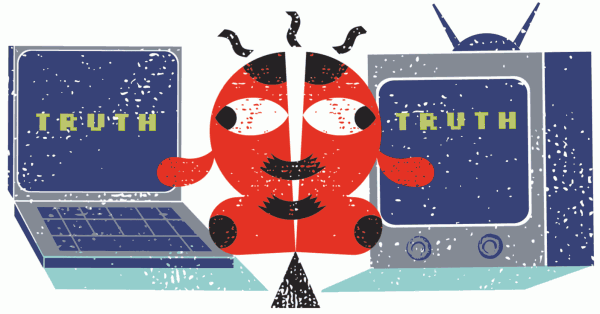
Truth and lies flourish equally online. Exhausted readers are in retreat. Illustration by Matt Daley.
Though you might reasonably condemn the modern internet for a variety of reasons—ruining attention spans, turning all public discourse into a shouting match, or insulting your sexual prowess with badly punctuated mass emails—one thing the medium could always reasonably claim was its potential for spreading truth. Decentralized and egalitarian, the web seemed to herald the end of the coverup: with no authority to stop the spread of information, facts would inevitably slip the bonds of corrupt politicians, crooked industrialists, and tyrannical generals. Sooner or later, we believed, the real facts would always come to light. The Truth Is Out There.
It turns out that’s not, uh, true.
That’s if the results of a recent study from the University of Michigan are anything to go by. The researchers found that people are remarkably resistant to facts that deviate from beliefs they already hold; the phenomenon is particularly acute in those with strong political leanings. This is the “truthiness” that satirical news anchor Stephen Colbert famously named—a trust in gut instincts instead of documented facts. That intuitive concept has now, somewhat ironically, been scientifically proven. In other words, The Truth Is Out There, But Nobody Can Be Bothered To Go Looking For It.
We already know that falsehood, distortion, and bullshit flourish online just as much as fact. The internet is home to climate-change deniers, 9-11 conspiracy nuts, and fringe politics of all sorts—in part because it is so easy to find “facts” that support whatever you believe. The sheer glut and variety of information online has made it difficult to distinguish fact from invention and truthfulness from truthiness. The result, for many people, has been to retreat into the comfort of the mainstream media.
Canada experienced this during the G20 summit in Toronto in July. After some protestors caused property damage early in the weekend, many journalists found themselves at the centre of what they believed to be an excessive police reaction. Twitter, Facebook, and YouTube were central to this real-time reporting, and people who were following the demonstrations and police actions online had a very different experience than live-TV viewers—who mostly saw sensational footage of a burning police car on a continuous loop for two days.
TVOntario’s Steve Paikin—a man who has built a career on measured neutrality—told of what seemed like an illegitimate round up of legal protestors and the beating of a reporter from the U.K.’s Guardian. The Globe and Mail’s Lisan Jutras wrote of her experience being detained in the rain for hours and taken into police custody.
New media seemed to finally be fulfilling its promise: coverage that was richer, more immediate, more diverse, and faster.
Yet a few days after the summit, an Angus Reid poll revealed that a full two-thirds of Canadians not only supported the police action, but were also “disgusted” with the protestors, despite the fact that the majority of them did nothing more than walk down streets holding placards. Images of anarchists breaking windows dominated big media, and the fact that there was plenty of information online offering a different interpretation mattered little, if at all.
The problem is that, unlike TV, you have to choose what you view online. That means that unless you’re already looking for an alternative take, it’s unlikely to find you. But more than that, the web is full of so many different versions of the truth, from the legitimate to the lunatic, that their very existence undercuts the medium’s validity for many people. When it is as easy to stumble upon a cogent, well-researched critique of global capitalism as it is a raving theory about “the moon-landing hoax,” the tendency is to discount the medium altogether.
By allowing anyone to publish and disseminate information, the web broke the historical link between power and publishing. Many people cheered that change, and for understandable reasons. The web embodies the contemporary collapse of all the things that once seemed beyond question: truth, fact, authority. But when nothing is objectively true, it also means nothing is objectively false. Presented with an almost infinite mass of options, most people, rather than diving in, simply retreat into what they already know—and for the majority, that’s still television.
Tremendous excitement accompanied WikiLeaks’ July release of 91,000 military documents related to the conflict in Afghanistan. Perhaps it’s justified. But earlier this year, when the same organization released “Collateral Murder”—a video that showed an American helicopter crew killing unarmed civilians in Iraq—excitement and controversy produced nothing lasting.
Despite the video’s incendiary content, and the clip’s seven million YouTube views, almost nothing changed. In the face of the official story and people’s faith in the authority that stood behind it, the clip was nothing more than a grain of sand, like those blown about by that helicopter’s blades—one more “fact” among millions, lost in the roar of a rushing, directionless storm.
]]>
The G20 is less than two weeks away, and there’s a lot going on. You could just turn to the usual media suspects to get your news about the G20, but when it comes to the street-level collision of neoconservative colonialist plutocrats and anti-globalization activists (among many other blocs of interests), it pays to look off the beaten path for your news consumption. If previous G20 meetings and the demonstrations that accompanied them is any indication, you can’t trust big media to get beyond the usual hackneyed portrayals of anarchists in balaclavas and be-suited politicians doing photo-ops.
(We’ll be doing our very small part during the next two weeks by clipping and aggregating the best material we find on our G20 microblog — g20.this.org — and we welcome you to send us your photos, videos, blog posts, and links for sharing. Simply email [email protected] and we’ll take care of the rest.)
Here are the indie news sources we’ll be following in the next few weeks. Respond in the comments section if you have further sites that people should visit!
rabble.ca
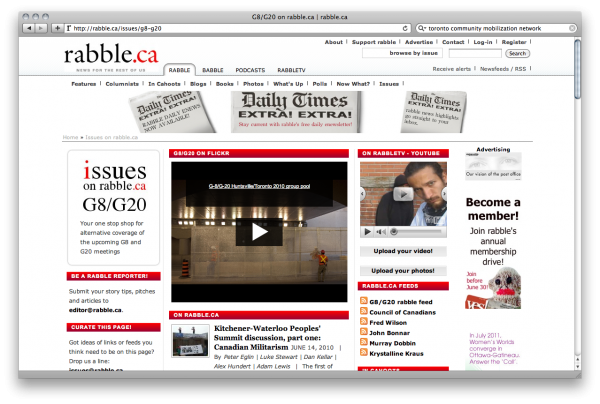
Our friends at Rabble have put together one of their “issues” pages that collects all of their G20 news and commentary in one easy-to-scan package. At a glance you can see any G20 related video on RabbleTV, submissions to the G20 Flickr group, what they’re tweeting and retweeting, and what their lively commentariat is saying on their message boards, Babble.
Toronto Media Co-op
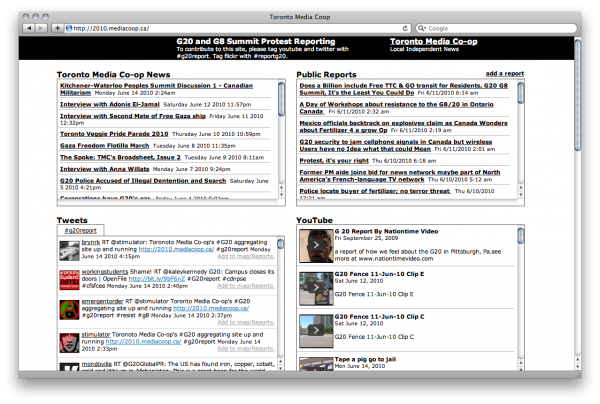
The Media Co-op is a grassroots network of independent news reporting collectives based in different cities coast to coast. Together, the co-op publishes The Dominion. The Toronto branch of the Media Co-op has set up a spartan but information-rich aggregation page for collecting photos, videos, tweets, news reports, and their own original reporting.
G20 Breakdown
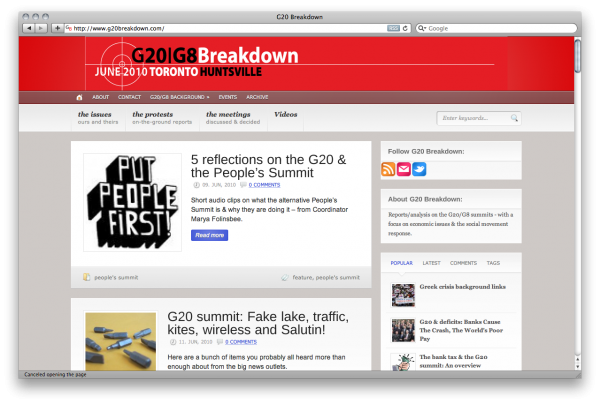
Darren Puscas started G20 Breakdown a few months ago and for a one-man operation, it features a lot of coverage. Puscas’ main areas of interest are economic and environmental issues, but he’s going to be on the ground in Toronto reporting directly on the People’s Summit this coming weekend, and the G20 itself the week after.
Toronto Community Mobilization
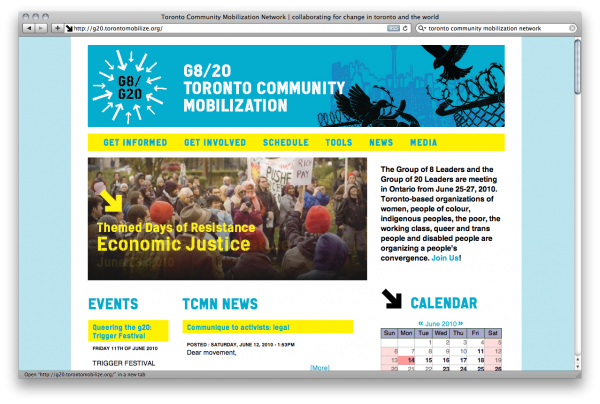
The Toronto Community Mobilization Network is the coalition of activist groups that is coordinating and publicizing the flood of social justice-themed events — demonstrations, concerts, panel discussions, parties, and more — in response to the G20. Their website won’t be so much a source of reporting as a place to keep on top of an ever-shifting schedule of stuff to do.
G20 Research Group

The G20 Research Group is an academic flying squad at the University of Toronto’s Munk School of Global Affairs, a largely student-run group that collects and sifts through the massive piles of information that the G20 produces. The emphasis here is on data, though there is some academic commentary (from across the political spectrum). The research group also sends students to the summit proper to report on individual meetings and press conferences. The academic analysis doesn’t always make for the most exciting reading, but when you’re the kind of reader who wants footnotes, this is your place.
]]>
In the documentary Helvetica, incensed graphic designer Michael Bierut hilariously critiques ads from old copies of Life Magazine. He attacks the verbosity and shrill insistence of early 1950s Coke ads prior to the introduction of Helvetica then flips admiringly to a minimalist ad set in the new font. Here again is a reminder of how design and material delivery can influence the content of a message. Just as I’m not likely to meet many wedding invitations written in a ransom-note font, I can’t imagine reading a romantic novel on an e-book.


Given both historical precedent and the exponential rate of media evolution, eventually I will do much of my reading on some kind of e-reader. Novels didn’t exist without industrialization (i.e., the printing press). With the hindsight of history, it’s easy for us to dismiss as naive the seventeenth-century book collectors who vowed never to own that cheap, ghastly and faddish new thing—the printed book. Today, newspapers already feel so last century, with their slaughter of trees for a day’s worth of programming which is pushed at crowds indiscriminately, not pulled selectively by readers. But then here I am, preferring my tales of head and heart on paper, not any kind of screen. If I can see the relationship between literacy and democracy with the technological shift from handwritten to printed books, what holds me back from doing the same with digitization, that next step in media evolution?
The answer lies in the nature of the novel itself.
Medieval literature was laboriously copied by hand. With this material preference for brevity, the author of medieval literature worked long before the writing advice “Show; don’t tell.” Medieval quests were written with bald declarations like, “He was very afraid.” Harold Bloom’s Shakespeare: The Invention of the Human goes so far as to say that a few centuries after the medieval romance, Shakespeare essentially invented the three-dimensional character. With their self-investigative soliloquies and their observation by an audience, if not other characters, Shakespeare’s characters are formed within their stories, not before them. (I know, I know: here come the parchment-and-quill hate mail from the medievalists). But these were plays: as with today’s noisy, ad-saturated cinema, you had to see them in a crowd, and on their schedule, not yours.
The novel—which you can read on your own schedule—is the child of poetry and drama, and like most children it displays inherited traits from both parents. Like the hand-copied medieval manuscript, the novel is read in private, not viewed in public like a play. But the novel also carries the play’s gene for evolving action and characters-in-flux. In The Art of the Novel, Milan Kundera admits, “As soon as you create an imaginary being, a character, you are automatically confronted by the question: What is the self? How can the self be grasped?
It’s one of those fundamental questions on which the novel, as novel, is based.” In love stories like Mordecai Richler’s Barney’s Version or Haruki Murakami’s Norwegian Wood or Michael Ondaatje’s The English Patient, characters find out who they are— and are simultaneously revealed to the reader—as they find out who they love. If that’s the content I’m looking for, I want the nakedness, tactility and privacy of a paper book, not the proprietariness and gadgetry of an e-reader.
There’s a tactile nakedness and independence to the book well-suited to the expansions and confessions I want from literature. I still have the copy of Louis de Bernières’s Captain Corelli’s Mandolin that I read a decade ago on the Greek island of Cephallonia, where the novel is set. I’d rather pass a romantic partner that copy, not an e-file.
After all, for the past 400 years, literature has combined abstract words with the subtle physicality of paper books. That subtlety presents a challenge. In From Where You Dream: The Process of Writing Fiction, American fiction writer and creative writing professor Robert Olen Butler notes that literature is unique amongst the arts for not being inherently sensuous. Abstract and symbolic writing does not have the emphatic physicality of theatre, visual art or music. Books have to make the most of what they’ve got: If a romantic novel and I are going to undress each other, I want to feel each page unfurl. And I want to be able to read it in the bath.
]]>
With the rise of paid death notices, the old-fashioned obit's days may be numbered. Photo by Graham F. Scott.
Apple Inc. co-founder Steve Jobs’ conspicuously detailed death announcement, accidentally published by Bloomberg news service in 2008, revealed a little-known fact about the craft of writing obituaries: the blood doesn’t have to have gone cold before someone writes the first draft of your final epitaph. In fact, there doesn’t even have to be a reason to suspect that you’re in dire straits for an editor to assign a writer the task of encapsulating your entire life history into six inches of column space.
That’s why it might not be too early to start writing about the death of the obituary itself. Obituaries may not be dead and gone, but they’ve certainly seen better days. And as things stand now, obituaries may just predecease the rest of the newspaper industry. “The dead beat,” as it’s called by professional obituary writers, may finally live up to its name.
“In this country I think there are five or six people left on ‘the dead beat,’” says the Globe and Mail’s Alan Hustak, a 30-year veteran obituary writer with 700 obits to his name. “I would venture to guess all across North America there are probably no more than 100 of us.”
Most newspapers don’t have the luxury of having a full-time obituary writer anymore, he says, since they’re too busy trying to survive with a reduced staff. Instead, they buy articles from American wire services. “If you look at Canwest newspapers, very few Canadians die now, but you’ll have a detailed obituary about the floor salesman who worked at Filene’s Basement or a hairdresser for Marilyn Monroe,” says Hustak.
John Heald, a funeral director by trade and vice-president of sales for Tributes.com, stands to gain from the newspaper industry’s losses. “If you look at the current state of the newspaper industry now versus what it was three years ago,” says Heald, “the only section of the newspaper that hasn’t successfully migrated to the internet are death notices and obituaries.”
The brainchild of Monster.ca founder Jeff Taylor, Tributes.com hopes to change that by cataloguing new and archived obituaries going back to 1936 from those submitted to newspapers by funeral homes. As a business model, literary obituaries aren’t nearly as profitable to newspapers as paid obituaries from the families of the bereaved.
“In the newspaper industry, there used to be an editorial staff that wrote obituaries that told a life story and which would take up a couple of inches of a newspaper,” says Heald. “But what would happen was an obituary was always free, because it was just good content, and that couldn’t be supported.”
What remains, says Heald, is a paid death notice in the form of classified advertising.
“It’s too expensive to tell everyone how much of a great person this guy was and his interests and his hobbies, so the days of some really robust good editorial obituaries being written are far and few between,” he says.
Obituaries for the rich and famous, however, are still in tight supply.
Marilyn Johnson, author of The Dead Beat: Lost Souls, Lucky Stiffs, and the Perverse Pleasures of Obituaries, got her start writing celebrity obits at Life magazine in 1997, following the death of Diana, Princess of Wales. Many of her assignments, however, were for people who still had a pulse.
“I actually had assignments from a series of magazines to write obits of celebrities who were presumed to be on their way out, and everybody I wrote about sort of got a fresh wind,” she said. Her obituary of Katharine Hepburn, originally intended for Life, didn’t see the light of day after the magazine predeceased Hepburn by three years when it folded in 2000.
Hustak, who left the Montreal Gazette in March of last year after 22 years on the obit desk, says people often stop him on the street to say, “Oh, you’ve left the Gazette? That must mean no one’s going to die anymore.”
Hustak hasn’t stopped writing obits entirely, and even if he did you would still be able to run into his byline for years to come, since he has a cache of 100 unpublished pieces just waiting for their recipients to expire.
So could the obituary industry go on living longer than expected? If the experience of obit writers is anything to go on, mortality is a fickle thing.
“One of those obits I’ve already written was written 14 years ago because I was told this man had one week to live,” says Hustak. “I had lunch with him two weeks ago. Only [God] knows.”
]]>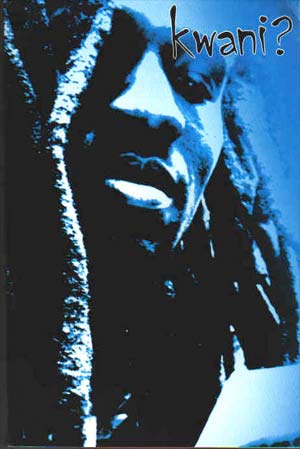
Issue #1 of Kwani?, the journal of contemporary African literature.
Several of my previous blog posts have mentioned Kwani?, the Nairobi literary journal/publishing network dedicated to building contemporary African literature. My interest in the publication was first aroused by the contrasting literary scenes in Uganda and Kenya. While FEMRITE, based in Kampala, Uganda, is a strong local writers’ organization, I never found a literary magazine like Kwani? in Eastern Africa, which offered everything the local and foreign reader could want: fiction, non-fiction, poetry, illustrations—all dealing with the world that is Kenya from a hundred different perspectives.
So, when I was first introduced to Kwani?, I could not let go. Since then, I’ve learned a lot about the role of literature in the development of a national psyche, particularly in post-conflict situations. Words have a way of immortalizing moments that are otherwise easily swept under the rug forever. In this sense, we are indebted to the artists that immortalize these events and ensure their recognition in the long-term, whether political, economic or social. As Kahora says, “writers are society’s conscience.”
In Kenya, this has been particularly important. The post-election crisis could have become just that: another post-election crisis. Previous elections have been bloody. Previous elections have been rigged. Previous elections were built on empty promises and on bought votes. But through literature like Kwani?, perhaps there is an acute awareness among the public that this is not just another post-election crisis. This was the final straw.
The last two issues of Kwani? focused on the post-election crisis, making an indelible impression on readers. The goal was to record in pictures, cartoons, poetry, fiction and creative non-fiction what happened in the first 100 days of 2008. As Kahora says, “One of the big problems we’ve always had is a problem in recording momentous events in this country which leads to a widespread amnesia; such a record, makes sure there is no excuse, at least from a literary community’s viewpoint, for the kind of behaviour [during the post-election crisis].”
Consequently, Kwani? also wants to focus on the younger generation of Kenyans and their aspirations for the country as ‘leaders of tomorrow.’ Kahora says that the next issue of Kwani? will focus on “youth expressions—as a way of going deeper into the 46-year-old malaise [Kenya] is suffering…re-evaluating who we are and what directions we are heading in.” Closer to the 2012 elections, Kahora says Kwani? will use the magazine “as [a] way of making people remember.”
Among youth, the coming generation of Kenyan leaders and doers, Kahora says that Kwani? represents “a younger un-texted space that falls outside of official narratives, that can be written into being.” Kenya is a country saturated with stale political narratives that never seem to change, published day to day in the big local newspaper, The Daily Nation. Kwani?, though perhaps only drop in the bucket in the long-run, offers youth, and other Kenyans, a means of looking beyond the mainstream and writing out a new idea of Kenya. Perhaps, through this process, some of these aspirations will become reality.
]]>
Map to This Magazine's booth at Word On The Street. Click for larger version
 We’re setting up our booth right now for Word On The Street in Toronto, and looking forward to meeting lots of current and future readers of This Magazine. We’ll be offering special deals on back issues and subscriptions today, so please come and say hello! We’re at Booth #235, at the corner of Queen’s Park Crescent and St. Joseph Street. Hope to see you there!
I’ll also be talking at a panel discussion later in the afternoon on “How To Get Published,” along with Jared Bland of The Walrus and Tara Quinn of Brick, moderated by Toronto freelancer (and This contributor) David Hayes. It’s in the Canadian Magazines tent, from 5:15 to 6 pm.
]]>
As the large networks close small affiliate stations, is there hope for the future of local television news?
The sky is falling on news, said Mike Katrycz, but this isn’t the first time.
The veteran news director joined a panel discussion called “Local TV News Under Siege” at Ryerson Journalism School on Wednesday night. With him were CTV managing editor Adrian Bateman, CBC managing editor Sophia Hadzipetros, and CITY Toronto reporter Farah Nasser.
Katrycz used the rise of the Toronto Sun from the ashes of the Toronto Telegram as an example of news organizations adapting to changing times. When the Telegram closed in October 1971, a group of the newsroom staff started the Sun immediately. The new tabloid sized paper was radically different from its broadsheet predecessor, and is still in print.
CHCH’s story is similar. Katrycz and his team were told the station was up for sale, and slated to close at the end of August if no buyer emerged. The newsroom managers changed the format to all-day news to try something different. The station sold a few weeks ago, but Katrycz and his staff will have to wait to see the numbers before they know if their gamble paid off, or hiring any new staff.
The panel members seemed eager to share the innovations they’d made at their stations to “save the news.” CHCH adopted a news wheel format, like CP24, repeating pre-packaged burst of news which are periodically updated. CBC stations nation wide switched to a new 90 minute supper hour newscast, similar to what CITY was already doing. Both Hadzipetros and Nasser said their long-format local news offers them the chance to tell each story from different angles.
While this all sounded very hopeful, it doesn’t really match up with what we’re seeing. Slashed budgets, and stations and newspapers folding across the country are high on my radar, being a recent J-school grad with looming student loan payments. Longer local newscasts are just that: longer. The same number of staff, and in some newsrooms fewer staff, are filing an extra half hour of news.
Near the end of the question period, a recent journalism grad stepped up to the mic. Her story echoed my thoughts. After graduation, she moved from Toronto to Brandon, MB to work for a small TV station. On her second day of work, the station manager announced they would close by the end of the summer. Now she’s back in Toronto looking for another job.
The road may be paved with technological advancement in Toronto, but the GTA is double the population of the four Maritime provinces combined. Smaller centres, the ones who rely on TV news, are in trouble. The networks need to realize that the small local stations are the roots that feed the big network stations, Adrian Bateman said to loud applause last night. It was a nice sentiment, but he was preaching to the choir in a room full of journalists and current journalism students—who will soon be out looking for their own jobs.
RTNDA Canada plans to podcast a video of the discussion on their website in the future.
UPDATE: The podcast is now online.
]]>