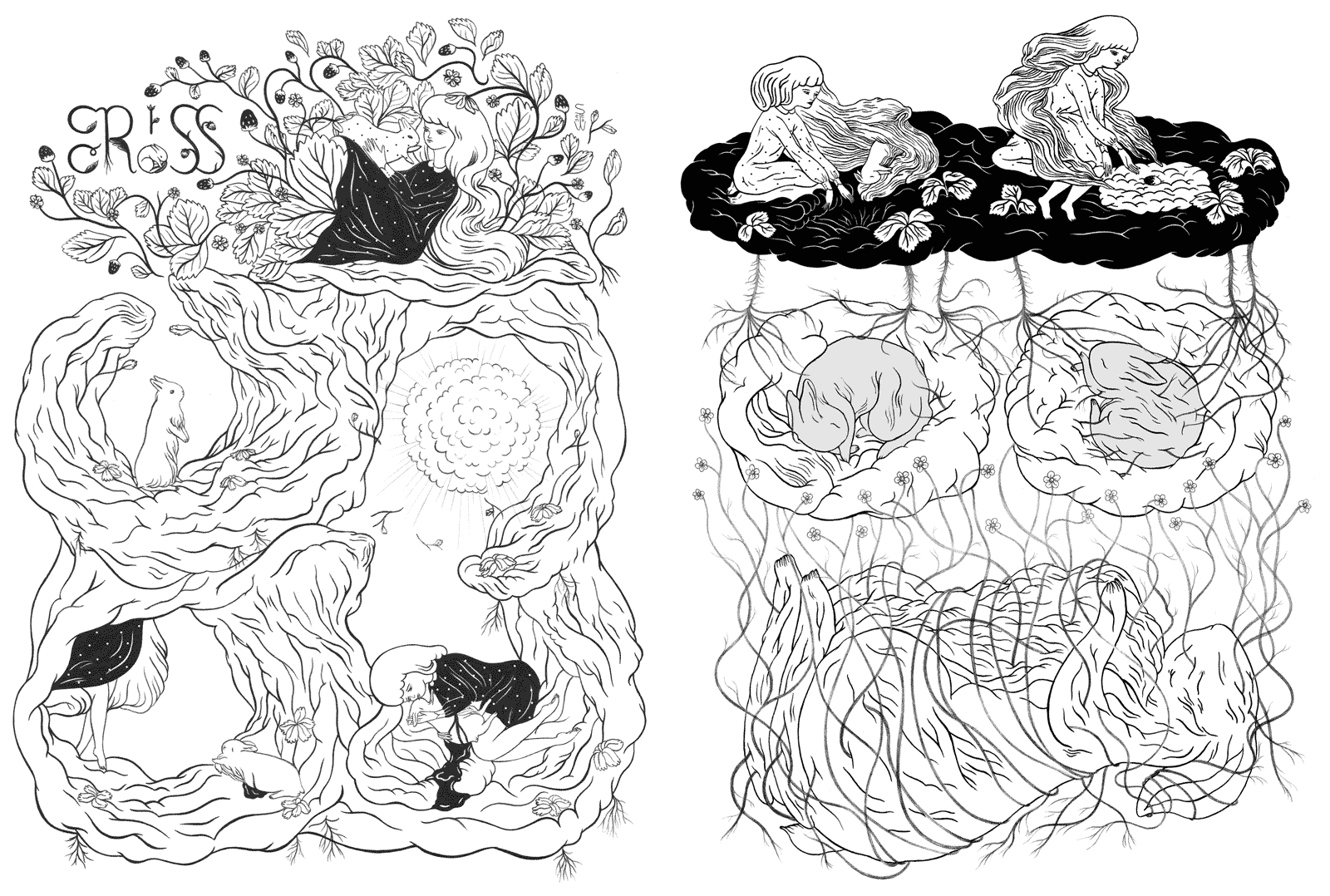
Selena Wong's 1st place winning entry in the Great Canadian Literary Hunt graphic narrative cateogry, “Criss Cross”. CLICK TO ENLARGE
 Sunlight, on one leg, limps out to the meadow and settles in.
Insects fall back inside their voices,
Little fanfares and muted repeats,
Inadequate language of sorrow
— (Charles Wright “Nine-Panel Yaak River Screen”)
Cocoon of dry throated days (hospital vigil, machines
stilled, packing up, singularities knit tight with details
then the silent drive, watching out for deer)
opens up: a house beside train tracks
set among fields. Jostling embraces
by oldest friends, my children, my man steadying.
Brilliant fall weather unblinking
stares me down; all this activity is background
sound, the love proffered is meddling.
Sunlight, on one leg, limps out to the meadow and settles in.
In slanted light, snow geese rise
in their hundreds above the stubble. We walk
the grid road alongside furrows. I’m numb
to my friend’s talk of her car ride from the coast,
time she took to ponder – should she leave
her daughter’s father? I can’t care now about her choices,
I’m just grateful that she’s here. And our other friend
who’s rooted in this land, though she says
she never walks it. Our talk breaks down to noises.
Insects fall back inside their voices.
Next day a wake. Mouths affirm life not grief.
Ranged in chairs, we know the celebration’s hollow,
that current may capsize us easy as it rocks us.
So I stammer my few words, listen
to the clear eyed keening of children
too young to know grief, that cheat
of promise. Friends play songs my brother loved,
some he’d written: plunges in mad river, a new year’s kiss.
Again and again the same regrets, stories we relate,
little fanfares and muted repeats.
Give me a scotch I’d said. Now his boss
has sent round trays of whiskey. Bar open
I weave myself into knots of his people,
drink deep of their memories, and that beer he liked
not for craft’s sake but because it’s cheap. I down glasses
for numbness now, redemptive pain tomorrow,
then return to warp and weft of spouse, sister, his close friends,
these two women mine. We spin words harder to think
than say, all trying on phrases, sentences we borrow,
completely inadequate language of sorrow.
Pictures of Sam. Illustration by Ben Clarkson.
Now
 The power went out. The television emitted an electric squelch before the picture vanished into darkness. In that moment Sam saw his reflection seated neat to his sister in the TV glass. Their image was bathed in the blackness of the blank screen, obscuring their features and the fine details of the room around them. She wasn’t more than a head shorter than him these days. Sam ran his tongue along the outline of his missing tooth and rolled his neck back until he was facing the ceiling. He could hear the sound of light rain outside. Clara broke the silence,
“Maybe an electric converter exploded.”
“That sounds about right. Must be pouring somewhere.”
Sam turned to look at her, reaching out and mussing her hair. Between his fingers and her ruffled bangs he could see that static expression on her face, and then suddenly the power was back on. The TV sputtered back to life in the middle of a commercial break. Clara emitted a “phew” with so much enunciation Sam could see the speech bubble above her head. Sam smiled and then relaxed his mouth without looking away from her.
“Have you seen any movies lately? That you liked?”
“No,” Clara’s responded curtly but her eyes were soon staring actively up at the ceiling. “Yeah I did. I saw one with Ola.”
“What was it called?”
“He’s wearing a different tie.”
“What?”
“The man in the show. Before they left the police station he was wearing a blue tie. Now he’s wearing a brown tie.” Clara was laughing quietly and picking at her dress. “I wonder why?”
Sam ended up making some spaghetti in the kitchen while Clara sat and watched Looney Toons. He’d been back home now for about a month and a half. The whole experience was far less claustrophobic than he had imagined once, but every single bit as strange. A year ago he had put his mom’s blue clay ash tray through one of the big living room windows. The summer before that he had set fire to the garage by accident, passed out on painkillers with a cigarette in his mouth. Every room had a ghost of some kind or another hidden amongst the clutter. A game of I Spy. And yet, being home was good. A comforting oasis.
Then Sam was in the kitchen making dinner, thinking it was nice to be around Clara. She’d grown a whole lot since he last felt like himself. He stood there, lost in thought, spooning spaghetti and meat sauce onto plates like gobs of brain lobe. Clara was diagnosed with Aspergers when she was nine and Sam was eighteen. She was a little puzzle he wasn’t much good at, maybe even he had gotten worse these eight years later. And not that little anymore. She looked more like their mom than ever before, which was unsettling. Dressing like a teenage girl, too. It seemed somewhat obscene, but of course Sam didn’t know how he’d like her to dress like instead. Old overalls.
“Dinner’s ready, geek.”
“You’re a dickhead Sam… Thank you for making spaghetti. It looks nutritious.”
Flashes of attitude and humour that bubbled up occasionally from underneath Clara’s unstirring surface bewildered Sam. Difficult to decipher or reconcile or simply ignore. Whenever she made him laugh, really laugh, he’d start to get overwhelmed. She once described her mom’s friend Don as a Korean David Caruso, another time she dropped a book she was carrying and said ‘fuck a duck!’ Both times Sam had been a lot closer to laughing and then crying than laughing until he cried.
And yet, a question was still hanging in the space between them, bound and gagged. How normal are you these days? Where do you fit on that spectrum? What do people see when they take you in? Of course, that question was there for him, too. More so. Inescapable. Are you normal now?
Then
It was along time ago. So far back Sam could hardly recall it. It was back before he got his tooth knocked out. He was having an episode and ended up driving all the way back to his mom’s house. He was drunk and hadn’t changed his clothes in a couple days. It was 1:23 a.m. and he was feeling like he was in some kind of zone. Each traffic light he hit turned yellow just as he crossed the threshold. The breeze from out the window felt like a cool hand across his face. A couple times he closed his eyes tight and let his right foot get heavy on the gas. Good energy. Tapped in. Sam listened carefully to the music snaking out of his car stereo. In his mind’s eye he could see the CD spinning furiously under the scraping gaze of the disc player’s laser. Faster and faster until it began to wobble off its axis. He passed by the spot Vera Variety used to be before it closed down some years ago and discovered a few mysterious tears crawling down his face. He felt on fire.
As he pulled into the driveway, Sam noticed the absence of his mother’s car. It was entirely possible Clara was gone, too. Maybe they’d gone up to Uncle Stephen’s cottage for the weekend. If that was the case he’d drive up there next. Sam got out of the car and went around to the back, but the door was locked. Rage built up in his jaw. He was wasting too much time. He was missing his window. He managed to track down a spare key inside a false rock by the old swing set. Another good omen. He let himself in. He was still crying.
“Clara! Clara wake up! Clara where are you? I know you’re here! Clara where the fuck are you? Come down! I need you to come out right now!” Sam didn’t wait for a response, he ran down the hallway to Clara’s room. He forced the door open so hard it probably would have concussed her had she been on her way out. It gave a sharp smack against the wall and knocked something off of her dresser. Clara was sitting upright under her sheets in the dark. Sam dragged her out by the wrist in her pajamas to the kitchen table and sat her down. They stared at each other for a long moment while he caught his breath.
Sam arranged the water pitcher, the box of salt and the pint glass in a line in between himself and his sister. It was very important that the salt went in the glass first. Sam told her so. He poured it carefully out from the box and then examined his work. Not enough, needs more. When he was satisfied he filled the rest of the glass with water up until it teetered on the brim before stirring it around with his index finger.
“You have to drink this.” She didn’t respond. Clara had wet pajama bottoms. “You have to drink this Clara. They’re poisoning you and I’m going to fix it. You have to trust me, you have to drink this.”
Still nothing.
Sam slammed his firsts down on the kitchen table, spilling more salt water. She drank. She drank glass after glass after glass until she threw up bile from her parched throat onto the floor, and then he made her drink more. Later, a nurse at the hospital would explain to their mother what salt poisoning was. She would be there for three days.
Pictures of Sam
Clara drew this one when she was visiting Sam at the CAMH facility. Clara had trouble with perspective and straight lines, but her drawings were vibrant and astonishingly true to life. This one is no different. The room around Sam is captured in perfect detail. The messy sheets on the bed, the geometric pattern of the tiled floor and two beams of dusty light shooting in from the window on the left. In the picture Sam is sitting restlessly, his weight shifted to one side. He is captured in the midst of a conversation, mouth open, palms outstretched. His mouth is puffy and the gap in his teeth is rendered in thick pencil. His tattoo sleeve is visible, peeking out under his shirt at his wrist and neck. His shoes are untied and his hair is a mess.
In another one, Sam is playing guitar barefoot and cross-legged in the backyard. His hair is buzz cut. There is a coffee mug on the ground beside him. He’s wearing his glasses and there’s an open song book in front of him. He looks heavier than the picture from CAMH. The guitar has a Black Flag sticker on its worn body, left over from long ago. Sam is smiling in this picture, his eyes downcast at the song book at his feet. Behind him looms the decrepit swing set from Clara’s youth.
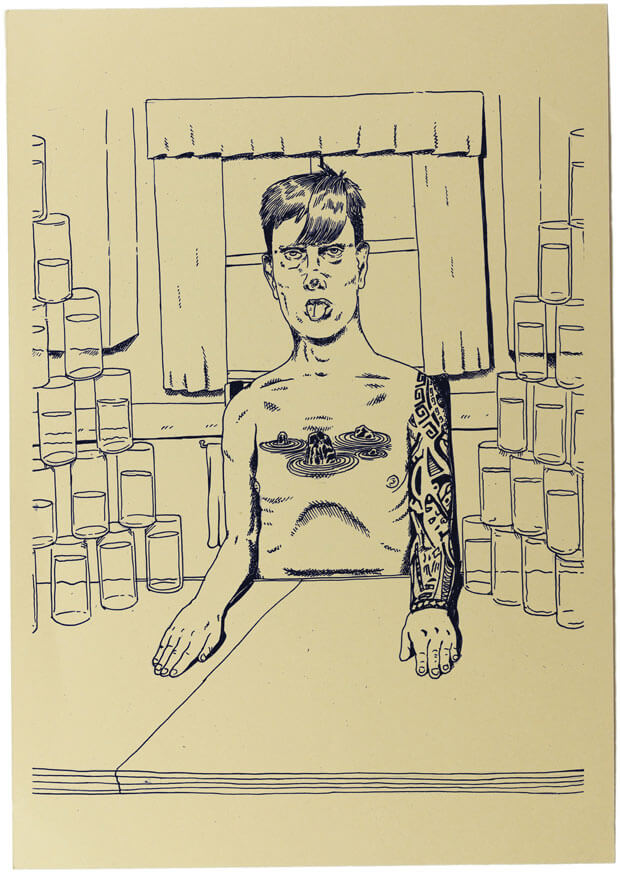
There is another picture that does not live in the same stack. It is hidden elsewhere. Sam is staring out of it, across a kitchen table. He looks thin and his posture is slumped. Sam bares an empty expression and a tongue lolling out of his mouth. In it, he is shirtless and his tattoo is in full view. A zen garden. His hands are placed in front of him symmetrically. On his left and right, stacked on the table almost to the top of the page, are glasses of water. Water glass pyramids. Inside each glass is the texture of a snowstorm. No two are completely alike.
Editor’s note: This is an excerpt of Robin Evans’s story — the full version will appear in the Spring 2012 issue of The Fiddlehead. We’re happy to be partnering with both of them to present you with this sample of Robin’s work.
 I take the bus to Doctor Patel’s. Usually, I get off a few stops early and walk the rest of the way. I use the time to figure out something to talk about. She’s supposed to be helping me get my life together but the more we see each other, the harder it is to come up with anything decent.
Patel’s not a real doctor, she’s a PhD. She sits in a basement office on West 6th and talks to people like me while hugging Peruvian-style pillows to her chest.
She says, let’s talk about you.
Mom drops off groceries at my new apartment. Two bottles of red wine, canned snails and other pantry leftovers. Dented cans of soup, dryer sheets. The essentials. “This whole situation with Ryan is like a crazy flashback.” Mom talks for a long time.
She eases into it with long silences, then finishes with a rush of words that scatter like confetti. Our age-old family saga, the day Dad left her. A defining moment, a story told so often, she knows exactly where to pause for effect and when to laugh at herself.
But she still can’t say his name. “Your father.” “That man.” Nothing more than that in thirty years. He’s become a faceless ghost-man with an afro and a polyester suit. How did he ever manage to move away, get married and have another kid, when she has him so frozen in place? The last card he sent had a picture of him with his car. A Taurus. He was bald and kind of small-town mall fat with saggy eye pouches. Nothing special, no great loss.
I have no problem saying Ryan’s name. And because he’s the only Ryan I know, when I say it, I’m not fooling anyone, it’s all about him.
I let Patel know, despite what she may have heard, Ryan is a good guy.
“I’ve not heard anything, Lily” she says. “From what you say it sounds like you were very happy.”
Her monotone takes some getting used to. It’s like she’s heard everything a thousand times before. But then she looks at you and it’s a different story. She’ll eat you up when she looks at you, bad news and all.
That’s the trouble with talking about it. People love every minute but act like they’re doing you a favour. Like listening takes so much out of them. Frown, nod, here have a Kleenex, maybe that’ll get you bawling. The worse off you are, the better. Lost jobs, dead relatives, cancer, all of it works. But heartbreak creates a special kind of feeding frenzy. Better just to keep your mouth shut.
“A person shouldn’t have to buy more than three spatulas in one lifetime.” It’s not one of my most inspired openers but Patel takes the bait and leads me in a safe, familiar direction. New life, self determination, reinvention, assimilation.
“How are you settling in to your new apartment?”
“Love it.”
“And the neighbourhood, you feel safe?”
“Funny story, I walked up to Hastings yesterday and on the way back this guy’s sitting in his truck getting a blow job. Parked right in front of my building. I had to walk past them doing it. And there was this stupid tricycle on the sidewalk right there, like they used it as a stepladder to get into the truck.”
Patel’s eyes light up whenever I mention sex. She compensates by making her voice go even flatter.
“Did you tell Ryan?”
Sneaky Patel. I’m not supposed to be talking to Ryan. I agreed to stop leaving messages.
“I just went home and got drunk.”
Patel senses I’m holding back. Her nose scrunches up a little as she thinks this. It’s the most unattractive she can make herself look and she doesn’t even know she’s doing it. I throw her a crumb.
“I realized something. I don’t look in the mirror. Can’t even tell you what my hair looks like. What does my hair look like?” I pull on a tight curl, stretch it out until it’s almost straight, then let it bounce back.
“You look fine.”
“Yeah, well, I sat next to this woman on the bus, she was at least eighty. Her hair was just a big cotton puff. And her make up was nuts.” I shake my hands in the air on either side of my head in the universal hand sign for crazy. “How’s my make up anyway? Can you see it in this light?”
“You look fine. About the woman on the bus?”
“Yeah. I don’t think she’s looked in the mirror for twenty years, maybe fifty. I thought, okay, I can do that.”
“The mirror isn’t so hard. It’s looking yourself in the eye that’s the big test. What so awful about you that you can’t look yourself in the eye?”
I know the answer. The egg timer on the back shelf goes off. Time’s up.
“Oh, you know, bad hair day,” I say finally, breaking through Patel’s silence.
I stand up and when I stretch, my fingers push at the low ceiling. The tile wobbles like it might fall on top of me.
“One day, when you’re ready.” Patel extends her hand.
Today is a bad session. We have not made progress. When I give her what she wants, I get a mama-bear hug, a squeeze, a “chin up” tilt of the head that says she knows best and I’m right to trust her. On days when I fend for myself I get a handshake before she settles herself back on the couch to wait for the next fixer-upper.
Read the Spring 2012 issue of The Fiddlehead for the rest of Robin’s prizewinning story!
 Sunday
Evening is a wet map torn in the folds
A bowl of sand into which you place your hands
Evening is an accordion on a child, a road in the desert
A dark hallway of lockers and uneven floors
Evening is deep sounds, car doors
Water in the pipes
Kitchenettes and closets
Laying out ties on the table in the shape of a wheel
And feeling around for tomorrow
Monday
Evening is a torn drum, a closed mouth
A box taped up
Evening is a clamshell, a shawl
A shallow dive
Evening is a folded tablecloth, a heavy gold earring
Moths and motionless trees
Hearing snow plows grating at the curb
Hugging only your knees
Tuesday
Evening is hot coals for eyes,
Mouse haste, vice-grips, chapped lips
Socket wrench on the basement floor
Evening is the shocked shape of a face in the wind
A landslide, a lock, a trance
Evening is a banging on the door, grinding gears of the heart
Mirrors in the dark
Twisting the screws just to take things apart
Wednesday
Evening is a stretching panther, a collection of earth from elsewhere
Catching a train, flowers in your hair
Evening is a quick breath, a stolen cheque
Click of heels in an elevator
Evening is an orange swallowed whole, a flag pulling at the pole
A cold hand, a clear eye, a deer hide
A cake balanced across two plates
Thursday
Evening is a doorstop, a window propped
A ladder leaning against a tree
Evening is a hand of cards dealt
Face down and sliding
A tarmac, a loose strap, a cold latch
Old letters stuck closed with sealing wax
Evening is flour on the counter top, scissors on the table
Turning your back on the water
To make it boil hotter
Friday
Evening is popcorn on the stovetop
Evening is moving and still
A riptide, a hand haling a cab
A wagon let loose on a hill
Evening is a balcony, a bear, a bird in the snow
Evening is money on the mind
A magazine cutting itself to pieces
Evening is a gossip, a mouth, a note and a bathroom wall
Evening is a bad influence
It knows you want to and it will
Take you into the steam of the engine
Onto the platform of another’s dream
Saturday
Evening is a ring of keys, an invitation and rolled up sleeves
A tightrope, a lit torch, a tongue
Evening is a phone call, a beach ball, swimming in the rain
Monkeys, mocha, applause
Evening is blinders on a white horse
City lights and open signs, fish skin in the sun
Saying there is nowhere else,
And nothing can ever make this music come undone
– i –
 Here’s Jack, lanky in a cut-down suit, narrow-chested but chippy as life in the rattle scrape east end of Montreal can make an English-speaking kid. He’s got Catholicism in common with the French kids, but they want to know “es-tu canadien or es-tu anglais?” They push; he pushes back.
He doesn’t go looking for a fight, though, not like Ger. A year and a half older, Gerry is shorter than Jack but solid and scrappy. Real tough. Tough enough to take down a big guy older than him, boys and men crowding round to watch him fight. Even the guy’s father, hands by his sides, face like an old sock, a crumpled handkerchief. Jack asks, “why don’t you stop it?” The man shrugs, real tired looking, says it’s a lesson. Next time the son’ll watch who he picks on.
Katie and Helen are working. They have good jobs at the hospital, doing research for a doctor, mixing things in labs, making people well. The doctor made a big impression on his sisters, talking about people dying, and not enough beds for them all. The charity wards are full, and the rest cure is the only thing for the consumption. Worried about his cough, the girls pulled strings for him. That’s how Jack ended up in this place, like a bump on a log. The doctors call it chasing the cure, but Jack knows that’s a load of bull, you can’t chase anything when you’re lying still.
Blue bowl, often white-streaked, often grey. You don’t see skies like that in the city, and his mother and the girls are agog over the beauty when they come to see him. They make the same winding train trip Jack had taken, steam whistle wailing out, sounding lonely as hell and that’s how he feels in this bed, this basket on wheels. He has to lie there all the time, on this porch and in the dark night dormitories full of the snores and farts of strangers, old men and young ones, many no older than Jack.
The blue bowl is inverted, held up by the mountains. On the porch, lying there, all in a row, Jack feels the air cold and oh-so-good-for-you fresh. Out with the bad air, in with the good. But if he’s got to chase a cure, he’d rather be chasing it the way the kids on the block used to chase each other, or the precious puck the French kids stole from them, leaving them with nothing but horse turds to play shinny with, Jack and Ger and the guys on Rachel Street.
Some of the people are really sick, skeleton skinny, coughing themselves hollow. Jack measures the distance down the slope toward the lake when one of them starts coughing. Others are like Jack, here because… Jack is hard-pressed to say exactly why he’s here but there was whispered talk in the pantry over dinner dishes. Ma and sisters that worried about him. The consumption is in the family. Aunt Claire died of it five years ago. Whispering over weak-chested, tall and gangly Jack, wrists out of the suits Ma made by cutting down their father’s old police uniforms. He left a couple of uniforms when he died, the last Ma will have to work with.
How could they send me away? he wonders; I was just starting to make money at the factory, dammit. Man’s money, almost. Not like the message-boy money they were so proud to hand over to Ma when he and Ger worked at the Birks building.
They’d sit in that narrow dusty room with its wood floors that creaked, itching for the bell to ring, to spring them, he and Gerry each waiting a turn to carry something, a message or a parcel, it didn’t matter. To be out running, just flying, through the building, down the alleyways. Ger would beat him to the bell, especially when the message had to go far. They’d wind up wrestling and rolling around on the floor. Jack got the worst of it, Ger was that tough. Beat Jack up bad one time. Ma wanted to know what happened to his face, so Jack told her the French kids did it. Katie didn’t like them fighting, not at all. She was the one who got them the jobs, in the building where she typed all day.
Now she and Helen were working for that doctor. That’s how he got here, the girls put in a word. Ma told him how lucky he was. Lots of people with the consumption, dying of it like her sister, and never enough beds. Less than a hundred here, and a smaller place on the other slope for the Jews, that’s what Albert tells Jack when they first get talking.
Albert used to be a patient. He caught the cure, but he’ll never be well enough to go back to the foundry. They let him work here. He does odd jobs, pushes the meal cart. He wheels beds out onto the porch every morning and every afternoon for the patients to take the air, wheels them back to the long sleeping rooms.
This is no place for me, Jack thinks. It’s fine for the rich snots to lie there reading their newspapers and fat books. They’re used to sitting around, some flunky bringing them their breakfasts. No big deal to have metal bowls brought in so they can wash and shave. Not Jack. He started shaving last year. He’d break the ice on the bucket, the way their grown brothers had, when he and Ger were whippersnappers watching them. No one ever brought him a bowl.
It’s cold on the porch sometimes, other times hot. Buzzing hot, but all Jack keeps is cold. He feels it in his young bones, feels the days line up like boxcars on a siding: waiting to be wheeled outside, waiting to be moved indoors. Nothing ever new except when the doctor walks through, his coat snapping behind him. And visiting days, his sisters going on about people in the parish, Ma sighing over how the mountains remind her of being a girl in Ste. Sophie. It’s always the same slow rhythm. At what point does blue streaked with white become white streaked with blue, a milky bowl?
Once in a while, they bring a different bowl and he has to spit. There’s no blood, never. Albert will say that Jack had none of those germs, the ones that make the consumption, but much later when he helps Jack pack his grip.
Albert jokes with Jack. He calls him the sleepwalker. Pretends Jack’s last name is Dempsey. He’s talking about those first few nights when Jack would get out of bed. He wasn’t doing anything bad – just got up to peer through windows, see what his feet looked like in the moonlight, find out what was beyond that door. It took two orderlies to strap him down, he fought the ties so. Albert puts down the putty knife he’s using for the storm windows, throws his arms and head around, laughing. His hands are open fists. The big orderly, Charlie, finally landed one good punch, Albert says, and Jack didn’t give them any more trouble. Now he settles down peaceful as a babe every night.
It’s long ago to Jack, but the nurses still pin him with their sharp gazes. Not that there’s anything he could do in the white shift they traded for his suit, nowhere he could go. Snow sprawls on the mountains beyond. Sometimes the hillsides are green, sometimes parched like a faded yellow blanket, but always they slope away, out of reach.
He thinks about his family. Ma off to Westmount every day, to do for Mrs. Marler. She brings home Mrs. Marler’s old clothes, still perfectly good, for the girls. Brings home Mrs. Marler ways: doilies on the arms of the sofa, and pass the peas please. His father would slam his fist on the table so the dishes rattled, mouth pursed, his voice shrill: “Mrs. Marler, Mrs. Jesus Marler, for crissake!” But the old man is gone. The pleurisy took him in less than a month, leaving just two sets of uniforms for Ma to make over.
The girls are smart in Mrs. Marler’s made-over clothes. Katie and Helen have good paying jobs. All the girls play piano, like Ma. They have manners like Mrs. Marler’s daughters.
The older brothers are grown and gone to the lumber camp or the merchant navy. Gerry never comes to visit Jack. Scared of the germs, Helen says. He wants to come but he can’t, Katie says. He’s apprenticing with a tile-setter. He’s home only for bed, and for the meat and cold potatoes Ma puts aside on the hob. Time off for Mass, of course.
It doesn’t sound much like Gerry to Jack. He can’t imagine Ger working hard, toeing the line. But everyone has to pull their weight now the old man’s gone.
So, why send Jack away when he’d started to make real money? On the delivery run, he’d race up and down stairs with boxes full of stockings in their paper packets, so quick that Ernie hardly had time to finish his smoke. He taught himself to drive by watching Ernie’s feet work the clutch, the brake, the gas. Ernie sometimes let him drive back after the last deliveries. And the factory paid better. Those three months when he had a fatter pay envelope to carry home to Ma, he didn’t mind the big room steamy from the vats, his fingers wrinkled and hands cramped from putting wet stockings on the forms.
He thinks about Ger working with the tile-setter, handing him tools, learning how to make the pieces go in straight. He has to make himself not think about Ger. He looks at the slice of lake he can see from the porch, counts the trees that block his view, looks at the sky. There’s always the sky, even when it’s years he has to count.
It’s nearly spring again when Jack finally puts his suit back on, feels fabric strain over his chest when he does the buttons up. He rides the train back to the city alone, just like when he came. He never once tested positive, practically a year, that’s what Albert tells him as he leaves.
– ii –
The factory’s not taking on any more men. Jobs in the city are harder to find. Jack takes ones far away. He goes to the Gaspé, then up north in Ontario.
The north is snow crunch and fly buzz: Deep River, Chapleau. Each town another tie on tracks that go on and on, rumble and hum. Every place the same cold stretch of distance, whether there’s white or green beneath the blue bowl.
He doesn’t see the family often. He paces the wooden floors of rented rooms in railway towns, relearns silence in gold-brown liquid at the bottom of a glass and the gentle burn that starts in his stomach. He drinks in his room, or in bars, at tables a little away from the lumberjacks who sing and swear and down glasses, though not with the railwayman.
Montreal, when he goes back for visits, is noisy bustle. Hugs from Ma and sisters, little nephews and nieces, slaps on the back and nights in the tavern with Ger. He pulls Gerry out of fights, or backs him up. When they put on uniforms, they make a fine pair: the tall one and the short one, Air Force and Army. Both broad-shouldered now, and sharp. They turn a head or two.
Then a different trip. Back, for Ma’s funeral. Telegraph poles tick by and the train jostles. The rumble of the tracks builds. There’s pressure in his ears and behind his eyes. Tightness rises from his chest to his throat, squeezes, chokes him. A swig or two from his flask helps, but he doesn’t drink more. He won’t shame the family at the funeral.
But afterwards, his brothers-in-law gone after only one round, Jack roars through taverns. With Ger shipped out to England, it’s not like it was. He just drinks until he stumbles back, waking his sister’s house, roars some more, drops and sleeps.
The next morning, there’s little Maureen showing her brother the hole Uncle Jack punched in the wall. His head is muzzy, and he’s anxious to be on his way, furlough over. He carries the train’s rattle with him to where his unit is stationed.
The buzz stays in his head long after the C.O. comes to the barracks with the news. Gerry, killed overseas. Didn’t even see action, poor bugger. An enlisted man pulled a knife on him, in a barroom fight.
Jack never makes it home again. He knows other cities, lives in one with a view of mountains that make the Laurentians seem like hills. He meets someone at the office where he’s taken a job. She’s a woman from Toronto, but Catholic, and he accompanies her to Mass. She agrees to marry him though they think they’re probably too old to start a family. To their surprise, a baby girl, arrives after they’ve moved to another new city.
He puts down the bottle because his wife says he must. He gets dry and stays dry. There are groups she wants him to go to. He tries them, but it’s all talk. So he goes it alone, never takes another drink.
They have another daughter. Their last move is to the prairie, where the bowl is wide, no hills to be seen.
– iii –
The blinds half-lowered, the blue or milky blue or grey outside is shut out to allow him and the others a discreet snooze, all in their chairs. They’re all old, and mostly women. The people here don’t strap him down. They did in the hospital when it hurt so bad to cough and his chest was full – pneumonia, they said. He kept wanting to sit up and catch a breath. But he didn’t fight the ties, just worked and worried at them until he came here.
What he is doing in this place, so still and quiet? He has a department to run, a family to see to, man’s responsibilities that he shoulders gladly. His children visit, with pictures of their mother. Bitter is the word he finds as he realizes he remembers nothing about her. They remind him again, but gently, that she died last year.
The girls are doing well. He’s proud of them, their good jobs. It was their doing, he remembers now. They brought him. A fine daughter on either side for the long ride – he glowed with pride. But why the hell must he stay, with these old women, staring at flickering colours on a screen?
It’s still now. Jack hears the women’s voices, the quiet clatter of cutlery – at a distance. The years slope away. He is part of those hills.
 I was born without a mouth and the doctor shouted, “It’s a girl!”
I was born without a mouth, so every morsel I ever ate was a metaphor.
I was born without a mouth but my ears were sharp enough to hear every denigration, Retard.
Since I was born without a mouth, it became obvious that I was incapable of profound thought.
I was born without a mouth, so the court appointed a lawyer to speak on my behalf, who took a fee and left me his phone number.
Given that I was born without a mouth, the court made a ruling concerning how my body could be used, and by whom.
I was born without a mouth, so my obstetrician declared an emergency and cut a hole in my belly to let out the screams.
I was born without a mouth so every word I ever wrote hurt my throat.
I was born without a mouth so there is no song, no story to tell.
This has been a minute of silence, observed in remembrance of the men
who suffered for my beauty and duplicity.
This has been a minute of silence.
Thank you for your patience.
There is nothing that can be said.
Put on your coat.
Please go home.

Only five days remain until the deadline of the Great Canadian Literary Hunt! If you’re like me, you’re intimately familiar with those scarce final minutes.
My art teacher back in the day, Cynthia Lewis, lived by the mantra: “Good art takes a long time.” While there were obvious exceptions, there was never good reason to believe those hastily jotted charcoal lines would suffice. Good writing also takes a while to ripen. Here’s how to best spend your remaining time.
1. Write your entry
Perhaps you already have a Word document of golden prose saved for this very occasion. In that case, please skip to step four. If you’re the NaNoWriMo type, read on.
You’re going to need that internally-motivating idea that keeps you up at night, begging to be scribbled somewhere, anywhere. It feels like a crush. You’re also going to need externally-motivating factors. I like to write near busy people and a steady stream of coffee. Maybe your aid of choice is wine. Perhaps you can only write in the nude while listening to Bowie. Wherever your ideal environment may be, stay put until you have plenty of content on that page.
2. Edit your entry
Now walk away. Pull on some pants and leave your writing sanctuary. Talk to friends, strangers and mentors about your ideas. Drink more wine. Get lost in Value Village. Return with the will to kill your babies. By this I mean you have to be able to let go of words, sentences, even whole paragraphs (or verses, poets), that don’t add to your piece. Pluck these out like weeds and be glad you’re rid of them.
3. Title your entry
A title that evokes nostalgia for you could be bland for our judges, so something short and catchy might be best. Make it stand out in a crowd. Something like “Genital Lemonade” might do the trick, but make sure it pertains to the story or poem. (If you expect out judges to read about genital lemonade, it had better be great.)
4. Send us your entry
You can submit your story or poem electronically or by mail. Since the future of the mail is foggy, you might like to opt for electronic submission. Email your entry as an attachment to [email protected]. The entry fee is $25 — pay online, and we’ll take care of the rest. Click here for details on how to send your entry by mail.
The final deadline — drum-roll please — is 11:59 p.m. EST on July 4. Electronic entries must arrive by that time. Mailed entries must be postmarked on or before July 4.
]]>