StumbleUpon icon Stumble This
Email icon Email This

May 5, 2009: Diplomacy, Economics, Environment, May-June 2009, Travel

Whaling: the latest culture war

Japan claims its annual Antarctic whale hunt is its cultural heritage. Is it racist if we tell them to stop? A report from the front lines of the whaling wars
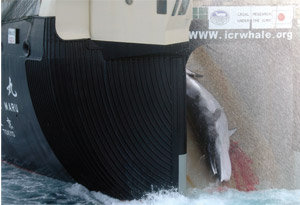
A whale being hauled up the slipway of the Japanese whaling flagship, the Nisshin Maru. Photo by Joshua Gunn

A whale being hauled up the slipway of the Japanese whaling flagship, the Nisshin Maru. Photo by Joshua Gunn

It’s a sight I’ll never forget: a whale being hacked up in front of me, cut into tiny squares, its excess blood and guts discarded. One minute, it was a whole whale; 20 minutes later, nothing but a spinal cord and the harpoon that killed it.

It was February 6, 2009, and I had spent two months in the Antarctic Ocean with Sea Shepherd, the radical conservationist group. Sea Shepherd is notorious for the extreme tactics it uses to stop whaling in the southern oceans each year. Its ship, the M/Y Steve Irwin, had chased and harassed the Japanese whaling fleet for weeks to prevent them from hunting. But on this particular day, the whalers killed in front of us, and at first we could only watch from a distance. But it soon became a confrontation.

The Yushin Maru No. 3, a harpoon ship, attempted to transfer a dead whale to the mother ship, Japan’s whaling flagship, the Nisshin Maru, the floating factory that processes whale meat at sea. The Irwin moved to block that transfer by manoeuvring into the Yushin Maru’s path. Within seconds, the boats collided with a loud crash and screeching noise that rang through our ears. The Irwin tipped 30 degrees on its side—it felt as if the ship was going belly-up. I was on the outside deck of the Irwin, hanging on to a railing watching the water approach from below. The Yushin was pushed down into the water by the force of the impact. I can only imagine the crew must have thought they would have to abandon ship. But 22 seconds later, when the two boats scraped apart, all had survived, with only minor damage to the vessels. It was a collision of two boats—but also a collision of worlds.

The Institute of Cetacean Research in Tokyo, along with many of its supporters, argue that the annual whale hunt by Japan is the country’s national heritage, and that efforts to end Japan’s whaling is colonial Western arrogance. The critics, such as Sea Shepherd, claim that the Japanese government is simply playing a “culture card” to stymie criticism. They believe that conservation—preserving wildlife—outweighs any such cultural differences.

However, are eco-issues, like whaling, really a simple matter of culture versus conservation? Are these two opposing sides? Can they be reconciled? And if they are in opposition, is it right for cultural concerns to trump environmental ones? I take the issue personally. In high school, I lived in Japan for a year on an exchange program. I lived with a Japanese host family, attended a Japanese-speaking high school, and grew to love the culture, country, and my new friends: Japan became a second home for me. But my first home is the environmental movement. My parents, Robert and Bobbi Hunter, were ecoactivists who had fought on the first anti-whaling campaigns against the Soviets in the North Pacific in the 1970s. My father co-founded Greenpeace, which has campaigned against the global whaling industry for decades.

So you can understand why, on one hand, I felt it was important to be part of the environmental battle for the whales. But on the other, I believe cross-cultural understanding and co-operation is vital. The issue is more complex than black and white. Japan claims that its annual whale hunt is for scientific purposes. The “research” hunt is run by the Institute of Cetacean Research, which is heavily subsidized by the government of Japan. The ICR studies whale-stock demography and health. To do this, the Japanese whaling fleet targets around 900 Minke whales annually. In addition, each year a different endangered species of whale is targeted, including humpback and fin whales.

Once the scientific data is collected, the whale meat is then sold for commercial use by Kyodo Senpaku, the same private firm that runs the fleet. Selling whale meat for commercial use after collecting it for scientific use is acceptable under current international whaling laws. Recently, however, the hunt has also been called “cultural” by the ICR, which says that Japan is simply continuing its centuries-old cultural practice of whaling. Sea Shepherd and Greenpeace, among others, dismiss these claims as a smokescreen. If it is in fact commercial and not scientific, that would make the hunt illegal: there has been an international ban on commercial whaling since 1986.

Believing the law is on its side, Sea Shepherd was the lone group to oppose the Japanese whaling hunt in Antarctica this past winter. Sea Shepherd fights the whaling industry everywhere, whether Norwegian, Icelandic, or Japanese. Sea Shepherd’s members don’t buy the cultural basis of the hunt any more than they buy its scientific value. And so the group engages in radical direct action to stop the hunts, such as ramming ships at sea and sinking ships in port, which is why some governments have labelled Sea Shepherd “eco-terrorists.” Its activities have undoubtedly stopped or limited whaling activity around the world.

Some critics, such as Milton Freeman, a specialist in ecology and culture at the University of Alberta, view groups like Sea Shepherd as difficult cases. He worries that their anti-Japanesewhaling line leads to rhetoric that is simply anti-Japanese. Freeman views anti-whaling actions as not just an animal-rights issue, but also a type of cultural bullying. It’s Western ecogroups campaigning against the remaining whaling nations, such as Japan, demanding they cease their hunt and assimilate Western cultural beliefs about whales and conservation.

This is what’s increasingly known in academic circles as “political ecology”—essentially, the politics of nature and the different ways people understand and treat nature. For some, a whale is just another fish in the sea, a resource like any other to be harvested. Others put a different value on a whale, and see a socially complex, highly intelligent sentient being that deserves the chance for a full and healthy life.

Freeman argues that our own Western views on whaling don’t give us the right to attack Japanese beliefs about it: “Seeking to stop a culturally valued activity, in any society,” he says, “is to attack those people’s culture and identity.”

Jun Hoshikawa doesn’t feel attacked. “What is taking place in the Southern Ocean is not part of Japanese culture and traditions,” says Hoshikawa, director of Greenpeace Japan. “There is a difference between coastal whaling in Japan and the industrial hunt in the Southern Ocean. Coastal whaling has taken place for centuries and continues today on a small scale with boats and spears. That can be argued to be part of Japan’s culture and identity … The industrial hunt in the Antarctic was introduced by western countries post-World War II, and is run by the government of Japan today using a six-ship fleet with exploding harpoons and guns, and it kills whales on a mass scale. It was and is purely a commercial industry. I do not call that culture.”

Hoshikawa says 82 percent of people in Japan do not eat whale meat. The profits come mainly from delicacy food restaurants or “public provisions,” where whale meat is provided to high school cafeterias, jails and the military. Mainly, it “goes to people who cannot reject the whale meat,” Hoshikawa says in a phone interview from Tokyo.

In the past, the whale-meat industry regularly produced ¥7 billion annually (US$74 million) in profit. But in recent years, profits have dropped off due to decreasing demand in Japan and unfilled catch quotas because of interference from groups like Sea Shepherd and Greenpeace. In 2007, the industry saw profits of just ¥5 million (US$51,000). The government of Japan has heavily subsidized the ICR’s whale program over the years to allow its work to continue, despite the financial loss. The real reason Japan persists with whaling, says Hoshikawa, is not because it is a profitable industry any longer, but because “the whaling issue has been framed through a lens of nationalism. It has less to do with whales or the industry and more to do with protecting the sovereign right of a country.” With so much negative international attention focused on Japan because of its whaling, the country is being pressured by other nations to stop the whaling project. In the last few years, nationalism has crept onto the scene: although the hunt is commercially unviable, countries like Japan that still run whaling hunts now see it as a political defeat to cave in to international pressure.

This is not an abstract issue for Canada: many of the same dynamics are at play when it comes to Canada’s annual seal hunt. On this issue, we are regarded with much the same contempt by the international community that Japan bears for its whaling.

“Every state is sovereign and can do whatever it wants” says Calestous Juma, former special advisor to the chair of the International Whaling Commission and professor of International Development Studies at Harvard University. “You can’t condemn sovereign states for exercising their rights because they will just go ahead and do it.” The International Whaling Commission is the international body that regulates whaling. Over the years, the IWC has sent letters of protest to Japan against the hunt in the Southern Ocean. In the IWC’s 2007 letter, it wrote that the lethal hunt of whales was unnecessary for Japan’s research, and called upon the government of Japan to suspend the whaling program.

But there are no real consequences for flouting the IWC rules, since as Juma says, there is no separate enforcement body for the treaty. The IWC comprises 84 member states that meet once a year to set quotas and regulations on whaling. But without an enforcement body, the regulations are toothless. Norway for example, works outside of the IWC and engages in commercial whaling despite the moratorium. Japan, in contrast, attempts to work within the framework by using the scientific loophole. This is because Japan has a real interest in doing things legally. “They want to be a good global citizen,” says Juma.

Ironically, the Japan Whaling Association states on its website that the purpose of the Japanese scientific research in whale stocks and health is to gather evidence that will lift the moratorium so that commercial whaling can resume. Dr. Hiroshi Hatanaka, director-general of the Institute for Cetacean Research in Tokyo, says that because the ICR believes whale stocks to be plentiful and healthy, “there is no need or reason to prevent sustainable commercial whaling in the Antarctic under IWC management procedures.”

The international community has reacted, but so far the results have been lacklustre. Panama de-registered the whaling fleet’s cargo vessel late last year, but Japan re-registered it under its own national registration; the Australian and New Zealand governments toughened their stance against Japan’s whaling, threatening to take action legally in international courts. But so far, these diplomatic and legal actions have been unsuccessful or stalled. Australian Prime Minister Kevin Rudd said in June 2008 that Australia and Japan would simply have to agree to disagree.

Over the winter, a small group of IWC countries have been working at negotiating an agreement with Japan that would gradually phase out whaling in the Southern Ocean by reducing the catch by 20 percent per year for five years. In exchange, Japan would get permission to kill an increased but yet-to-be-determined number of whales off Japan’s coasts in the Pacific Ocean.

The package was developed at the request of the American chairman, Bill Hogarth, a Bush administration appointee. It was intended to be a step forward in ending Southern Ocean whaling and break the deadlock with Japan. However, most environmental groups, such as the International Fund for Animal Welfare, believe this was a compromise that would both allow Japan to continue its commercial hunt, and effectively lift the global moratorium on commercial whaling. But Japan refused the deal. Japan’s Agriculture, Forestry and Fisheries minister Shigeru Ishiba said, “We cannot accept any proposal that would allow outside countries to prohibit Japan from continuing its research hunt.”

So the question becomes: is whaling simply a question of sovereignty? In this case, does diplomacy trump ethics, leaving the international community powerless to stop the killing? The Japanese whaling industry has cunningly used the term “culture” as a get-out-of-jail-free card—by framing this as an issue of culture or sovereignty, it aims to make any antiwhaling group look like they are colonialist and discriminatory. But the reality is that the hunt is senseless slaughter in service of fake science, a dead industry, and nationalist posturing. The whales should not bear the punishment for our foolishness.

How far are we willing to go—how much environmental damage are we willing to do—in the name of culture, heritage, national pride? None of these things will be of much use in an environmentally devastated land- and seascape.

More than 30 years ago, in 1977, my parents fought to end whaling in Australia. Their protest, in Albany, Western Australia, led to international attention, that culminated in the end of whaling in Australia. It is now one of the strongest anti-whaling nations in the world.

At the end of the anti-whaling campaign I went on this year with Sea Shepherd, I found myself in Australia and decided to visit Albany. What I found there was a miniature eco-haven: a dozen wind-power generators spinning on the horizon and organic crops in the fields. One of the old harpoon ships of the Australian whaling fleet, Cheynes IV, is now an on-land museum, and boats go out every day filled with tourists for whale-watching. The whale-watching industry has now surpassed the profitability of the whale-killing industry of 30 years ago.

I took a boat ride myself to see the whales. We got to see them up close, close enough that I could touch them. They played together in their pod, diving and chasing, waving their fins out of the water as they breached, tails in the air. It’s another sight I’ll never forget.

Comments

This website uses IntenseDebate comments, but they are not currently loaded because either your browser doesn't support JavaScript, or they didn't load fast enough.

10 Comments on "Whaling: the latest culture war"

  1. The political economy of killing blubbery animals : This.org on Tue, 5th May 2009 1:36 pm 

    [...] just posted Emily Hunter’s feature story from the May-June 2009 issue, because it has some bearing on the current controversy over the [...]

  2. Michael Williams on Wed, 6th May 2009 5:22 am 

    Congratulations Emily! Great article that outlines the insane argument for this insane annual practice of execution.

  3. Nick Zarzycki on Thu, 14th May 2009 6:38 am 

    “The Institute of Cetacean Research in Tokyo, along with many of its supporters, argue that the annual whale hunt by Japan is the country’s national heritage”

    Indeed, many Japanese remember how, centuries ago, fishermen would go out to hunt with nothing more than their spears and 500-foot factory ships.

  4. EcoChamber #8: Michaëlle Jean’s misleading seal feast : This.org on Fri, 29th May 2009 3:09 pm 

    [...] this story is the same old story; Japan too claims to be defending its “culture” with its annual Southern Ocean whale hunt of nearly a thousand whales, including endangered [...]

  5. paul whalen on Wed, 17th Jun 2009 1:23 am 

    Nicely put article-lottta work. Your hook is one I can empathize with, and so most others will too- its right said right. The sovereignty idea. Take it a step further kid. Peter says yer smart enough and if you do find yourself in the political meat grinder, just remember,you can blame that on yer parents. I blame your parents for convinceing me I could do stuff that made nothing but trouble for me. Yes, they so casually suggested , I was invinceable and for a while , I was. The reality of losing your self to a cause is a “priority” , I am glad you have taken that into account. Political appointment – Your looking at the brass ring. That is the training ground this environmnetal movement has failed to win. I suppose politics is as much of an abyse as ever there could be.

  6. Daruma Tokyo Japan on Fri, 18th Sep 2009 3:46 am 

    WHALING IS *NOT* JAPANESE CULTURE!

    96% of Japanese people DO NOT eat whale meat

    Asahi Newspaper, National News & television media of Japan, reports that ‘96% of Japanese people DO NOT regularly eat whale meat.’ – Asahi News Service – TOKYO JAPAN.

  7. Daruma Tokyo Japan on Fri, 18th Sep 2009 4:08 am 

    Whaling, killing whales & eating them is Not Japanese Culture!

    Japan is BUDDHIST and Shinto! Japanese Buddhist and Shinto culture and tradition hold that all life is sacred and spirits are in all things!

    Though not mandated, it is Vegetarianism, NOT eating meat that comprises one of the More highly regarded basic principles of Buddhist culture and tradition!

    Buddhism & Shinto is the culture and tradition of the majority of Japan! Killing whales and eating whale meat is AGAINST the tradition and culture of JAPAN!

    “If a person does not harm any living being, and does not kill or cause others to kill-that person is a true spiritual practitioner. -Dhammapada (The Buddha!)

    “In order to satisfy one human stomach, so many lives are taken away. We must promote vegetarianism. It is extremely important.” -His Holiness the 14th Dalai Lama!

    “The Bodhisattva, whose nature is Compassion, is not to eat any meat” For fear of causing terror to living beings let the Bodhisattva who is disciplining himself to attain Compassion, refrain from eating flesh.” -Lankavatara Sutra (The Buddha)

    Japan is over 80-90% Buddhist and Shinto. Anyone slaughtering and eating whales for their meat when not out of necessity is considered a BAD BUDDHIST. For it is the act of NOT killing and NOT eating animals is the more highly regarded tradition & culture of the MAJORITY OF JAPAN!

  8. Daruma Tokyo Japan on Fri, 18th Sep 2009 4:46 am 

    Whaling is NOT the tradition or culture of JAPAN!

    EATING MEAT WAS *BANNED* IN JAPAN FOR OVER 1,200 YEARS!

    In 676 AD the 40th Emperor Tenmu banned eating meat.

    You read right! It is the act of NOT eating meat, not eating it, that is the actual traditional culture of Japan!

    The eating of meat was looked DOWN upon! And in fact, the act of eating meat was actually BANNED by the Emperor Tenmu in the year 676 A.D.!

    This Ban against eating meat existed as Japanese culture for more than 1,200 years!

    The entire lineage of Japanese Emperors continued bans on varieties of meat for over a millennium!

    In 721 AD the 44th Emperor Genshou forbade killing animals.
    In 725 AD the 45th Emperor Shoumou forbade the killing of animals.
    In 752 AD the 46th Emperor Kouken forbade the killing of animals.
    In 1127 AD the 75th Emperor Sutoku forbade the killing of all animals.
    In 1188 AD 82nd Emperor Gotoba forbade the killing of animals.

    and more!

    NOT-EATING meat is is the thousand-year+ culture & tradition of Japan, which remained unbroken all the way up until foreign contact in the 1800’s. Eating meat is not Japanese tradition, eating meat is BREAKING Japanese tradition.

    Specific instances of the eating of meat, or specific acts of the killing of whales, whether the act was depicted thousands of years ago or not does Not mean that eating whale meat was a “proud Japanese tradition” any more than finding log accounts of acts of murder happening 6,000 years ago in Europe, or finding depictions of human crucifixions means that murder & crucifixion are some how “fine European traditions” that should be continued today.

    The mere fact that ’some’ people ‘did’ it, doesn’t mean something is some kind of great tradition! Just like instances of murder have been recorded happening thousands of years ago, and ’some’ people did it, doesn’t mean that is a ‘good’ part of that culture, to be merrily perpetuated today.

    -

    In fact, the real culture and tradition of Japan for over 1,000 years was NOT to kill and eat animals, even held so strongly that it was set down by Emporial decree!

    In Japan, the emperor was not simply regarded as some ‘leader’, the EMPEROR was regarded as divine! It means the act of NOT eating meat was set down as the National principle tradition across the entire nation, for over 12 centuries by the highest leaders of Japan whom the Japanese people regarded so highly they hought of them as a GOD!

    -

    The actual time when the eating of whale meat was most popularized was only AFTER WORLD WAR 2! When Japan was conquered, and forced to surrendur by westerners after World War 2!

    It was Western Generals who introduced the act of eating pieces of whale meat to those who existed in the circumstances after the bombings and malnourishment in the 1940’s, at the time of World War 2!

    The popularization of eating whale meat was introduced by WESTERNERS!

    Eating whale meat is a FOREIGN tradition!

    And 1,200 years of Japanese culture and tradtion beats something that has been happening for only 60 and forced on people and popularized in Japan by Gaijin!

    So the Whale killer, the person who is touting the eating of whale meat, is not For apanese tradition, and the whalers are not For Japanese culture, the person cheering the eating of whale meat is touting something that is AGAINST Japanese culture, the eating of meat in defiance of over 1,200 years of Japanese Emporial Law, and in breach of the will of the Japanese leader who is regarded as a GOD!

    It is Japanese Whalers that BETRAY Japan.

    Whalers are the ones sabotaging and going against Japanese culture, and trying to force on people something that was mainly popularized in Japan by Foreigners forcing it on Japan!

    It is ANTI-WHALERS, and all good 96% of Japanese people who dont even eat whale meat, and SSCS and anyone stopping whaling that is upholding the most highly regarded tradition and culture of Japan.

    It is PRO-WHALERS who betray, undermine, and stain 1,200 years of culture and tradition of Japan.

  9. Daruma Tokyo Japan on Fri, 18th Sep 2009 5:59 am 

    WHALERS & PRO-WHALERS ARE OFTEN RACIST.

    Anti-Whalers are less often racist.

    The person cheering Whaling is AGAINST Japan & hurts Japanese people.

    The person Stopping Whaling is the FRIEND of Japan & its people.

    WHALE MEAT CONTAINS METHYL MERCURIC POISON!
    MERCURY causes brain tissue damage. Whale meat is loaded with amounts so toxic, that it is 10 to 1,000 times more infested with Mercury than seafood and fish. Mercury such as in whale meat, causes organ damage. Anyone eating whale meat can have their future children born deformed.

    Any person ENCOURAGING Japanese citizens to eat whale meat, is mass-poisoning tens of thousands of Japanese people, their families, and children, and hurting Japan.

    Any person working to STOP a tiny faction of whale killers from pushing Japanese people & children to eat whale meat, is SAVING Japanese people! Anti-whalers are protecting Japanese children. Everyone who is AGAINST whaling is the friend of the majority of the Japanese people.

    Firstly, it is possible for any already-inherent racist, to latch on to *any* issue, no matter what it is. For example, there exist prejudicial Japanese who are against China who pretend to support Tibet, not because they want to actually help Tibet, but because they know it is a severe sore spot for China, and they can exploit it and use the otherwise kind Tibet issue in order to say bad things about Chinese people.

    The question is, whether the exact act of stopping whaling itself is racist, and the answer is No, it’s actually beneficial for all wonderful Japanese people to stop whaling.

    The act of anti-whaling itself is actually not against Japan, the act of stopping whaling is actually pro Japan!

    WHALE MEAT IS POISON!

    Any person working to put a stop to a small faction of killers who even tried to put whale meat contaminated with Methyl Mercuric poison into Japanese children’s school lunches, is not only NOT racist, that anti-whaling advocate is not only saving whales, that person is saving tens of thousands of good Japanese people, that person is along WITH 96% of Japanese people who DONT eat whale meat in the first place, and that anti-whaling person is helping Japan by cleaning the shame that whalers bring upon their own country, off of Japan’s good name, and helping the entire good Nation of Japan to shine again.

    NEXT…

    Any PRO-WHALER who *tries* to accuse other countries of being racist, IS the racist.

    First, this is not a “one country against some other country” issue! Every country has both good and bad people in it! This is a matter of “all the good people, of EVERY country… against all the bad killers, of EVERY country”.

    For example, it is ERRONEOUS to go around as if it is somehow “australians” against the “japanese”!-that is false! It’s whalers who try to assert this! Not anti-whalers. And what they do, is then begin to employ things like: “hey, you kill kanagroos and dont allow US to kill whales–you are racist!”–That is False!

    Because it is NOT 1 country versus some other one! That debunked notion simply leads back & forth in a “you did this. oh, yeah?? well, you did that!” tennis match where everyone loses.

    No.

    Instead, there are good people and bad people in Australia (and every other country), and both good & bad Japanese too! Hopefully the majority of all countries consists of good people, but we all have people in prisons. No country is exempt from that.

    So the real situation, is that it is all the people who care about animals, the ones in Australia, the ones in Japan too, the ones all over the world who care, for both animals and people too…AGAINST killers! Killers in ANY country. Australia too, not just Japan.

    And therefore the situation now is this… all the good people in Japan, which is the majority, even possibly up to 96% who dont eat whale meat, PLUS all the good people in Australia, plus all the good people from all other countries, against BOTH the Japanese whale killers in Japan, AND AGAINST any and all Kangaroo killers in Australia too!

    Real Anti whalers are Not going around cheering kangaroo killers, then scoffing at whalers! That is not the case. The same people who are caring enough to stop whale killing ARE ALSO against kangaroo killers! Even if they are Australian! And that goes for any other situation too! Every instance of this bogus “But (country name here) kills (animal name here)” is now DEBUNKED! That’s false. You can no longer attempt to assert the “hey, Americans CANT tell “us” to stop killing whales, “they” kill cows!”–That is false. Because it is likely to be the very same anti-whalers, in America, who are not FOR but rather AGAINST killing cows. Or pigs, or whatever other argument PRO-WHALERS attempt to falsely use!

    It’s that PRO-WHALER who attempts to assert that ALL people of a certain race, or nationality, ALL do it, or ALL think it, or are ALL the same, who is the racist!

    It is the person who is caring, the one who feels, understands, and cares enough to try to help an animal, because they can understand, and feel what it may feel, who is more likely to be not racist at all! And they understand that its not ALL the people of a certain race that do something, its not ALL the people inside a certain country that practice something. It’s anti-whalers that have a higher proportion of understanding this, because by definition these are the people who have the capability inside them to feel another’s pain!

    It’s the PRO-WHALE-KILLER who doesn’t care, could care less, is more interested in their own benefit and how much money they can get, or who think They are “better” than other animals, and so forth, that are MORE likely to possess the arrogance and lack of capacity for feeling that exemplifies the judging of one’s own superiority over that of one’s fellow man and woman.

    And lastly, any PRO-WHALER attempting to declare “racism against Japanese” is wrong by definition! “Japan” is not a race! Japan is a nation! “Asian” is a race! And it’s not “asians” who are whaling! It’s Japan! In fact, “asians” have what could be the greatest proportion of VEGETARIANS IN THE WORLD!

    Killing and eating whales is not a “racial” thing! Hardly any other asian countries do it! And “asians” comprise many Hindus, Buddhists, and more, who are vegetarians! India (asian!) has over a billion people! China (asian!) has even more! And there are many many vegetarians among them! :) It’s not “asians” that are killing whales. It’s not even “Japan” or “Japanese” that are killing whales! 96% of Japanese people dont even eat it! And 99.999% of Japan, or over 128 million peopler are NOT whalers by profession! It is ONLY a few hundred, Japanese Whalers, that kill whales in Japan! And likewise not just Japanese whale kilers but whale killers in Iceland, Faroe island Denmark whale killers, North American native whalers, and Norwegian whale killers.

    Therefore, anti-whaling is NOT against any particular race. Asian is the race, Japan is not a race, it’s a country. And anti-whalers are FOR the vast majority of asians, and in fact anti-whalers are the friends of 99% of Japan! And anti-whalers are also against the whale killers who are in countries where the whalers consist of a variety of other races! Therefore stopping whaling is not racist. In fact, it’s not even Nationalist, because whale killers are the ones that actually comprise less proportion of a certain country than non-killers, and can be of any race, and they can be from any Nation.

    It is Whalers and Pro-Whalers who try to make people believe that their “whole” country, or “whole race” kill whales. And try to force people to believe that killing whales is what ALL asians do, or its something that ALL Japanese believe in, who are the stereotypers. And it’s pro-whalers, accusing ALL people of a certain other race or country, who have generalised based upon that race or country, using preconceptions and the elements of racism.

    It’s PRO-Whalers that are racist.

  10. Culture vs. Conservation over seals? on Sun, 25th Apr 2010 6:56 pm 

    [...] Yet this story is the same old story; Japan too claims culture in their annual Southern Ocean whale hunt of nearly a thousand whales including endangered. As discussed in my article Culture Wars for THIS, a thousand year old tradition by native groups is not the same as a needless large-scale commercial killing by governments. [...]

Tell us what you're thinking...
and oh, if you want a pic to show with your comment, go get a gravatar!


feedback button